


A MULTI-COUNTRY STUDY OF PREVALENCE AND EARLY CHILDHOOD MORTALITY AMONG CHILDREN WITH OMPHALOCELE
Supporting Files

-
12 2020
-
File Language:
English
Details
-
Alternative Title:Birth Defects Res
-
Personal Author:Nembhard, Wendy N. ; Bergman, Jorieke E.H. ; Politis, Maria D. ; Arteaga-Vázquez, Jazmín ; Bermejo-Sánchez, Eva ; Canfield, Mark A. ; Cragan, Janet D. ; Dastgiri, Saeed ; de Walle, Hermien E.K. ; Feldkamp, Marcia L. ; Nance, Amy ; Gatt, Miriam ; Groisman, Boris ; Hurtado-Villa, Paula ; Kallén, Kärin ; Landau, Danielle ; Lelong, Nathalie ; Lopez-Camelo, Jorge ; Martinez, Laura ; Morgan, Margery ; Pierini, Anna ; Rissmann, Anke ; Šípek, Antonin ; Szabova, Elena ; Tagliabue, Giovanna ; Wertelecki, Wladimir ; Zarante, Ignacio ; Bakker, Marian K. ; Kancherla, Vijaya ; Mastroiacovo, Pierpaolo
-
Corporate Authors:
-
Description:Objective:
Omphalocele is the second most common abdominal birth defect and often occurs with other structural and genetic defects. Little is known about rates, patterns and trends of mortality after the first year of life in diverse populations. The objective of this study was to determine the prevalence, time trends and mortality during early childhood for infants with omphalocele overall, by geographical region, and by presence of associated anomalies.
Methods:
We conducted a retrospective study with 23 birth defect surveillance systems in 18 countries who are members of the International Clearinghouse for Birth Defects Surveillance and Research, which submitted data on cases ascertained between 2000 and 2012. Approximately 16 million pregnancies that ended in livebirths, stillbirths, or elective terminations for fetal anomalies (ETOPFA) were surveyed and cases with omphalocele were included. Overall prevalence and mortality rates for specific time periods were calculated (24 hours, neonatal, infant and early childhood). We used Kaplan-Meier estimates with 95% confidence intervals (CI) to calculate cumulative mortality and joinpoint regression for time trend analyses.
Results:
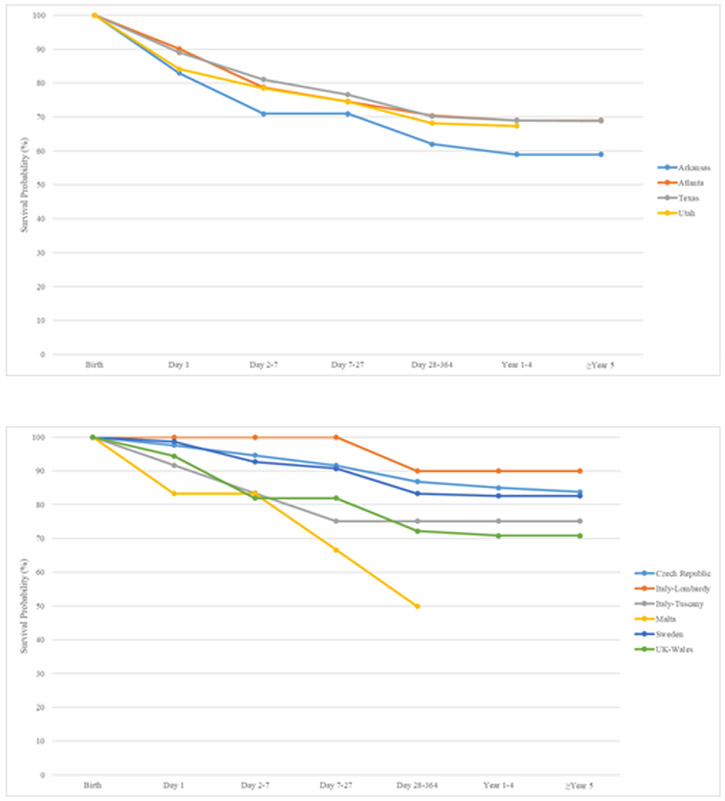
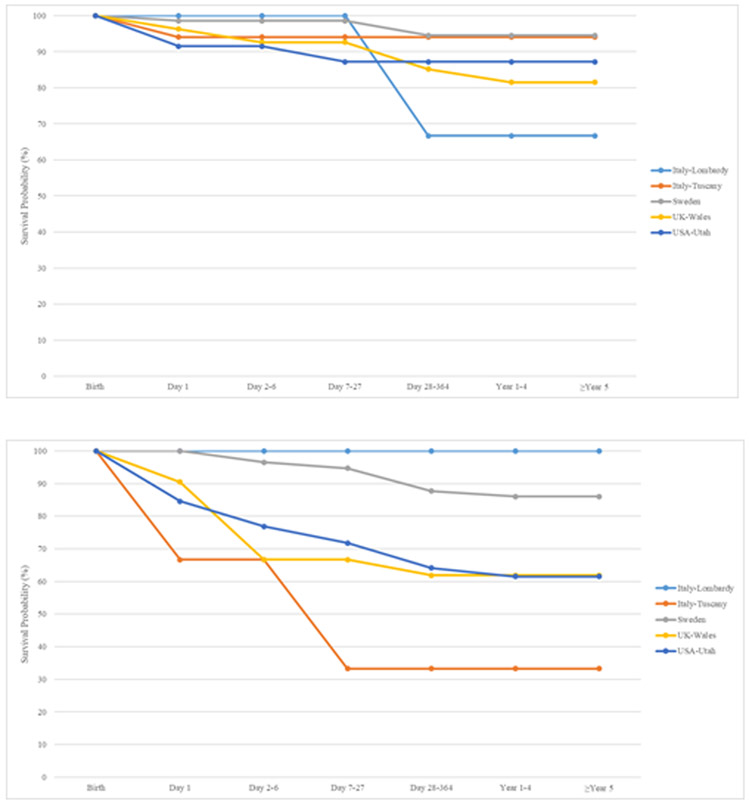
Between 2000 and 2012, the prevalence of omphalocele was 2.6 per 10,000 births (95% CI: 2.5, 2.7). Prevalence decreased minimally during 2000-2012 (average annual percent change = −0.19%, P=0.52). The overall mortality rate for this period was 32.1% (95% CI: 30.2, 34.0). Most deaths occurred during the neonatal period and among children with multiple or syndromic omphalocele. Prevalence and mortality varied by registry type (e.g., hospital- vs. population-based) and inclusion or exclusion of ETOPFA.
Conclusions:
The prevalence of omphalocele did not change over time during the study period. Approximately one-third of children with omphalocele did not survive early childhood with most deaths occurring in the neonatal period.
-
Subjects:
-
Source:Birth Defects Res. 112(20):1787-1801
-
Pubmed ID:33067932
-
Pubmed Central ID:PMC7722785
-
Document Type:
-
Funding:5U01DD000491/DD/NCBDD CDC HHSUnited States/ ; Instituto de Salud Carlos III/ ; 037062/Arkansas Biosciences Institute/ ; AZV 17-29622A/Czech Ministry of Health/ ; CC999999/ImCDC/Intramural CDC HHSUnited States/ ; Ministry of Science and Innovation, of Spain/ ; Fundación 1000 sobre Defectos Congénitos, of Spain/ ; Direzione Diritti di cittadinanza e coesione sociale-Regione Toscana/ ; Dutch Ministry of Welfare, Health and Sports/ ; Dutch Ministry of Welfare, Health and Sports./ ; Public Health Wales/
-
Volume:112
-
Issue:20
-
Collection(s):
-
Main Document Checksum:urn:sha256:342f4c2b2884ce08e072300d9943975a08ddc8d34efb69f3580762af40da77a7
-
Download URL:
-
File Type:
 [PDF
- 496.06 KB
]
[PDF
- 496.06 KB
]
Supporting Files


File Language:
English
ON THIS PAGE



CDC STACKS serves as an archival repository of CDC-published products including
scientific findings,
journal articles, guidelines, recommendations, or other public health information authored or
co-authored by CDC or funded partners.
As a repository, CDC STACKS retains documents in their original published format to ensure public access to scientific information.
As a repository, CDC STACKS retains documents in their original published format to ensure public access to scientific information.
You May Also Like
COLLECTION
CDC Public Access