



Survey of poliovirus antibodies in Borno and Yobe States, North-Eastern Nigeria
Supporting Files

-
September 26 2017
File Language:
English
Details
-
Alternative Title:PLoS One
-
Personal Author:Gofama, Mustapha Modu ; Verma, Harish ; Abdullahi, Hamisu ; Molodecky, Natalie A. ; Craig, Kehinde T. ; Urua, Utibe-Abasi ; Garba, Mohammed Ashir ; Alhaji, Mohammed Arab ; Weldon, William C. ; Oberste, M. Steven ; Braka, Fiona ; Muhammad, Ado J. G. ; Sutter, Roland W.
-
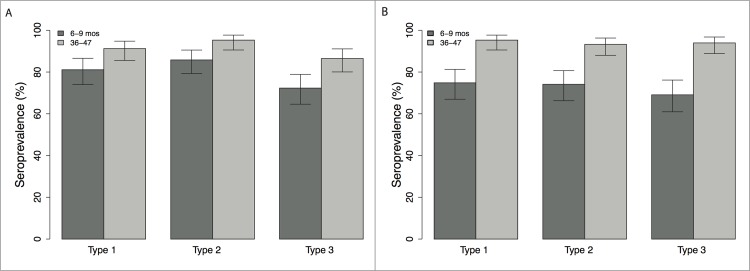
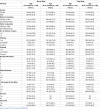
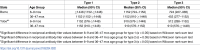
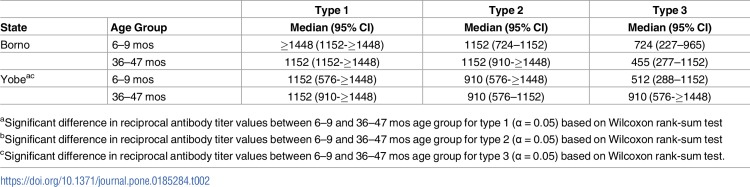
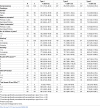
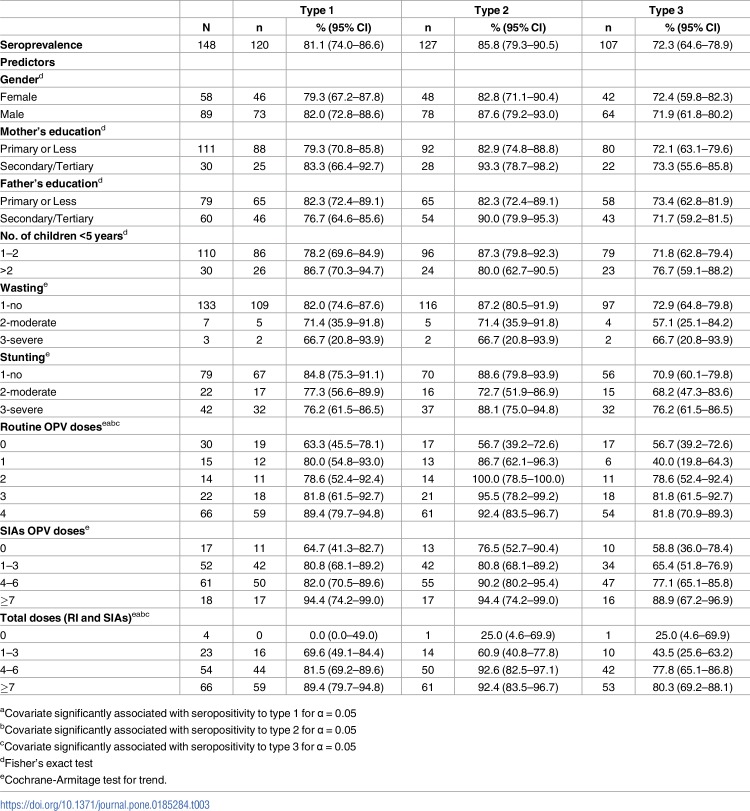
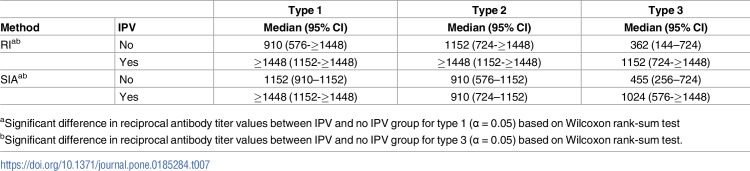
Description:Background ; Nigeria remains one of only three polio-endemic countries in the world. In 2016, after an absence of 2 years, wild poliovirus serotype 1 was again detected in North-Eastern Nigeria. To better guide programmatic action, we assessed the immunity status of infants and children in Borno and Yobe states, and evaluated the impact of recently introduced inactivated poliovirus vaccine (IPV) on antibody seroprevalence. ; Methods and findings ; We conducted a facility-based study of seroprevalence to poliovirus serotypes 1, 2 and 3 among health-seeking patients in two sites each of Borno and Yobe States. Enrolment was conducted amongst children 6–9 and 36–47 months of age attending the paediatrics outpatient department of the selected hospitals in the two states between 11 January and 5 February 2016. Detailed demographic and immunization history of the child was taken and an assessment of the child’s health and nutritional state was conducted via physical examination. Blood was collected to test for levels of neutralizing antibody titres against the three poliovirus serotypes. The seroprevalence in the two age groups, potential determinants of seropositivity and the impact of one dose of IPV on humoral immunity were assessed. A total of 583 subjects were enrolled and provided sufficient quantities of serum for testing. Among 6-9-month-old infants, the seroprevalence was 81% (74–87%), 86% (79–91%), and 72% (65–79%) in Borno State, and 75% (67–81%), 74% (66–81%) and 69% (61–76%) in Yobe States, for serotypes-1, 2 and 3, respectively. Among children aged 36–47 months, the seroprevalence was >90% in both states for all three serotypes, with the exception of type 3 seroprevalence in Borno 87% (80–91%). Median reciprocal anti-polio neutralizing antibody titers were consistently >900 for serotypes 1 and 2 across age groups and states; with lower estimates for serotype 3, particularly in Borno. IPV received in routine immunization was found to be a significant determinant of seropositivity and anti-polio neutralizing antibodies among 6-9-month-old infants for serotypes 1 and 3, but demonstrated a non-significant positive association for serotype 2. Children receiving IPV through SIAs demonstrated significantly higher anti-polio neutralizing antibodies for serotypes 1 and 3. ; Conclusions ; The seroprevalence to poliovirus remains suboptimal in both Borno and Yobe States in Nigeria. The low seroprevalence facilitated the continued transmission of both wild serotype 1 and serotype 2 circulating vaccine-derived poliovirus detected in Borno State in 2016. Further efforts are necessary to improve the immunity status of these populations to ensure sufficient population immunity to interrupt transmission.
-
Subjects:
-
Source:PLoS One. 12(9)
-
Pubmed ID:28949979
-
Pubmed Central ID:PMC5614605
-
Document Type:
-
Funding:
-
Place as Subject:
-
Volume:12
-
Issue:9
-
Download URL:
-
File Type:
 [PDF - 1.80 MB]
 -
Collection(s):
-
Main Document Checksum:urn:sha256:960b51d136ea5d5fc6b9f662439270125153966979dd5cfb64a67a733c4db478
Supporting Files


File Language:
English
 Was this page helpful?
 Found an issue?









CDC STACKS serves as an archival repository of CDC-published products including
scientific findings, journal articles, guidelines, recommendations, or other public health information authored or
co-authored by CDC or funded partners.
As a repository, CDC STACKS retains documents in their original published format to ensure public access to scientific information.
As a repository, CDC STACKS retains documents in their original published format to ensure public access to scientific information.
You May Also Like
COLLECTION
CDC Public Access