



Indicators of Social Competence and Social Participation Among US Children With Tourette Syndrome
Supporting Files

-
8 2020
-
Available in CDC Stacks on August 01, 2021, 12:00 AM
File Language:
English
Details
-
Journal Article:J Child Neurol
-
Personal Author:
-
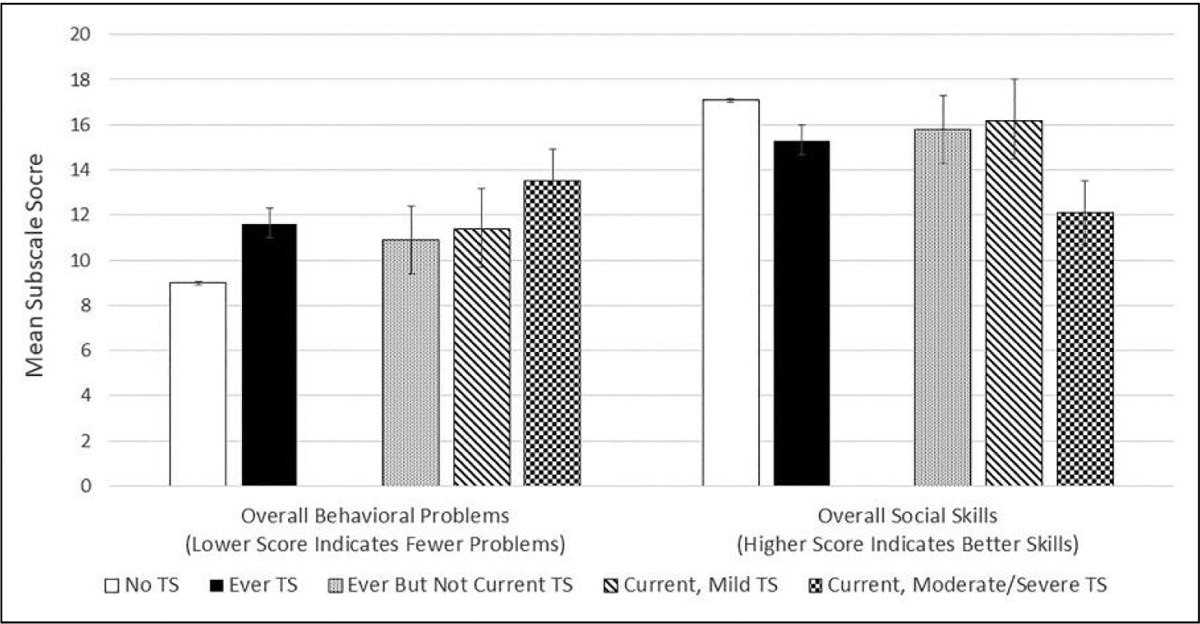
Description:Children with Tourette syndrome often have behavioral and social difficulties, which may be associated with co-occurring mental, emotional, or behavioral disorders. This study investigated social competence, including behavioral problems and social skills, and social activities between children with and without Tourette syndrome using a nationally representative sample. In the 2007 National Survey of Children's Health, parents reported on health care provider diagnosis of Tourette syndrome, co-occurring mental, emotional, or behavioral disorders, and indicators of social competence. Children aged 6-17 years with and without Tourette syndrome were compared. Most (78.7%) children with Tourette syndrome had a co-occurring mental, emotional, or behavioral disorder. Children with Tourette syndrome had significantly lower social competence, exhibited by higher levels of behavior problems (mean score 11.6 for Tourette syndrome and 9.0 for no Tourette syndrome) and lower levels of social skills (mean 15.3) than children without a Tourette syndrome diagnosis (mean 17.1); however, these associations were no longer significant after controlling for co-occurring mental, emotional, or behavioral disorders. Moderate to severe Tourette syndrome was associated with the highest ratings of behavioral problems and the lowest ratings of social skills. Children with and without Tourette syndrome were equally likely to participate in social activities; the difference for children with moderate to severe Tourette syndrome being less likely to participate in activities compared to children with mild Tourette syndrome had a chi-square test | value of .05. In conclusion, Tourette syndrome was associated with lower social competence, particularly for children with moderate to severe Tourette syndrome. Monitoring social functioning and co-occurring conditions among children with Tourette syndrome, and referral for evidence-based interventions when needed, may benefit overall health and functioning.
-
Subjects:
-
Source:J Child Neurol. 35(9):612-620
-
DOI:
-
Pubmed ID:32515671
-
Pubmed Central ID:PMC7478331
-
Document Type:
-
Funding:
-
Genre:
-
Volume:35
-
Issue:9
-
Download URL:
-
File Type:
 [PDF - 192.94 KB]
 -
Collection(s):
-
Main Document Checksum:urn:sha-512:c80c4e17e361b7d5d82a1d7bbd24ee3086c50009555782aecafd441d791b89efe1d662b6f136f58818d984ce2eb28d5af5ee92f276c64c518ce2dcde22c80507
Supporting Files


File Language:
English
 Was this page helpful?
 Found an issue?

CDC STACKS serves as an archival repository of CDC-published products including
scientific findings, journal articles, guidelines, recommendations, or other public health information authored or
co-authored by CDC or funded partners.
As a repository, CDC STACKS retains documents in their original published format to ensure public access to scientific information.
As a repository, CDC STACKS retains documents in their original published format to ensure public access to scientific information.
You May Also Like
COLLECTION
CDC Public Access