


Evaluating short- and long-term impacts of a Medicaid “lock-in” program on opioid and benzodiazepine prescriptions dispensed to beneficiaries
Supporting Files

-
November 14 2017
-
File Language:
English
Details
-
Alternative Title:Drug Alcohol Depend
-
Personal Author:
-
Description:Background
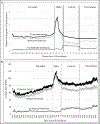
Insurance-based “lock-in” programs (LIPs) have become a popular strategy to address controlled substance (CS) (e.g., opioid) misuse. However, little is known about their impacts. We examined changes in CS dispensing to beneficiaries in the 12-month North Carolina Medicaid LIP.
Methods
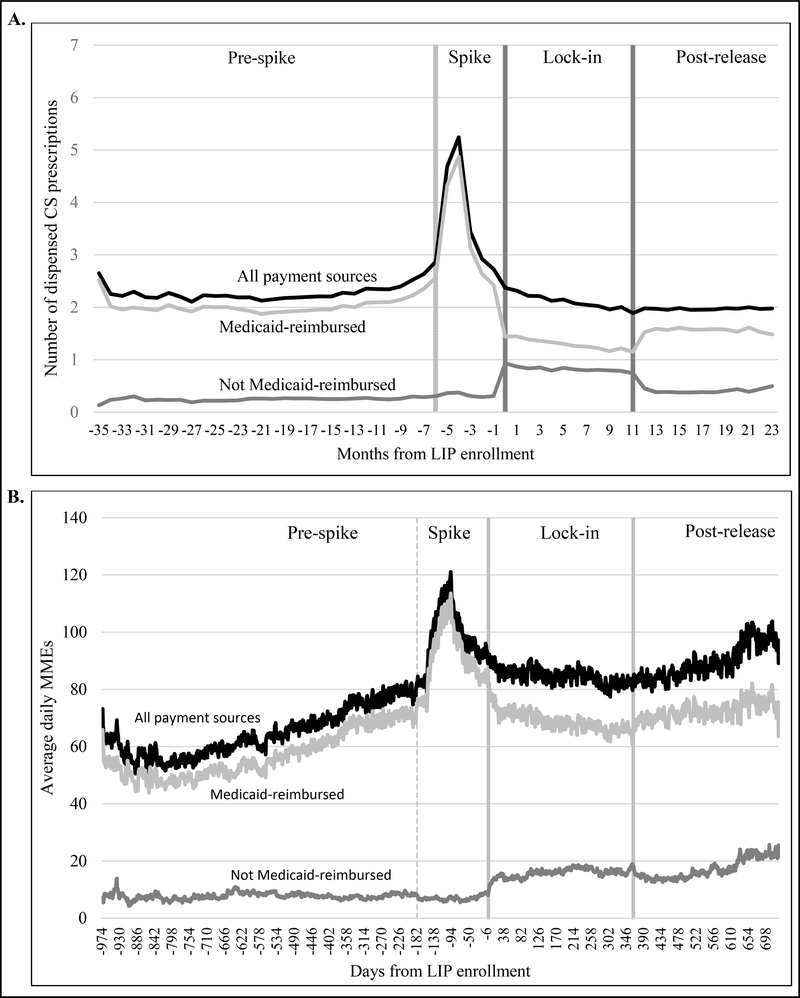
We analyzed Medicaid claims linked to Prescription Drug Monitoring Program (PDMP) records for beneficiaries enrolled in the LIP between October 2010 and September 2012 (n= 2,702). Outcomes of interest were 1) number of dispensed CS prescriptions and 2) morphine milligram equivalents (MME) of dispensed opioids while a) locked-in and b) in the year following release.
Results
Compared to a period of stable CS dispensed prior to LIP enrollment, numbers of dispensed CS during lock-in and post-release were lower (count difference per person-month: −0.05 (95% CI: −0.11, 0.01); −0.23 (95% CI: −0.31, −0.15), respectively). However, beneficiaries’ average daily MMEs of opioids were elevated during both lock-in and post-release (daily mean difference per person: 18.7 (95% CI: 13.9, 23.6); 11.1 (95% CI: 5.1, 17.1), respectively). Stratification by payer source revealed increases in using non-Medicaid (e.g., out-of-pocket) payment during lock-in that persisted following release.
Conclusions
While the LIP reduced the number of CS dispensed, the program was also associated with increased acquisition of CS prescriptions using non-Medicaid payment. Moreover, beneficiaries acquired greater dosages of dispensed opioids from both Medicaid and non-Medicaid payment sources during lock-in and post-release. Refining LIPs to increase beneficiary access to substance use disorder screening and treatment services and provider use of PDMPs may address important unintended consequences.
-
Subjects:
-
Source:Drug Alcohol Depend. 182:112-119
-
Pubmed ID:29150151
-
Pubmed Central ID:PMC7475002
-
Document Type:
-
Funding:
-
Volume:182
-
Collection(s):
-
Main Document Checksum:urn:sha256:7b4a7e027208c5b5a06d3e18175f05661a2017ed37ae65ad78590b3e041119df
-
Download URL:
-
File Type:
 [PDF
- 511.00 KB
]
[PDF
- 511.00 KB
]
Supporting Files


File Language:
English
ON THIS PAGE

CDC STACKS serves as an archival repository of CDC-published products including
scientific findings,
journal articles, guidelines, recommendations, or other public health information authored or
co-authored by CDC or funded partners.
As a repository, CDC STACKS retains documents in their original published format to ensure public access to scientific information.
As a repository, CDC STACKS retains documents in their original published format to ensure public access to scientific information.
You May Also Like
COLLECTION
CDC Public Access