



Strengthening timely detection and reporting of unusual respiratory events from health facilities in Yaoundé, Cameroon
Supporting Files

-
3 2020
File Language:
English
Details
-
Alternative Title:Influenza Other Respir Viruses
-
Personal Author:Alroy, Karen A. ; Gwom, Luc Christian ; Ndongo, Chanceline Bilounga ; Kenmoe, Sebastien ; Monamele, Gwladys ; Clara, Alexey ; Whitaker, Brett ; Manga, Henri ; Tayimetha, Carolle Yanique ; Tseuko, Dorine ; Etogo, Bienvenu ; Pasi, Omer ; Etoundi, Alain Georges ; Seukap, Elise ; Njouom, Richard ; Balajee, Arunmozhi
-
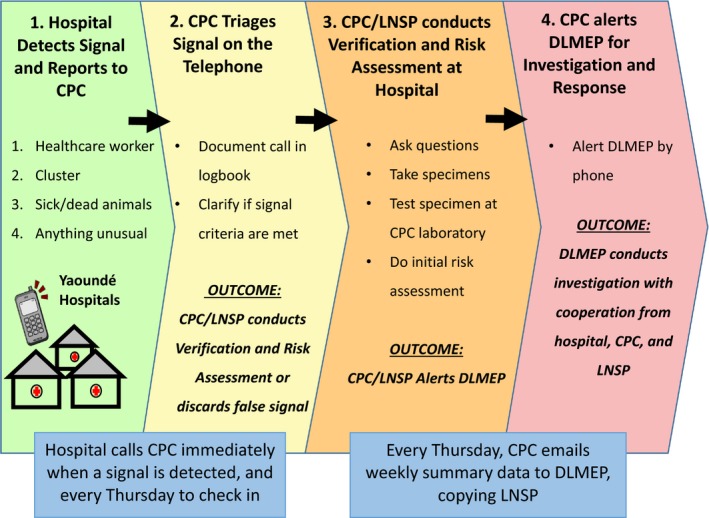
Description:Background ; The International Health Regulations state that early detection and immediate reporting of unusual health events is important for early warning and response systems. ; Objective ; To describe a pilot surveillance program established in health facilities in Yaoundé, Cameroon in 2017 which aimed to enable detection and reporting of public health events. ; Methods ; Cameroon’s Ministry of Health, in partnership with the US Centers for Disease Control and Prevention, Cameroon Pasteur Center, and National Public Health Laboratory, implemented event‐based surveillance (EBS) in nine Yaoundé health facilities. Four signals were defined that could indicate possible public health events, and a reporting, triage, and verification system was established among partner organizations. A pre‐defined laboratory algorithm was defined, and a series of workshops trained health facilities, laboratory, and public health staff for surveillance implementation. ; Results ; From May 2017 to January 2018, 30 signals were detected, corresponding to 15 unusual respiratory events. All health facilities reported a signal at least once, and more than three‐quarters of health facilities reported ≥2 times. Among specimens tested, the pathogens detected included Klebsiella pneumoniae, Moraxella catarrhalis, Streptococcus pneumoniae, Haemophilus influenza, Staphylococcus aureus, Pneumocystis jiroveci, influenza A (H1N1) virus, rhinovirus, and adenovirus. ; Conclusions ; The events detected in this pilot were caused by routine respiratory bacteria and viruses, and no novel influenza viruses or other emerging respiratory threats were identified. The surveillance system, however, strengthened relationships and communication linkages between health facilities and public health authorities. Astute clinicians can play a critical role in early detection and EBS is one approach that may enable reporting of emerging outbreaks and public health events.
-
Subjects:
-
Source:Influenza Other Respir Viruses. 14(2):122-128
-
Pubmed ID:31923349
-
Pubmed Central ID:PMC7040971
-
Document Type:
-
Funding:
-
Place as Subject:
-
Volume:14
-
Issue:2
-
Download URL:
-
File Type:
 [PDF - 370.62 KB]
 -
Collection(s):
-
Main Document Checksum:urn:sha256:f28b1d67629c2ea73c5dc80fe7b9187279e45517f8629ba36a5225f56f309afc
Supporting Files


File Language:
English
 Was this page helpful?
 Found an issue?

CDC STACKS serves as an archival repository of CDC-published products including
scientific findings, journal articles, guidelines, recommendations, or other public health information authored or
co-authored by CDC or funded partners.
As a repository, CDC STACKS retains documents in their original published format to ensure public access to scientific information.
As a repository, CDC STACKS retains documents in their original published format to ensure public access to scientific information.
You May Also Like
COLLECTION
Stephen B. Thacker CDC Library