



Impact of the Introduction of Rotavirus Vaccine on Hospital Admissions for Diarrhea Among Children in Kenya: A Controlled Interrupted Time-Series Analysis
Supporting Files

-
May 23 2020
-
Available in CDC Stacks on 2019-09-23T00:00:00Z
File Language:
English
Details
-
Alternative Title:Clin Infect Dis
-
Personal Author:Otieno, Grieven P ; Bottomley, Christian ; Khagayi, Sammy ; Adetifa, Ifedayo ; Ngama, Mwanajuma ; Omore, Richard ; Ogwel, Billy ; Owor, Betty E ; Bigogo, Godfrey ; Ochieng, John B ; Onyango, Clayton ; Juma, Jane ; Mwenda, Jason ; Tabu, Collins ; Tate, Jacqueline E ; Addo, Yaw ; Britton, Tuck ; Parashar, Umesh D ; Breiman, Robert F ; Verani, Jennifer R ; Nokes, D James
-
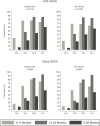
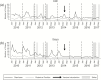
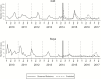
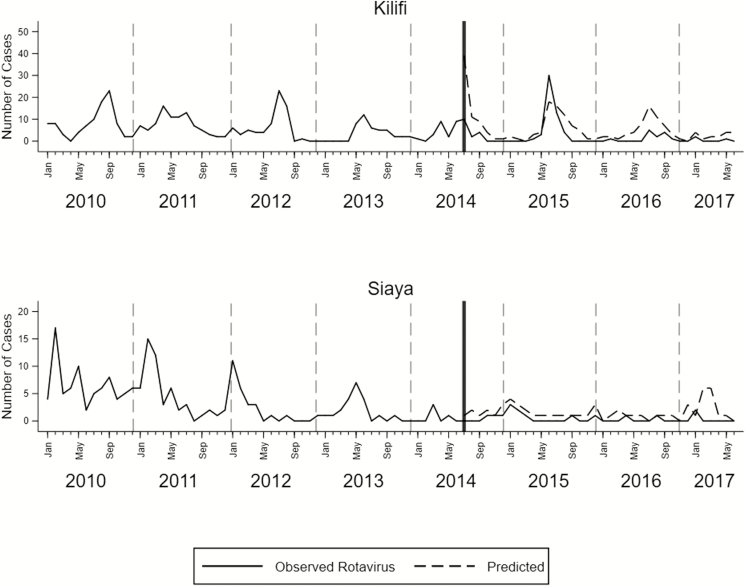
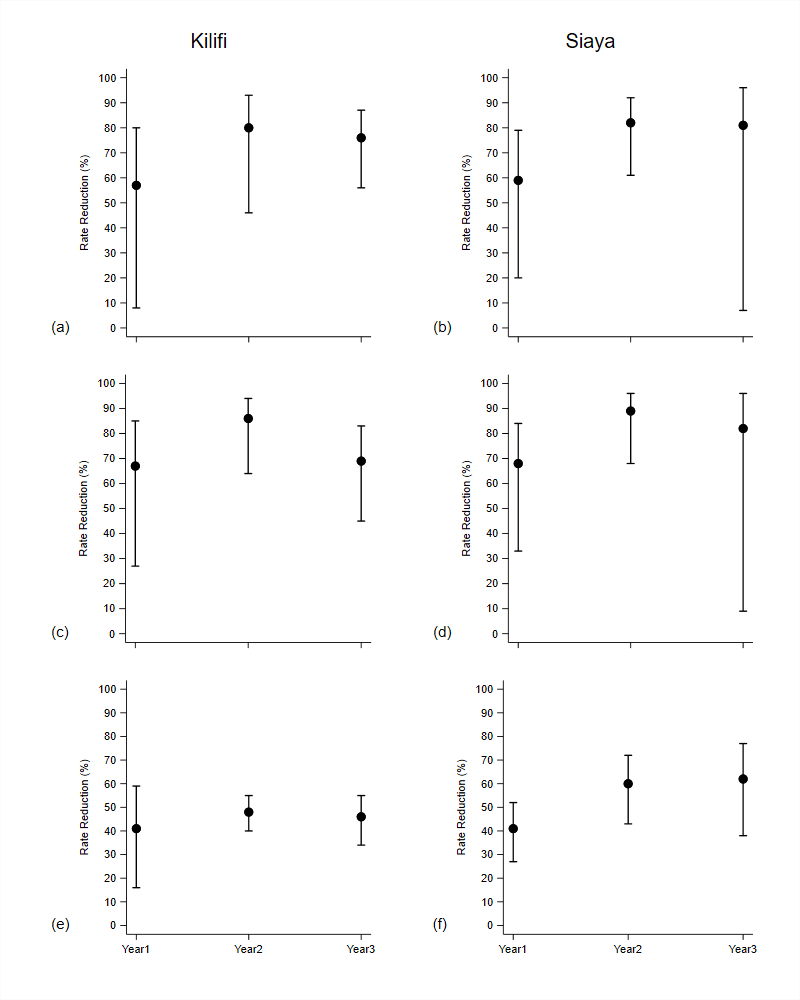
Description:Background ; Monovalent rotavirus vaccine, Rotarix (GlaxoSmithKline), was introduced in Kenya in July 2014 and is recommended to infants as oral doses at ages 6 and 10 weeks. A multisite study was established in 2 population-based surveillance sites to evaluate vaccine impact on the incidence of rotavirus-associated hospitalizations (RVHs). ; Methods ; Hospital-based surveillance was conducted from January 2010 to June 2017 for acute diarrhea hospitalizations among children aged <5 years in 2 health facilities in Kenya. A controlled interrupted time-series analysis was undertaken to compare RVH pre– and post–vaccine introduction using rotavirus-negative cases as a control series. The change in incidence post–vaccine introduction was estimated from a negative binomial model that adjusted for secular trend, seasonality, and multiple health worker industrial actions (strikes). ; Results ; Between January 2010 and June 2017 there were 1513 and 1652 diarrhea hospitalizations in Kilifi and Siaya; among those tested for rotavirus, 28% (315/1142) and 23% (197/877) were positive, respectively. There was a 57% (95% confidence interval CI, 8–80%) reduction in RVHs observed in the first year post–vaccine introduction in Kilifi and a 59% (95% CI, 20–79%) reduction in Siaya. In the second year, RVHs decreased further at both sites, 80% (95% CI, 46–93%) reduction in Kilifi and 82% reduction in Siaya (95% CI. 61–92%); this reduction was sustained at both sites into the third year. ; Conclusions ; A substantial reduction in RVHs and all-cause diarrhea was observed in 2 demographic surveillance sites in Kenya within 3 years of vaccine introduction.
-
Subjects:
-
Source:Clin Infect Dis. 2019; 70(11):2306-2313
-
Pubmed ID:31544211
-
Pubmed Central ID:PMC7245159
-
Document Type:
-
Funding:
-
Place as Subject:
-
Volume:70
-
Issue:11
-
Download URL:
-
File Type:
 [PDF - 1.06 MB]
 -
Collection(s):
-
Main Document Checksum:urn:sha256:1cc68bea2f32816f41b6029404507f38a34eb8ac730871cf85aeb9835dac441d
Supporting Files


File Language:
English
 Was this page helpful?
 Found an issue?





CDC STACKS serves as an archival repository of CDC-published products including
scientific findings, journal articles, guidelines, recommendations, or other public health information authored or
co-authored by CDC or funded partners.
As a repository, CDC STACKS retains documents in their original published format to ensure public access to scientific information.
As a repository, CDC STACKS retains documents in their original published format to ensure public access to scientific information.
You May Also Like
COLLECTION
CDC Public Access