


Endemic Chromoblastomycosis Caused Predominantly by Fonsecaea nubica, Madagascar1
Supporting Files
Public Domain

-
Jun 2020
File Language:
English
Details
-
Alternative Title:Emerg Infect Dis
-
Personal Author:Rasamoelina, Tahinamandranto ; Maubon, Danièle ; Andrianarison, Malalaniaina ; Ranaivo, Irina ; Sendrasoa, Fandresena ; Rakotozandrindrainy, Njary ; Rakotomalala, Fetra A. ; Bailly, Sébastien ; Rakotonirina, Benja ; Andriantsimahavandy, Abel ; Rabenja, Fahafahantsoa Rakato ; Andrianarivelo, Mala R. ; Cornet, Muriel ; Ramarozatovo, Lala S.
-
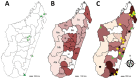
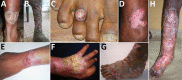
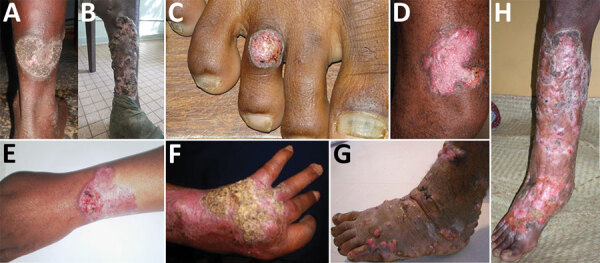
Description:Chromoblastomycosis is an implantation fungal infection. Twenty years ago, Madagascar was recognized as the leading focus of this disease. We recruited patients in Madagascar who had chronic subcutaneous lesions suggestive of dermatomycosis during March 2013-June 2017. Chromoblastomycosis was diagnosed in 50 (33.8%) of 148 patients. The highest prevalence was in northeastern (1.47 cases/100,000 persons) and southern (0.8 cases/100,000 persons) Madagascar. Patients with chromoblastomycosis were older (47.9 years) than those without (37.5 years) (p = 0.0005). Chromoblastomycosis was 3 times more likely to consist of leg lesions (p = 0.003). Molecular analysis identified Fonsecaea nubica in 23 cases and Cladophialophora carrionii in 7 cases. Of 27 patients who underwent follow-up testing, none were completely cured. We highlight the persistence of a high level of chromoblastomycosis endemicity, which was even greater at some locations than 20 years ago. We used molecular tools to identify the Fonsecaea sp. strains isolated from patients as F. nubica.
-
Subjects:
-
Source:Emerg Infect Dis. 26(6):1201-1211
-
Pubmed ID:32441639
-
Pubmed Central ID:PMC7258462
-
Document Type:
-
Place as Subject:
-
Location:
-
Volume:26
-
Issue:6
-
Collection(s):
-
Main Document Checksum:urn:sha256:6806a6e5e05e88df7cce6516ea00a8e17e14b94965ccc9631c4fcb8a177bcb3b
-
Download URL:
-
File Type:
 [PDF
- 2.57 MB
]
[PDF
- 2.57 MB
]
Supporting Files


File Language:
English
ON THIS PAGE




CDC STACKS serves as an archival repository of CDC-published products including
scientific findings,
journal articles, guidelines, recommendations, or other public health information authored or
co-authored by CDC or funded partners.
As a repository, CDC STACKS retains documents in their original published format to ensure public access to scientific information.
As a repository, CDC STACKS retains documents in their original published format to ensure public access to scientific information.
You May Also Like
COLLECTION
Emerging Infectious Diseases