



Automated Symptom and Treatment Side Effect Monitoring for Improved Quality of Life among Adults with Diabetic Peripheral Neuropathy in Primary Care: A Pragmatic, Cluster, Randomized, Controlled Trial
Supporting Files

-
1 2019
-
Available in CDC Stacks on May 19, 2020, 12:00 AM
File Language:
English
Details
-
Journal Article:Diabet Med
-
Personal Author:Adams, Alyce S. ; Schmittdiel, Julie A. ; Altschuler, Andrea ; Bayliss, Elizabeth A. ; Neugebauer, Romain ; Ma, Lin ; Dyer, Wendy ; Clark, Joel ; Cook, Bonieta ; Willyoung, David ; Jaffe, Marc ; Young, Joseph D. ; Kim, Eileen ; Boggs, Jennifer M. ; Prosser, Lisa ; Wittenberg, Eve ; Callaghan, Brian ; Shainline, Michael ; Hippler, Rosa M. ; Grant, Richard W.
-
Description:Aims:
To evaluate the effectiveness of automated symptom and side effect monitoring on quality of life among individuals with symptomatic diabetic peripheral neuropathy.
Methods:
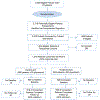
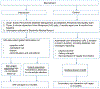
We conducted a pragmatic, cluster randomized controlled trial (July 2014 through July 2016) within a large health care system. We randomized 1,834 primary care physicians and prospectively recruited 1,270 of their patients newly prescribed medications to treat neuropathy symptoms. Intervention participants received automated telephone-based symptom and side effect monitoring with physician feedback over six months. The control group received usual care plus 3 non-interactive diabetes educational calls. Our primary outcomes were quality of life (EQ-5D) and select symptoms (e.g., pain) measured 4-8 weeks after starting medication and again 8 months after baseline. Process outcomes included receiving a clinically effective dose and patient-provider communication over 12 months. Interviewers collecting outcome data were blinded to intervention assignment.
Results:
1,252 participants completed baseline mean age st. dev.: 67 11.7, 53% female, 57% white, 8% Asian, 13% black, 20% Hispanic. 1,179 participants (93%) completed follow up (619 control, 560 intervention). Quality of life scores intervention: 0.6580.094; control: 0.6530.092 and symptom severity were similar at baseline. The intervention had no effect on primary EQ-5D: −0.002 (−0.01, 0.01), p=0.623; pain: 0.295 (−0.75, 1.34), p=0.579; sleep disruption: 0.342 (−0.18, 0.86), p=0.196; lower extremity functioning: −0.079 (−1.27, 1.11), p=0.896; depression: −0.462 (−1.24, 0.32); p=0.247 or process outcomes.
Conclusions:
Automated telephone monitoring and feedback alone was not effective at improving patient quality of life or symptoms for individuals with symptomatic diabetic peripheral neuropathy.
Trial Registration:
ClinicalTrials.gov (NCT02056431) -
Subjects:
-
Keywords:
-
Source:Diabet Med. 36(1):52-61
-
DOI:
-
Pubmed ID:30343489
-
Pubmed Central ID:PMC7236318
-
Document Type:
-
Funding:K23 NS079417/NS/NINDS NIH HHSUnited States/ ; R01 HL117939/HL/NHLBI NIH HHSUnited States/ ; U58 DP002641/DP/NCCDPHP CDC HHSUnited States/ ; R01 DK099108/DK/NIDDK NIH HHSUnited States/ ; R01DK099108/National Institute for Diabetes, Digestive and Kidney DiseasesInternational/ ; P30 DK092924/DK/NIDDK NIH HHSUnited States/ ; K24DK109144/National Institute for Diabetes, Digestive and Kidney DiseasesInternational/
-
Genre:
-
Volume:36
-
Issue:1
-
Download URL:
-
File Type:
 [PDF - 356.43 KB]
 -
Collection(s):
-
Main Document Checksum:urn:sha-512:25c15f3f160467c52c9f641ec5b7f5011d835672ebadb38b156163d63539a8be1c531f71dc04aabbbccd320c698afd08d939d5663e89a6d2c81517b74653052f
Supporting Files


File Language:
English
 Was this page helpful?
 Found an issue?



CDC STACKS serves as an archival repository of CDC-published products including
scientific findings, journal articles, guidelines, recommendations, or other public health information authored or
co-authored by CDC or funded partners.
As a repository, CDC STACKS retains documents in their original published format to ensure public access to scientific information.
As a repository, CDC STACKS retains documents in their original published format to ensure public access to scientific information.
You May Also Like
COLLECTION
CDC Public Access