



Unmet Needs for Assistance related to Subjective Cognitive Decline among Community-Dwelling Middle-Aged and Older Adults in the US: Prevalence and Impact on Health-Related Quality of Life
Supporting Files

-
7 2021
-
Available in CDC Stacks on July 01, 2022, 12:00 AM
File Language:
English
Details
-
Alternative Title:Int Psychogeriatr
-
Personal Author:
-
Description:Objectives
To estimate the prevalence of unmet needs for assistance among middle-aged and older adults with subjective cognitive decline (SCD) in the US and to evaluate whether unmet needs were associated with health-related quality of life (HRQOL).
Design
Cross-sectional study
Setting
United States – 50 states, District of Columbia, and Puerto Rico
Participants
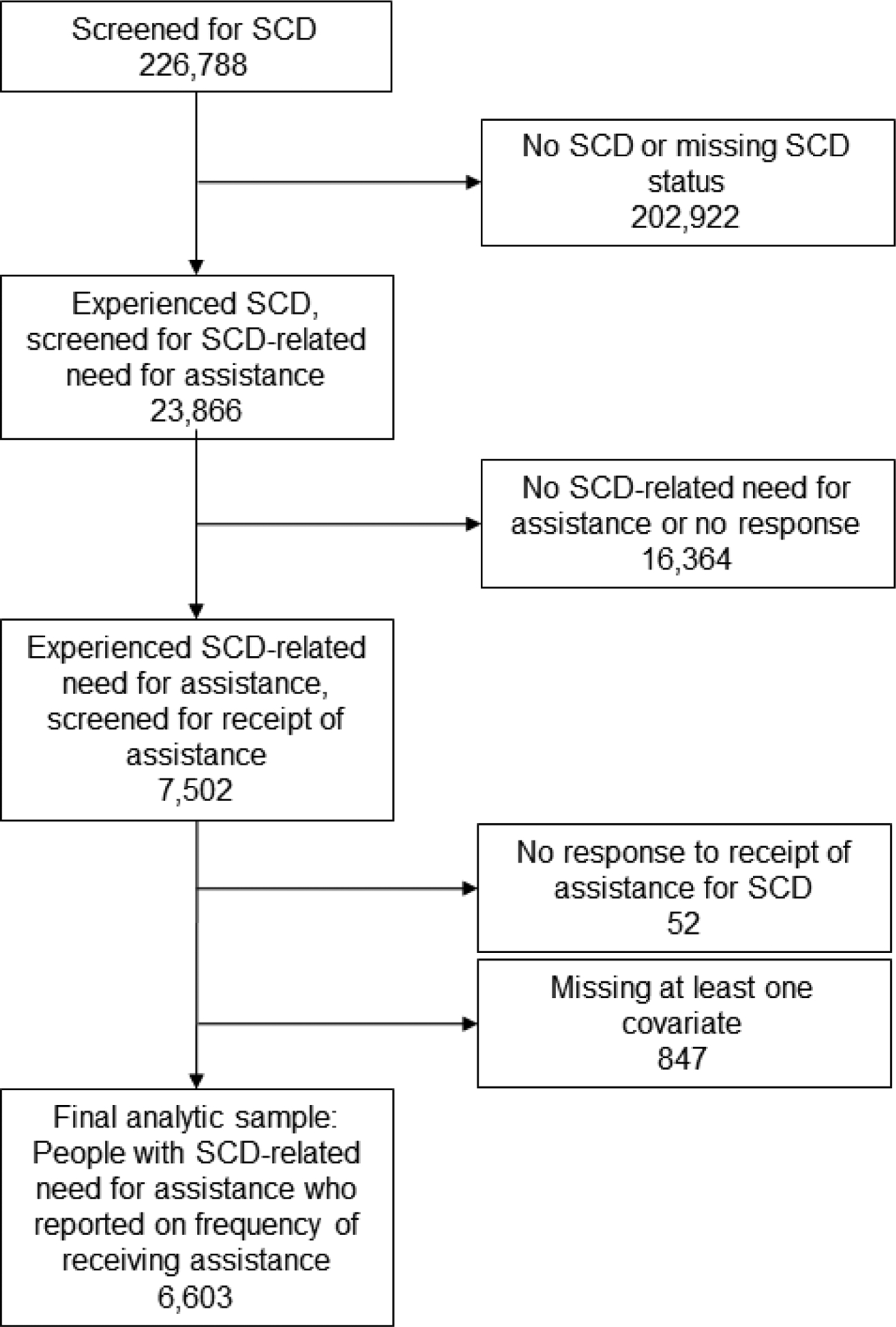
Community-dwelling adults aged 45 years and older who completed the Cognitive Decline module on the 2015–2018 Behavioral Risk Factor Surveillance System, reported experiencing SCD, and always, usually, or sometimes needed assistance with day-to-day activities because of SCD.
Measurements
We defined SCD as confusion or memory loss that was happening more often or getting worse over the past 12 months. Respondents with SCD were considered to have an unmet need for assistance if they sometimes, rarely, or never got the help they needed with day-to-day activities. We measured three domains of HRQOL: (1) mental (frequent mental distress, ≥14 days of poor mental health in the past 30 days), (2) physical (frequent physical distress, ≥14 days of poor physical health in the past 30 days), and (3) social (SCD always, usually, or sometimes interfered with the ability to work, volunteer, or engage in social activities outside the home). We used log-binomial regression models to estimate prevalence ratios (PR). All estimates were weighted.
Results
40.4% of people who needed SCD-related assistance reported an unmet need. Among respondents without depression, an unmet need was associated with a higher prevalence of frequent mental distress (PR=1.60, 95%CI:1.15–2.23, p=0.005). Frequent physical distress and social limitations did not differ between people with met and unmet needs.
Conclusions
Middle-aged and older adults with SCD-related needs for assistance frequently did not have those needs met, which could negatively impact their mental health. Interventions to identify and meet the unmet needs among people with SCD may improve HRQOL. -
Subjects:
-
Keywords:
-
Source:Int Psychogeriatr. 33(7):689-702
-
Pubmed ID:32883384
-
Pubmed Central ID:PMC8630807
-
Document Type:
-
Funding:
-
Place as Subject:
-
Volume:33
-
Issue:7
-
Download URL:
-
File Type:
 [PDF - 549.12 KB]
 -
Collection(s):
-
Main Document Checksum:urn:sha256:620ff3f97d16e747847f2ef16e75dfb50db0e1044bbafe6511de2ae64fb321ca
Supporting Files


File Language:
English
 Was this page helpful?
 Found an issue?

CDC STACKS serves as an archival repository of CDC-published products including
scientific findings, journal articles, guidelines, recommendations, or other public health information authored or
co-authored by CDC or funded partners.
As a repository, CDC STACKS retains documents in their original published format to ensure public access to scientific information.
As a repository, CDC STACKS retains documents in their original published format to ensure public access to scientific information.
You May Also Like
COLLECTION
CDC Public Access