



Rhizopus microsporus Infections Associated with Surgical Procedures, Argentina, 2006–2014
Supporting Files
Public Domain

-
May 2020
File Language:
English
Details
-
Alternative Title:Emerg Infect Dis
-
Personal Author:Bowers, Jolene R. ; Monroy-Nieto, Juan ; Gade, Lalitha ; Travis, Jason ; Refojo, Nicolás ; Abrantes, Ruben ; Santander, Jorge ; French, Chris ; Dignani, María Cecilia ; Hevia, Alejandra Ines ; Roe, Chandler C. ; Lemmer, Darrin ; Lockhart, Shawn R. ; Chiller, Tom ; Litvintseva, Anastasia P. ; Clara, Liliana ; Engelthaler, David M.
-
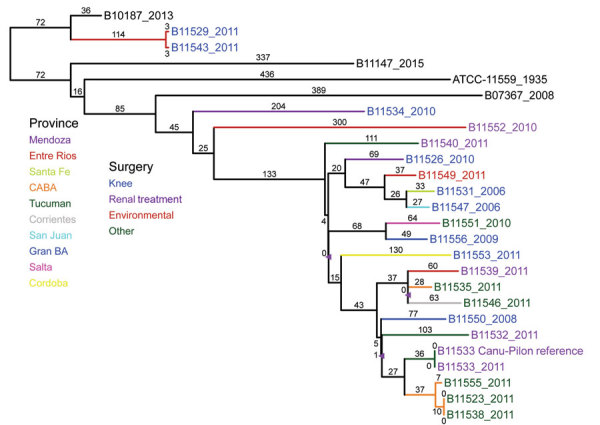
Description:Rhizopus spp. fungi are ubiquitous in the environment and a rare but substantial cause of infection in immunosuppressed persons and surgery patients. During 2005-2017, an abnormally high number of Rhizopus infections in surgery patients, with no apparent epidemiologic links, were reported in Argentina. To determine the likelihood of a common source of the cluster, we performed whole-genome sequencing on samples collected during 2006-2014. Most isolates were separated by >60 single-nucleotide polymorphisms, and we found no evidence for recombination or nonneutral mutation accumulation; these findings do not support common source or patient-to-patient transmission. Assembled genomes of most isolates were ≈25 Mbp, and multiple isolates had substantially larger assembled genomes (43-51 Mbp), indicative of infections with strain types that underwent genome expansion. Whole-genome sequencing has become an essential tool for studying epidemiology of fungal infections. Less discriminatory techniques may miss true relationships, possibly resulting in inappropriate attribution of point source.
-
Subjects:
-
Source:Emerg Infect Dis. 26(5):937-944
-
Pubmed ID:32310081
-
Pubmed Central ID:PMC7181922
-
Document Type:
-
Place as Subject:
-
Volume:26
-
Issue:5
-
Download URL:
-
File Type:
 [PDF - 1.25 MB]
 -
Collection(s):
-
Main Document Checksum:urn:sha256:60969503665949e5bee3f204be68385930a912168265b48d37532245048d8156
Supporting Files


File Language:
English
 Was this page helpful?
 Found an issue?

CDC STACKS serves as an archival repository of CDC-published products including
scientific findings, journal articles, guidelines, recommendations, or other public health information authored or
co-authored by CDC or funded partners.
As a repository, CDC STACKS retains documents in their original published format to ensure public access to scientific information.
As a repository, CDC STACKS retains documents in their original published format to ensure public access to scientific information.
You May Also Like
COLLECTION
Emerging Infectious Diseases