


A review of the WHO malaria rapid diagnostic test product testing programme (2008–2018): performance, procurement and policy
Supporting Files

-
December 02 2019
-
File Language:
English
Details
-
Alternative Title:Malar J
-
Personal Author:
-
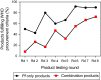
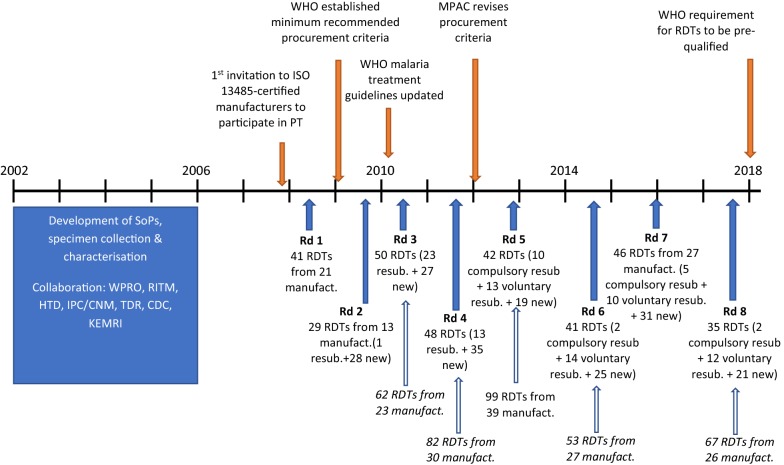
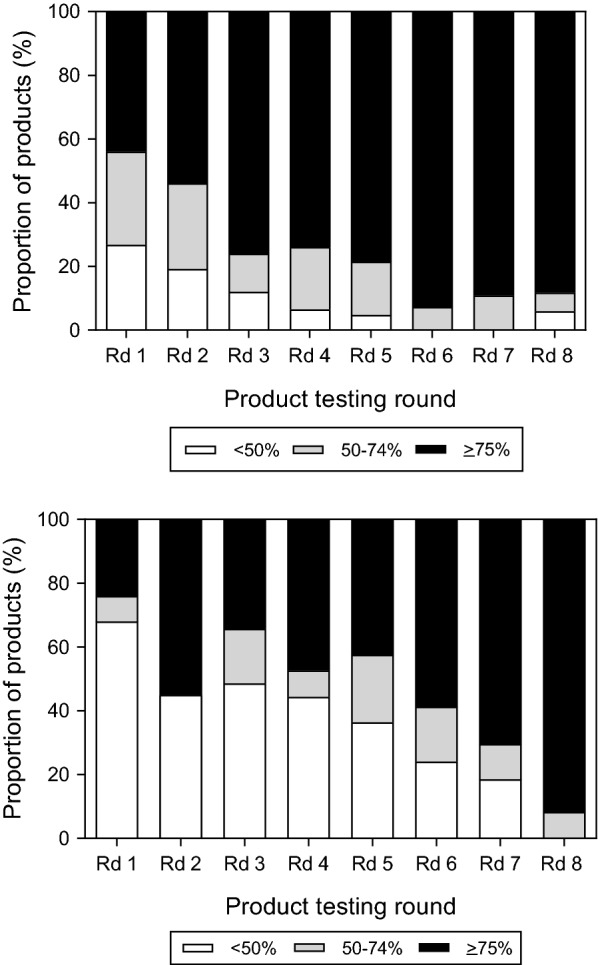
Description:Malaria rapid diagnostic tests (RDTs) emerged in the early 1990s into largely unregulated markets, and uncertain field performance was a major concern for the acceptance of tests for malaria case management. This, combined with the need to guide procurement decisions of UN agencies and WHO Member States, led to the creation of an independent, internationally coordinated RDT evaluation programme aiming to provide comparative performance data of commercially available RDTs. Products were assessed against Plasmodium falciparum and Plasmodium vivax samples diluted to two densities, along with malaria-negative samples from healthy individuals, and from people with immunological abnormalities or non-malarial infections. Three measures were established as indicators of performance, (i) panel detection score (PDS) determined against low density panels prepared from P. falciparum and P. vivax wild-type samples, (ii) false positive rate, and (iii) invalid rate, and minimum criteria defined. Over eight rounds of the programme, 332 products were tested. Between Rounds 1 and 8, substantial improvements were seen in all performance measures. The number of products meeting all criteria increased from 26.8% (11/41) in Round 1, to 79.4% (27/34) in Round 8. While products submitted to further evaluation rounds under compulsory re-testing did not show improvement, those voluntarily resubmitted showed significant increases in P. falciparum (p = 0.002) and P. vivax PDS (p < 0.001), with more products meeting the criteria upon re-testing. Through this programme, the differentiation of products based on comparative performance, combined with policy changes has been influential in the acceptance of malaria RDTs as a case-management tool, enabling a policy of parasite-based diagnosis prior to treatment. Publication of product testing results has produced a transparent market allowing users and procurers to clearly identify appropriate products for their situation, and could form a model for introduction of other, broad-scale diagnostics.
-
Subjects:
-
Source:Malar J. 18
-
Pubmed ID:31791354
-
Pubmed Central ID:PMC6889598
-
Document Type:
-
Funding:
-
Volume:18
-
Collection(s):
-
Main Document Checksum:urn:sha256:c837af77235354f618d4c383b2d0b5b0577c3f757243e0d956c785a03068dc36
-
Download URL:
-
File Type:
 [PDF
- 961.05 KB
]
[PDF
- 961.05 KB
]
Supporting Files


File Language:
English
ON THIS PAGE






CDC STACKS serves as an archival repository of CDC-published products including
scientific findings,
journal articles, guidelines, recommendations, or other public health information authored or
co-authored by CDC or funded partners.
As a repository, CDC STACKS retains documents in their original published format to ensure public access to scientific information.
As a repository, CDC STACKS retains documents in their original published format to ensure public access to scientific information.
You May Also Like
COLLECTION
CDC Public Access