



Longitudinal Association of Biomarkers of Pesticide Exposure with Cardiovascular Disease Risk Factors in Youth with Diabetes
Supporting Files

-
2 2020 ; 2-2020
-
Available in CDC Stacks on February 01, 2021, 12:00 AM
File Language:
English
Details
-
Alternative Title:Environ Res
-
Personal Author:
-
Description:Background:
Cardiovascular disease (CVD) is the leading cause of death among individuals with diabetes, but little is known about the role of exposures to environmental chemicals such as pesticides in the early development of CVD risk in this population.
Objectives:
To describe changes over time in concentrations of pesticide biomarkers among youth with diabetes in the United States and to estimate the longitudinal association between these concentrations and established risk factors for CVD.
Methods:
Pesticide biomarkers were quantified in urine and serum samples from 87 youth with diabetes participating in the multi-center SEARCH cohort study. Samples were obtained around the time of diagnosis (baseline visit, between 2006 and 2010) and, on average, 5.4 years later (follow-up visit, between 2012 and 2015). We calculated geometric mean (95% CI) pesticide biomarker concentrations. Eight CVD risk factors were measured at these two time points: body mass index (BMI) z-score, HbA1c, insulin sensitivity, fasting C-peptide (FCP), LDL cholesterol, HDL cholesterol, total cholesterol, and triglycerides. Linear regression models were used to estimate the associations between each pesticide biomarker at baseline and each CVD risk factor at follow-up, adjusting for baseline health outcome, elapsed time between baseline and follow up, sex, age, race/ethnicity, and diabetes type.
Results:
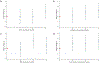
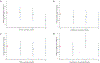
Participants were, on average, 14.2 years old at their baseline visit, and most were diagnosed with type 1 diabetes (57.5%). 4-nitrophenol, 3-phenoxybenzoic acid, 2,4-dichlorophenoxyacetic acid (2,4-D), 3,5,6-trichloro-2-pyridinol, 2,2-bis(4-chlorophenyl)-1,1-dichloroethene, and hexachlorobenzene were detected in a majority of participants at both time points. Participants in the highest quartile of 2,4-D and 4-nitrophenol at baseline had HbA1c levels at follow-up that were 1.05 percentage points (95% CI: −0.40, 2.51) and 1.27 percentage points (95% CI: −0.22, 2.75) higher, respectively, than participants in the lowest quartile of these pesticide biomarkers at baseline. These participants also had lower log FCP levels (indicating reduced beta-cell function) compared to participants in the lowest quartile at baseline: beta (95% CI) for log FCP of −0.64 (−1.17, −0.11) for 2,4-D and −0.39 (−0.96, 0.18) for 4-nitrophenol. In other words, participants in the highest quartile of 2,4-D had a 47.3% lower FCP level compared to participants in the lowest quartile, and those in the highest quartile of 4-nitrophenol had a 32.3% lower FCP level than those in the lowest quartile. Participants with trans-nonachlor concentrations in the highest quartile at baseline had HbA1c levels that were 1.45 percentage points (95% CI: −0.11, 3.01) higher and log FCP levels that were −0.28 (−0.84, 0.28) lower than participants in the lowest quartile at baseline, that is to say, participants in the highest quartile of trans-nonachlor had a 24.4% lower FCP level than those in the lowest quartile. While not all of these results were statistically significant, potentially due to the small same size, clinically, there appears to be quantitative differences. No associations were observed between any pesticide biomarker at baseline with BMI z-score or insulin sensitivity at follow-up.
Conclusions:
Exposure to select pesticides may be associated with impaired beta-cell function and poorer glycemic control among youth with diabetes. -
Subjects:
-
Keywords:
-
Source:Environ Res. 181:108916
-
Pubmed ID:31761333
-
Pubmed Central ID:PMC6982582
-
Document Type:
-
Funding:U18 DP002710/DP/NCCDPHP CDC HHSUnited States/ ; U18 DP006134/DP/NCCDPHP CDC HHSUnited States/ ; U18 DP006138/DP/NCCDPHP CDC HHSUnited States/ ; U18DP006138/ACL/ACL HHSUnited States/ ; UL1 TR000154/TR/NCATS NIH HHSUnited States/ ; U18 DP002714/DP/NCCDPHP CDC HHSUnited States/ ; U01 DP000248/DP/NCCDPHP CDC HHSUnited States/ ; U18DP006134/ACL/ACL HHSUnited States/ ; U18DP006131/ACL/ACL HHSUnited States/ ; UL1 TR000423/TR/NCATS NIH HHSUnited States/ ; U01 DP000246/DP/NCCDPHP CDC HHSUnited States/ ; P30 DK057516/DK/NIDDK NIH HHSUnited States/ ; HIR 10-001/HX/HSRD VAUnited States/ ; U18DP006139/ACL/ACL HHSUnited States/ ; UC4 DK108173/DK/NIDDK NIH HHSUnited States/ ; U01 DP000247/DP/NCCDPHP CDC HHSUnited States/ ; P30 DK048520/DK/NIDDK NIH HHSUnited States/ ; U18 DP006131/DP/NCCDPHP CDC HHSUnited States/ ; U18 DP006136/DP/NCCDPHP CDC HHSUnited States/ ; U18 DP002709/DP/NCCDPHP CDC HHSUnited States/ ; U18 DP006133/DP/NCCDPHP CDC HHSUnited States/ ; UL1 TR001425/TR/NCATS NIH HHSUnited States/ ; UL1 TR002319/TR/NCATS NIH HHSUnited States/ ; U18 DP006139/DP/NCCDPHP CDC HHSUnited States/ ; UL1 TR000077/TR/NCATS NIH HHSUnited States/ ; U18DP006136/ACL/ACL HHSUnited States/ ; U01 DP000250/DP/NCCDPHP CDC HHSUnited States/ ; U18DP006133/ACL/ACL HHSUnited States/ ; U18 DP002708/DP/NCCDPHP CDC HHSUnited States/
-
Volume:181
-
Download URL:
-
File Type:
 [PDF - 656.47 KB]
 -
Collection(s):
-
Main Document Checksum:urn:sha-512:8a876c213e773b3787acd39f521f2b341db9c0242a20336246f7612d722963a3befedc517b6f7e19bbafbc7d18d432befac00db64d8a4192bd78a24189b30d43
Supporting Files


File Language:
English
 Was this page helpful?
 Found an issue?



CDC STACKS serves as an archival repository of CDC-published products including
scientific findings, journal articles, guidelines, recommendations, or other public health information authored or
co-authored by CDC or funded partners.
As a repository, CDC STACKS retains documents in their original published format to ensure public access to scientific information.
As a repository, CDC STACKS retains documents in their original published format to ensure public access to scientific information.
You May Also Like
COLLECTION
CDC Public Access