


Comparison of models for analyzing two-group, cross-sectional data with a Gaussian outcome subject to a detection limit
Supporting Files

-
May 05 2014
File Language:
English
Details
-
Journal Article:Stat Methods Med Res
-
Personal Author:
-
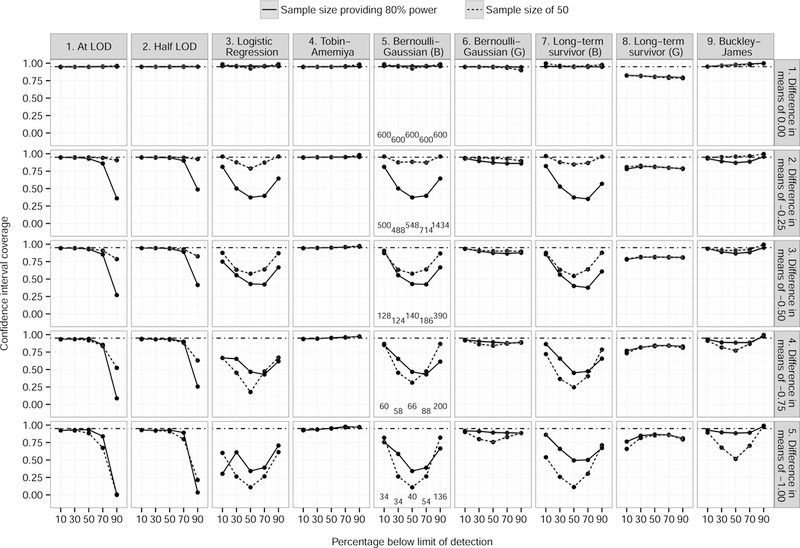
Description:A potential difficulty in the analysis of biomarker data occurs when data are subject to a detection limit. This detection limit is often defined as the point at which the true values cannot be measured reliably. Multiple, regression-type models designed to analyze such data exist. Studies have compared the bias among such models, but few have compared their statistical power. This simulation study provides a comparison of approaches for analyzing two-group, cross-sectional data with a Gaussian-distributed outcome by exploring statistical power and effect size confidence interval coverage of four models able to be implemented in standard software. We found using a Tobit model fit by maximum likelihood provides the best power and coverage. An example using human immunodeficiency virus type 1 ribonucleic acid data is used to illustrate the inferential differences in these models.
-
Subjects:
-
Source:Stat Methods Med Res. 25(6):2733-2749
-
DOI:
-
Pubmed ID:24803511
-
Pubmed Central ID:PMC6880228
-
Document Type:
-
Funding:
-
Genre:
-
Volume:25
-
Issue:6
-
Collection(s):
-
Main Document Checksum:urn:sha-512:69d4d046fcc408a0dba5d48083991d7f3e722f37ead04f6eb6698ea0ea92a591eccd1df03188f1e0de885e8f8df4ea0783b7bc5c73eb83083849663a61bff135
-
Download URL:
-
File Type:
 [PDF
- 974.86 KB
]
[PDF
- 974.86 KB
]
Supporting Files


File Language:
English
ON THIS PAGE


CDC STACKS serves as an archival repository of CDC-published products including
scientific findings,
journal articles, guidelines, recommendations, or other public health information authored or
co-authored by CDC or funded partners.
As a repository, CDC STACKS retains documents in their original published format to ensure public access to scientific information.
As a repository, CDC STACKS retains documents in their original published format to ensure public access to scientific information.
You May Also Like
COLLECTION
CDC Public Access