


Avian Influenza A Viruses among Occupationally Exposed Populations, China, 2014–2016
Supporting Files
Public Domain

-
December 2019
-
File Language:
English
Details
-
Alternative Title:Emerg Infect Dis
-
Personal Author:Quan, Chuansong ; Wang, Qianli ; Zhang, Jie ; Zhao, Min ; Dai, Qigang ; Huang, Ting ; Zhang, Zewu ; Mao, Shenghua ; Nie, Yifei ; Liu, Jun ; Xie, Yun ; Zhang, Baorong ; Bi, Yuhai ; Shi, Weifeng ; Liu, Peipei ; Wang, Dayan ; Feng, Luzhao ; Yu, Hongjie ; Liu, William J. ; Gao, George F.
-
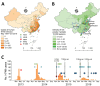
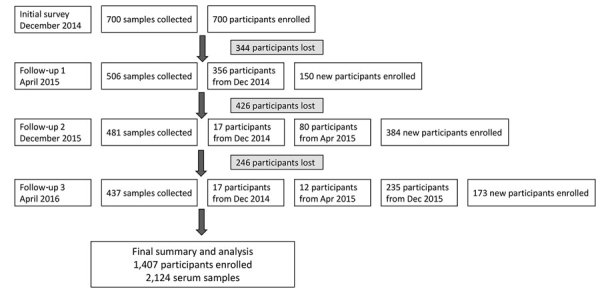
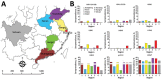
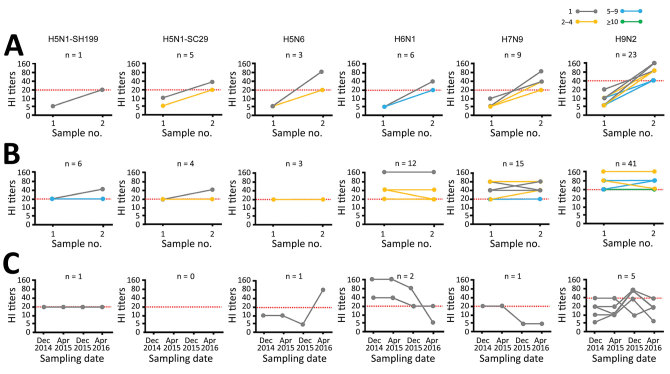
Description:To determine the seroprevalence and seroconversion of avian influenza virus (AIV) antibodies in poultry workers, we conducted a seroepidemiologic study in 7 areas of China during December 2014-April 2016. We used viral isolation and reverse transcription PCR to detect AIVs in specimens from live poultry markets. We analyzed 2,124 serum samples obtained from 1,407 poultry workers by using hemagglutination inhibition and microneutralization assays. We noted seroprevalence of AIV antibodies for subtypes H9N2, H7N9, H6N1, H5N1-SC29, H5N6, H5N1-SH199, and H6N6. In serum from participants with longitudinal samples, we noted seroconversion, with >4-fold rise in titers, for H9N2, H7N9, H6N1, H5N1-SC29, H6N6, H5N6, and H5N1-SH199 subtypes. We found no evidence of H10N8 subtype. The distribution of AIV antibodies provided evidence of asymptomatic infection. We found that AIV antibody prevalence in live poultry markets correlated with increased risk for H7N9 and H9N2 infection among poultry workers.
-
Subjects:
-
Source:Emerg Infect Dis. 25(12):2215-2225
-
Pubmed ID:31742536
-
Pubmed Central ID:PMC6874249
-
Document Type:
-
Place as Subject:
-
Location:
-
Volume:25
-
Issue:12
-
Collection(s):
-
Main Document Checksum:urn:sha256:85a9894c127df22253cb0f263c1561d1f763d4ad31d8f54d3943fb7d13307491
-
Download URL:
-
File Type:
 [PDF
- 3.05 MB
]
[PDF
- 3.05 MB
]
Supporting Files


File Language:
English
ON THIS PAGE



CDC STACKS serves as an archival repository of CDC-published products including
scientific findings,
journal articles, guidelines, recommendations, or other public health information authored or
co-authored by CDC or funded partners.
As a repository, CDC STACKS retains documents in their original published format to ensure public access to scientific information.
As a repository, CDC STACKS retains documents in their original published format to ensure public access to scientific information.
You May Also Like
COLLECTION
Emerging Infectious Diseases