



Highly Pathogenic Avian Influenza A(H5N1) Virus Infection among Workers at Live Bird Markets, Bangladesh, 2009–2010
Supporting Files
Public Domain

-
Apr 2015
File Language:
English
Details
-
Alternative Title:Emerg Infect Dis
-
Personal Author:Nasreen, Sharifa ; Khan, Salah Uddin ; Luby, Stephen P. ; Gurley, Emily S. ; Abedin, Jaynal ; Zaman, Rashid Uz ; Sohel, Badrul Munir ; Rahman, Mustafizur ; Hancock, Kathy ; Levine, Min Z. ; Veguilla, Vic ; Wang, David ; Holiday, Crystal ; Gillis, Eric ; Sturm-Ramirez, Katharine ; Bresee, Joseph S. ; Rahman, Mahmudur ; Uyeki, Timothy M. ; Katz, Jacqueline M. ; Azziz-Baumgartner, Eduardo
-
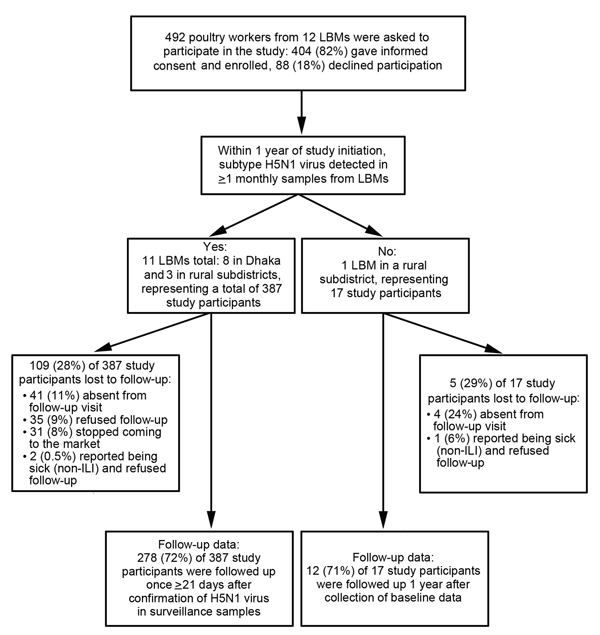
Description:The risk for influenza A(H5N1) virus infection is unclear among poultry workers in countries where the virus is endemic. To assess H5N1 seroprevalence and seroconversion among workers at live bird markets (LBMs) in Bangladesh, we followed a cohort of workers from 12 LBMs with existing avian influenza surveillance. Serum samples from workers were tested for H5N1 antibodies at the end of the study or when LBM samples first had H5N1 virus-positive test results. Of 404 workers, 9 (2%) were seropositive at baseline. Of 284 workers who completed the study and were seronegative at baseline, 6 (2%) seroconverted (7 cases/100 poultry worker-years). Workers who frequently fed poultry, cleaned feces from pens, cleaned food/water containers, and did not wash hands after touching sick poultry had a 7.6 times higher risk for infection compared with workers who infrequently performed these behaviors. Despite frequent exposure to H5N1 virus, LBM workers showed evidence of only sporadic infection.
-
Subjects:
- Research
- Adolescent
- Adult
- Farmers
- Female
- History, 21st Century
- Humans
- Incidence
- Influenza A Virus, H5N1 Subtype
- Influenza, Human/epidemiology
- Influenza, Human/history
- Influenza, Human/transmission
- Influenza, Human/virology
- Male
- Middle Aged
- Population Surveillance
- Risk Factors
- Seroepidemiologic Studies
- Serotyping
- Young Adult
-
Source:Emerg Infect Dis. 21(4):629-637.
-
Document Type:
-
Place as Subject:
-
Location:
-
Volume:21
-
Issue:4
-
Download URL:
-
File Type:
 [PDF - 1.81 MB]
 -
Collection(s):
-
Main Document Checksum:urn:sha256:caa1ca981ed87e6157b8a794c20c00dc64dffc12f8f04b5834e08e426c6ec620
Supporting Files


File Language:
English
 Was this page helpful?
 Found an issue?

CDC STACKS serves as an archival repository of CDC-published products including
scientific findings, journal articles, guidelines, recommendations, or other public health information authored or
co-authored by CDC or funded partners.
As a repository, CDC STACKS retains documents in their original published format to ensure public access to scientific information.
As a repository, CDC STACKS retains documents in their original published format to ensure public access to scientific information.
You May Also Like
COLLECTION
Emerging Infectious Diseases