


Exposure, Probable PTSD and Lower Respiratory Illness among World Trade Center Rescue, Recovery and Clean-Up Workers
Supporting Files

-
2012/05/01
-
File Language:
English
Details
-
Journal Article:Psychological Medicine
-
Personal Author:
-
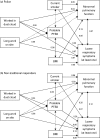
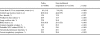
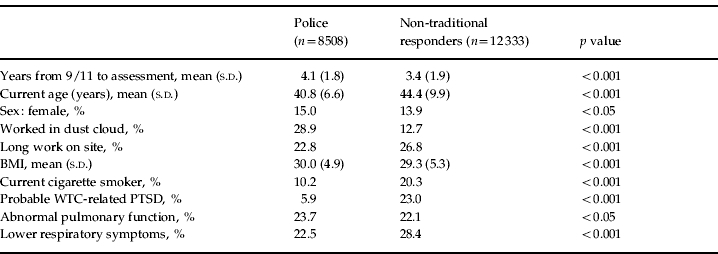
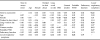
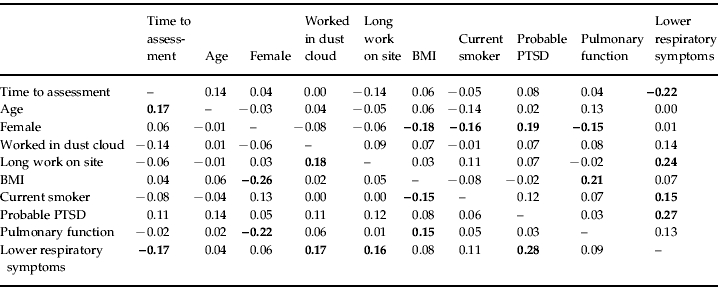
Description:Background. Thousands of rescue and recovery workers descended on the World Trade Center (WTC) in the wake of the terrorist attack of September 11, 2001 (9/11). Recent studies show that respiratory illness and post-traumatic stress disorder (PTSD) are the hallmark health problems, but relationships between them are poorly understood. The current study examined this link and evaluated contributions of WTC exposures. Method. Participants were 8508 police and 12,333 non-traditional responders examined at the WTC Medical Monitoring and Treatment Program (WTC-MMTP), a clinic network in the New York area established by the National Institute for Occupational Safety and Health (NIOSH). We used structural equation modeling (SEM) to explore patterns of association among exposures, other risk factors, probable WTC-related PTSD [based on the PTSD Checklist (PCL)], physician-assessed respiratory symptoms arising after 9/11 and present at examination, and abnormal pulmonary functioning defined by low forced vital capacity (FVC). Results. Fewer police than non-traditional responders had probable PTSD (5.9% v. 23.0%) and respiratory symptoms (22.5% v. 28.4%), whereas pulmonary function was similar. PTSD and respiratory symptoms were moderately correlated (r=0.28 for police and 0.27 for non-traditional responders). Exposure was more strongly associated with respiratory symptoms than with PTSD or lung function. The SEM model that best fit the data in both groups suggested that PTSD statistically mediated the association of exposure with respiratory symptoms. Conclusions. Although longitudinal data are needed to confirm the mediation hypothesis, the link between PTSD and respiratory symptoms is noteworthy and calls for further investigation. The findings also support the value of integrated medical and psychiatric treatment for disaster responders. [Description provided by NIOSH]
-
Subjects:
-
Keywords:
-
Source:Psychol Med 2012 May; 42(5):1069-1079
-
ISSN:0033-2917
-
Pubmed ID:22459506
-
Pubmed Central ID:PMC3315774
-
Document Type:
-
Funding:U10 OH008239/OH/NIOSH CDC HHSUnited States/ ; U10 OH008275/OH/NIOSH CDC HHSUnited States/ ; U10 OH008223/OH/NIOSH CDC HHSUnited States/ ; 5U1O 0H008232/PHS HHSUnited States/ ; U10 OH008216/OH/NIOSH CDC HHSUnited States/ ; 200-2002-0038/PHS HHSUnited States/ ; U10 OH008225/OH/NIOSH CDC HHSUnited States/
-
Genre:
-
Place as Subject:
-
CIO:
-
Division:
-
Topic:
-
Location:
-
Pages in Document:11 pdf pages
-
Volume:42
-
Issue:5
-
NIOSHTIC Number:nn:20040691
-
Contact Point Address:E. Bromet, Ph.D., Distinguished Professor, Departments of Psychiatry and Preventive Medicine, Stony Brook University, Stony Brook, NY 11794, USA
-
Email:Evelyn.bromet@stonybrook.edu
-
Federal Fiscal Year:2012
-
Performing Organization:Mount Sinai School of Medicine of New York
-
Peer Reviewed:True
-
Collection(s):
-
Main Document Checksum:urn:sha-512:01927d2a6345dd0a1c9d356a9a9d9dd16337f3c9f5fe0e82aca007770f67f210b4978bca04d457c3c1b7c15f84ccbb9d685964b5250b0a4ad50d28afdcd3cab3
-
Download URL:
-
File Type:
 [PDF
- 137.14 KB
]
[PDF
- 137.14 KB
]
Supporting Files


File Language:
English
ON THIS PAGE


CDC STACKS serves as an archival repository of CDC-published products including
scientific findings,
journal articles, guidelines, recommendations, or other public health information authored or
co-authored by CDC or funded partners.
As a repository, CDC STACKS retains documents in their original published format to ensure public access to scientific information.
As a repository, CDC STACKS retains documents in their original published format to ensure public access to scientific information.
You May Also Like