



Serological and PCR-based markers of ocular Chlamydia trachomatis transmission in northern Ghana after elimination of trachoma as a public health problem
Supporting Files
Public Domain

-
December 14 2018
File Language:
English
Details
-
Alternative Title:PLoS Negl Trop Dis
-
Personal Author:Senyonjo, Laura G. ; Debrah, Oscar ; Martin, Diana L. ; Asante-Poku, Adwoa ; Migchelsen, Stephanie J. ; Gwyn, Sarah ; deSouza, Dzeidzom K. ; Solomon, Anthony W. ; Agyemang, David ; Biritwum-Kwadwo, Nana ; Marfo, Benjamin ; Bakajika, Didier ; Mensah, Ernest O. ; Aboe, Agatha ; Koroma, Joseph ; Addy, James ; Bailey, Robin
-
Description:Background
Validation of elimination of trachoma as a public health problem is based on clinical indicators, using the WHO simplified grading system. Chlamydia trachomatis (Ct) infection and anti-Ct antibody responses (anti-Pgp3) have both been evaluated as alternative indicators in settings with varying levels of trachoma. There is a need to evaluate the feasibility of using tests for Ct infection and anti-Pgp3 antibodies at scale in a trachoma-endemic country and to establish the added value of the data generated for understanding transmission dynamics in the peri-elimination setting.
Methodology/Principal findings
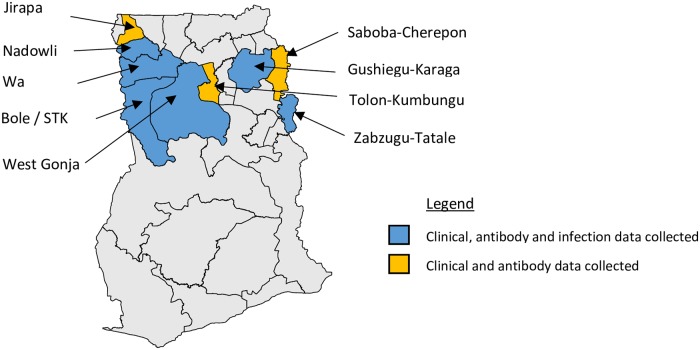
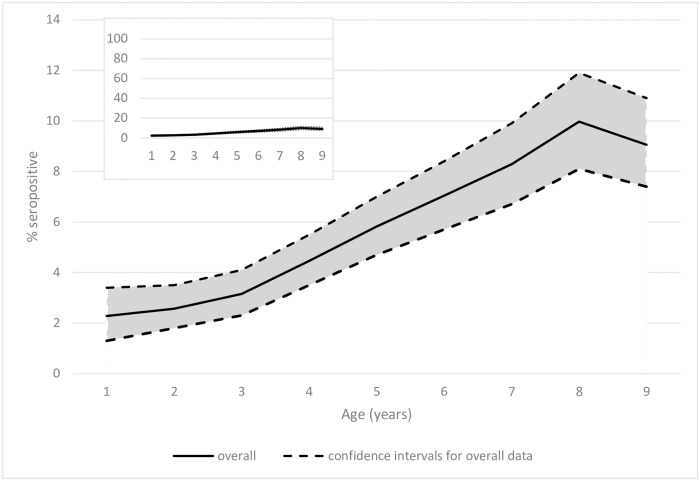
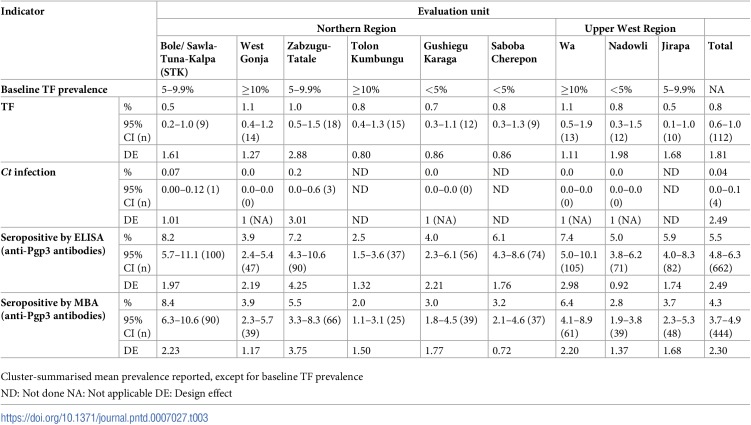
Dried blood spots for serological testing and ocular swabs for Ct infection testing (taken from children aged 1–9 years) were integrated into the pre-validation trachoma surveys conducted in the Northern and Upper West regions of Ghana in 2015 and 2016. Ct infection was detected using the GeneXpert PCR platform and the presence of anti-Pgp3 antibodies was detected using both the ELISA assay and multiplex bead array (MBA). The overall mean cluster-summarised TF prevalence (the clinical indicator) was 0.8% (95% CI: 0.6–1.0) and Ct infection prevalence was 0.04% (95%CI: 0.00–0.12). Anti-Pgp3 seroprevalence using the ELISA was 5.5% (95% CI: 4.8–6.3) compared to 4.3% (95%CI: 3.7–4.9) using the MBA. There was strong evidence from both assays that seropositivity increased with age (p<0.001), although the seroconversion rate was estimated to be very low (between 1.2 to 1.3 yearly events per 100 children).
Conclusions/Significance
Infection and serological data provide useful information to aid in understanding Ct transmission dynamics. Elimination of trachoma as a public health problem does not equate to the absence of ocular Ct infection nor cessation in acquisition of anti-Ct antibodies. -
Subjects:
-
Source:PLoS Negl Trop Dis. 12(12)
-
Pubmed ID:30550537
-
Pubmed Central ID:PMC6310292
-
Document Type:
-
Place as Subject:
-
Volume:12
-
Issue:12
-
Download URL:
-
File Type:
 [PDF - 869.83 KB]
 -
Collection(s):
-
Main Document Checksum:urn:sha256:5369080abd59f6afb3ed26ccbe53301406769d6d22acb55ba42b198bb72e7cb0
Supporting Files


File Language:
English
 Was this page helpful?
 Found an issue?







CDC STACKS serves as an archival repository of CDC-published products including
scientific findings, journal articles, guidelines, recommendations, or other public health information authored or
co-authored by CDC or funded partners.
As a repository, CDC STACKS retains documents in their original published format to ensure public access to scientific information.
As a repository, CDC STACKS retains documents in their original published format to ensure public access to scientific information.
You May Also Like
COLLECTION
CDC Public Access