


Metallic air pollutants and breast cancer heterogeneity
Supporting Files

-
10 2019
-
File Language:
English
Details
-
Alternative Title:Environ Res
-
Personal Author:
-
Description:Background:
Emerging evidence suggests airborne metals may be associated with breast cancer risk. However, breast cancer is heterogenous and associations with heavy metals vary by subtype. Heavy metals possess both carcinogenic and xenoestrogenic properties which may be related to different tumor etiologies. Therefore, we tested for etiologic heterogeneity, using a case-series approach, to determine whether associations between residential airborne metal concentrations and breast cancer differed by tumor subtype.
Methods:
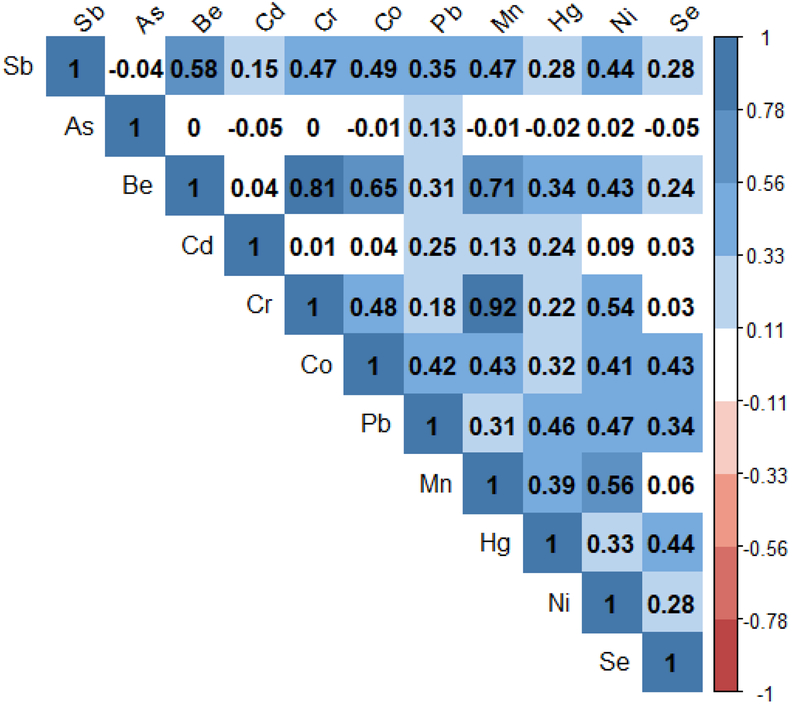
Between 2005–2008, we enrolled incident breast cancer cases into the Breast Cancer Care in Chicago study. Tumor estrogen and progesterone receptors status was determined by medical record abstraction and confirmed immunohistochemically (N=696; 147 ER/PR-negative). The 2002 USEPA’s National Air Toxics Assessment census-tract estimates of metal concentrations (antimony, arsenic, beryllium, cadmium, chromium, cobalt, lead, manganese, mercury, nickel and selenium) were matched to participants’ residences of the same year. Adjusted logistic regression models were used to examine whether the airborne heavy metal associations differed by tumor ER/PR status. Principal component analysis was performed to assess associations by metal co-exposures.
Results:
Comparing the highest and lowest quintiles, higher concentrations of antimony (odds ratio[OR]: 1.8, 95% confidence interval[CI]: 0.9, 3.7, P-trend: 0.05), cadmium (OR: 2.3, 95% CI: 1.2, 4.4, P-trend: 0.04) and cobalt (OR: 2.0, 95% CI: 0.9, 4.4, P-trend: 0.04) were associated with ER/PR-negative breast cancer. Mixture analysis using principal components suggested co-exposures to multiple airborne heavy metals may drive associations with tumor receptor status.
Conclusions:
Among women diagnosed with breast cancer, metallic air pollutants were associated with increased odds of developing ER/PR-negative breast cancer.
-
Keywords:
-
Source:Environ Res. 177:108639
-
Pubmed ID:31419716
-
Pubmed Central ID:PMC6717519
-
Document Type:
-
Funding:
-
Volume:177
-
Collection(s):
-
Main Document Checksum:urn:sha256:20d5d8b845dff5b422f39c93cba59f33e090dda65782e802da60ee6ab4f175b4
-
Download URL:
-
File Type:
 [PDF
- 576.47 KB
]
[PDF
- 576.47 KB
]
Supporting Files


File Language:
English
ON THIS PAGE


CDC STACKS serves as an archival repository of CDC-published products including
scientific findings,
journal articles, guidelines, recommendations, or other public health information authored or
co-authored by CDC or funded partners.
As a repository, CDC STACKS retains documents in their original published format to ensure public access to scientific information.
As a repository, CDC STACKS retains documents in their original published format to ensure public access to scientific information.
You May Also Like
COLLECTION
CDC Public Access