



A systematic genetic analysis and visualization of phenotypic heterogeneity among orofacial cleft GWAS signals
Supporting Files

-
9 2019 ; 9-2019
-
Available in CDC Stacks on September 01, 2020, 12:00 AM
File Language:
English
Details
-
Alternative Title:Genet Epidemiol
-
Personal Author:Carlson, Jenna C. ; Anand, Deepti ; Butali, Azeez ; Buxo, Carmen J. ; Christensen, Kaare ; Deleyiannis, Frederic ; Hecht, Jacqueline T. ; Moreno, Lina M. ; Orioli, Ieda M. ; Padilla, Carmencita ; Shaffer, John R. ; Vieira, Alexandre R. ; Wehby, George L. ; Weinberg, Seth M. ; Murray, Jeffrey C. ; Beaty, Terri H. ; Saadi, Irfan ; Lachke, Salil A. ; Marazita, Mary L. ; Feingold, Eleanor ; Leslie, Elizabeth J.
-
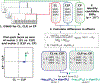
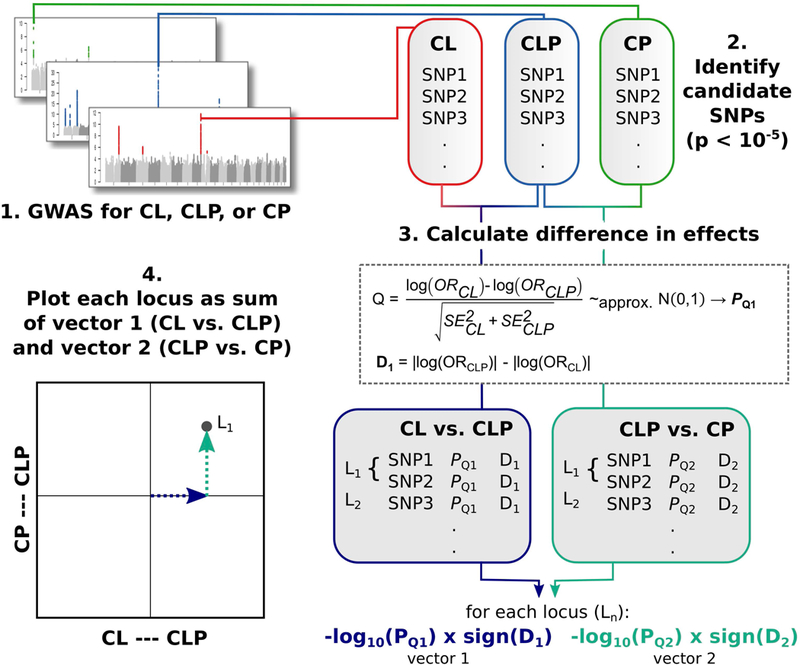
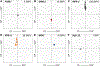
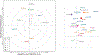
Description:Phenotypic heterogeneity is a hallmark of complex traits, and genetic studies of such traits may focus on them as a single diagnostic entity or by analyzing specific components. For example, in orofacial clefting (OFC), three subtypes-cleft lip (CL), cleft lip and palate (CLP), and cleft palate (CP) have been studied separately and in combination. To further dissect the genetic architecture of OFCs and how a given associated locus may be contributing to distinct subtypes of a trait we developed a framework for quantifying and interpreting evidence of subtype-specific or shared genetic effects in complex traits. We applied this technique to create a "cleft map" of the association of 30 genetic loci with three OFC subtypes. In addition to new associations, we found loci with subtype-specific effects (e.g., GRHL3 CP, WNT5A CLP), as well as loci associated with two or all three subtypes. We cross-referenced these results with mouse craniofacial gene expression datasets, which identified additional promising candidate genes. However, we found no strong correlation between OFC subtypes and expression patterns. In aggregate, the cleft map revealed that neither subtype-specific nor shared genetic effects operate in isolation in OFC architecture. Our approach can be easily applied to any complex trait with distinct phenotypic subgroups.
-
Subjects:
-
Keywords:
-
Source:Genet Epidemiol. 43(6):704-716
-
Pubmed ID:31172578
-
Pubmed Central ID:PMC6687557
-
Document Type:
-
Funding:R01 DE014667/DE/NIDCR NIH HHSUnited States/ ; U54 GM133807/GM/NIGMS NIH HHSUnited States/ ; U01 DE018993/DE/NIDCR NIH HHSUnited States/ ; U54 MD007587/MD/NIMHD NIH HHSUnited States/ ; UL1 TR003167/TR/NCATS NIH HHSUnited States/ ; S21 MD001830/MD/NIMHD NIH HHSUnited States/ ; HHSN268201200008C/HL/NHLBI NIH HHSUnited States/ ; R01 DE014581/DE/NIDCR NIH HHSUnited States/ ; R01 DE011948/DE/NIDCR NIH HHSUnited States/ ; U54 HD090216/HD/NICHD NIH HHSUnited States/ ; R00 DE025060/DE/NIDCR NIH HHSUnited States/ ; R37 DE008559/DE/NIDCR NIH HHSUnited States/ ; R01 DE011931/DE/NIDCR NIH HHSUnited States/ ; R00 DE024571/DE/NIDCR NIH HHSUnited States/ ; R01 DE016148/DE/NIDCR NIH HHSUnited States/ ; R03 DE024776/DE/NIDCR NIH HHSUnited States/ ; R21 DE016930/DE/NIDCR NIH HHSUnited States/ ; R00 DE022378/DE/NIDCR NIH HHSUnited States/ ; X01-HG007485 MLM/NH/NIH HHSUnited States/ ; HHSN268201200008I/HL/NHLBI NIH HHSUnited States/ ; R01 DE009886/DE/NIDCR NIH HHSUnited States/ ; R01 DE026172/DE/NIDCR NIH HHSUnited States/ ; R01 DD000295/DD/NCBDD CDC HHSUnited States/ ; R01-DE012472 MLM/NH/NIH HHSUnited States/
-
Volume:43
-
Issue:6
-
Download URL:
-
File Type:
 [PDF - 691.75 KB]
 -
Collection(s):
-
Main Document Checksum:urn:sha-512:653d1f5feccfc2fe77bf00b4d919b13779f081f00bde7f8da481ec3bf09a429544eff59254ae618082a09ea54123e3012a19a9e2e58b5a2fa3b2d27020c61117
Supporting Files


File Language:
English
 Was this page helpful?
 Found an issue?



CDC STACKS serves as an archival repository of CDC-published products including
scientific findings, journal articles, guidelines, recommendations, or other public health information authored or
co-authored by CDC or funded partners.
As a repository, CDC STACKS retains documents in their original published format to ensure public access to scientific information.
As a repository, CDC STACKS retains documents in their original published format to ensure public access to scientific information.
You May Also Like
COLLECTION
CDC Public Access