



Variable Protease-Sensitive Prionopathy Transmission to Bank Voles
Supporting Files

-
January 2019
File Language:
English
Details
-
Alternative Title:Emerg Infect Dis
-
Personal Author:
-
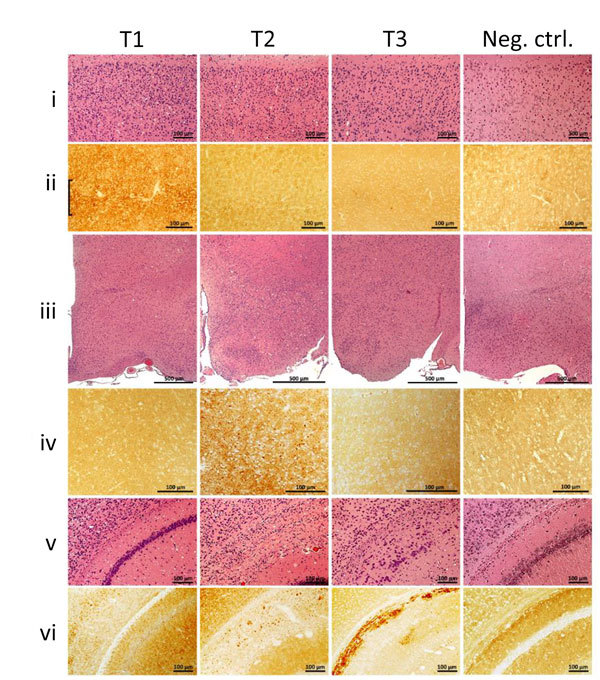
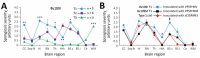
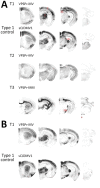
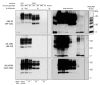
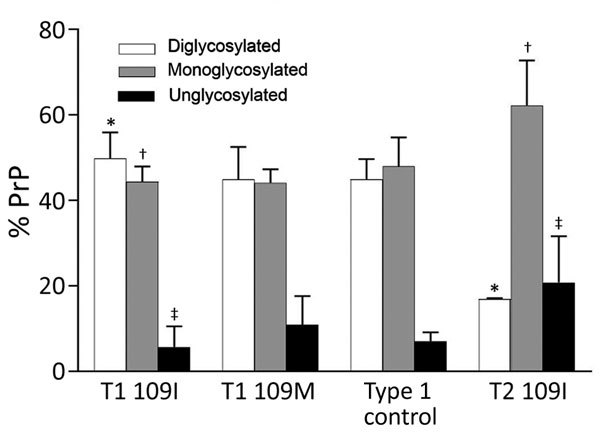
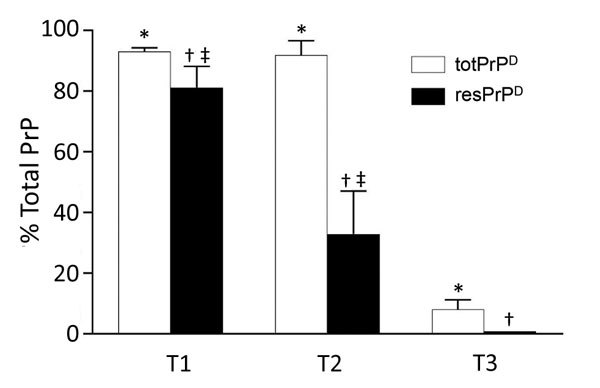
Description:Variably protease-sensitive prionopathy (VPSPr), a recently described human sporadic prion disease, features a protease-resistant, disease-related prion protein (resPrP|) displaying 5 fragments reminiscent of Gerstmann-Sträussler-Scheinker disease. Experimental VPSPr transmission to human PrP-expressing transgenic mice, although replication of the VPSPr resPrP| profile succeeded, has been incomplete because of second passage failure. We bioassayed VPSPr in bank voles, which are susceptible to human prion strains. Transmission was complete; first-passage attack rates were 5%-35%, and second-passage rates reached 100% and survival times were 50% shorter. We observed 3 distinct phenotypes and resPrP| profiles; 2 imitated sporadic Creutzfeldt-Jakob disease resPrP|, and 1 resembled Gerstmann-Sträussler-Scheinker disease resPrPD. The first 2 phenotypes may be related to the presence of minor PrP| components in VPSPr. Full VPSPr transmission confirms permissiveness of bank voles to human prions and suggests that bank vole PrP may efficiently reveal an underrepresented native strain but does not replicate the complex VPSPr PrP| profile.
-
Subjects:
-
Source:Emerg Infect Dis. 25(1):73-81
-
Pubmed ID:30561322
-
Pubmed Central ID:PMC6302590
-
Document Type:
-
Funding:
-
Volume:25
-
Issue:1
-
Download URL:
-
File Type:
 [PDF - 1.88 MB]
 -
Collection(s):
-
Main Document Checksum:urn:sha256:043e3edb8d49a9df139fc76b360325f7cb16763b4ab9d81e72e208817a61474e
Supporting Files


File Language:
English
 Was this page helpful?
 Found an issue?





CDC STACKS serves as an archival repository of CDC-published products including
scientific findings, journal articles, guidelines, recommendations, or other public health information authored or
co-authored by CDC or funded partners.
As a repository, CDC STACKS retains documents in their original published format to ensure public access to scientific information.
As a repository, CDC STACKS retains documents in their original published format to ensure public access to scientific information.
You May Also Like
COLLECTION
Emerging Infectious Diseases