


Cancer-Attributable Mortality among Solid Organ Transplant Recipients in the United States, 1987-2014
Supporting Files

-
April 29 2019
-
File Language:
English
Details
-
Alternative Title:Cancer
-
Personal Author:
-
Description:Background:
Solid organ transplant recipients have an elevated risk of cancer. Quantifying deaths attributable to cancer can inform priorities to reduce cancer burden.
Methods:
Linked transplant and cancer registry data were used to identify incident cancers and deaths among solid organ transplant recipients in the United States (1987–2014). Population-attributable fractions (PAFs) of deaths due to cancer and corresponding cancer-attributable mortality rates were estimated using Cox models.
Results:
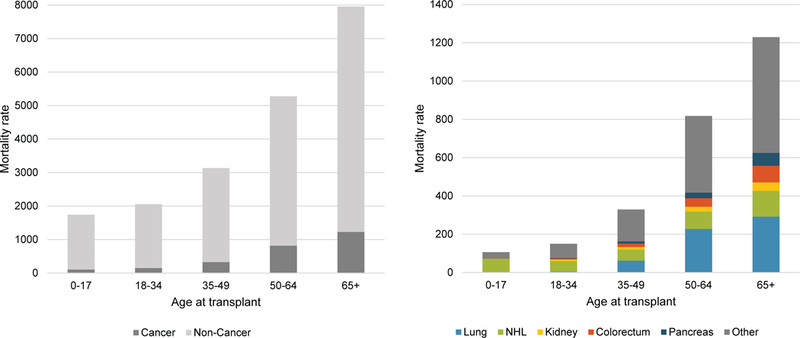
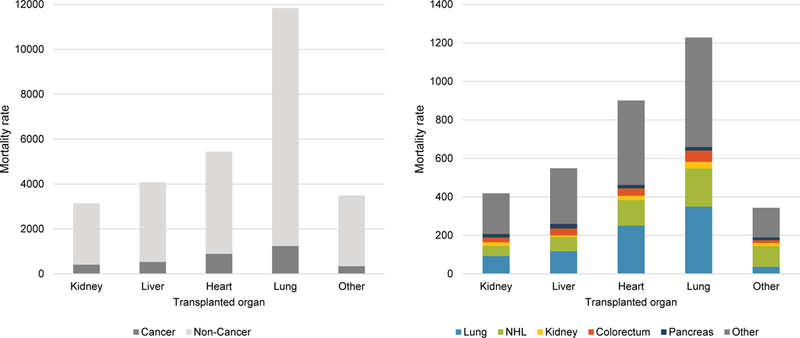
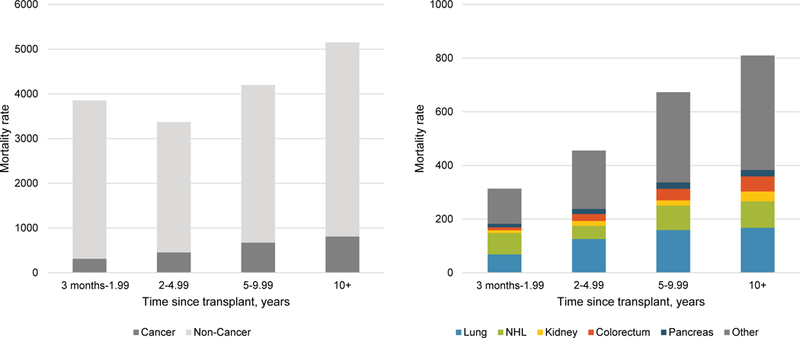
Among 221,962 transplant recipients, 15,012 developed cancer. Thirteen percent of deaths (PAF=13.2%) were attributable to cancer, corresponding to a cancer-attributable mortality rate of 516 per 100,000 person-years. Lung cancer was the largest contributor to mortality (PAF=3.1%), followed by non-Hodgkin lymphoma (NHL, PAF=1.9%), colorectal cancer (PAF=0.7%), and kidney cancer (PAF=0.5%). Cancer-attributable mortality rates increased with age at transplantation, reaching 1229 per 100,000 person-years among recipients 65+ years old. NHL was the largest contributor among children (PAF=4.1%) and lung cancer among 50+ year-olds (PAFs=3.7–4.3%). Heart recipients had the highest PAF (16.4%), but lung recipients had the highest cancer-attributable mortality rate (1241 per 100,000 person-years). Overall, mortality attributable to cancer increased steadily with longer time since transplant, reaching 15.7% of deaths (810 per 100,000 person-years) 10+ years post-transplant. Comparison of cancer-attributable mortality rates with specified causes of death indicated that some deaths recorded as other causes might instead be caused by cancer or its treatment.
Conclusions:
Cancer is a substantial cause of mortality among solid organ transplant recipients, with major contributions from lung cancer and NHL. Cancer-attributable mortality increases with age and time since transplant, so cancer deaths will become an increasing burden as recipients live longer.
-
Subjects:
-
Source:Cancer. 125(15):2647-2655
-
Pubmed ID:31034602
-
Pubmed Central ID:PMC6625902
-
Document Type:
-
Funding:HHSN261201000037C/CA/NCI NIH HHS/United States ; N01PC35143/CA/NCI NIH HHS/United States ; U58 DP003875/DP/NCCDPHP CDC HHS/United States ; N01PC35137/CA/NCI NIH HHS/United States ; HHSN261201300071C/CA/NCI NIH HHS/United States ; U58 DP003920/DP/NCCDPHP CDC HHS/United States ; U58 DP003933/DP/NCCDPHP CDC HHS/United States ; U58 DP000848/DP/NCCDPHP CDC HHS/United States ; HHSN261201300011I/CA/NCI NIH HHS/United States ; U58 DP000824/DP/NCCDPHP CDC HHS/United States ; U58 DP003883/DP/NCCDPHP CDC HHS/United States ; HHSN261201000035C/CA/NCI NIH HHS/United States ; P30 CA086862/CA/NCI NIH HHS/United States ; P30 AG028747/AG/NIA NIH HHS/United States ; HHSN261201000036C/CA/NCI NIH HHS/United States ; HHSN261201300011C/RC/CCR NIH HHS/United States ; U58 DP000807/DP/NCCDPHP CDC HHS/United States ; N01PC35142/CA/NCI NIH HHS/United States ; Z99 CA999999/ImNIH/Intramural NIH HHS/United States ; HHSN261201300021C/CA/NCI NIH HHS/United States ; HHSN261201000035I/CA/NCI NIH HHS/United States ; HHSN261201000034C/CA/NCI NIH HHS/United States ; U58 DP003921/DP/NCCDPHP CDC HHS/United States ; N01PC35139/CA/NCI NIH HHS/United States ; HHSN261201800002C/CA/NCI NIH HHS/United States
-
Genre:
-
Place as Subject:
-
Volume:125
-
Issue:15
-
Collection(s):
-
Main Document Checksum:urn:sha256:47d0119c04f45c074ddd88bc7dae4bfc89f8c2b7bc673fdf794cfc0b186b2ad7
-
Download URL:
-
File Type:
 [PDF
- 234.01 KB
]
[PDF
- 234.01 KB
]
Supporting Files


File Language:
English
ON THIS PAGE


CDC STACKS serves as an archival repository of CDC-published products including
scientific findings,
journal articles, guidelines, recommendations, or other public health information authored or
co-authored by CDC or funded partners.
As a repository, CDC STACKS retains documents in their original published format to ensure public access to scientific information.
As a repository, CDC STACKS retains documents in their original published format to ensure public access to scientific information.
You May Also Like
COLLECTION
CDC Public Access