



Climate Change, Extreme Events and Increased Risk of Salmonellosis in Maryland, USA: Evidence for Coastal Vulnerability
Supporting Files

-
June 18 2015
-
Available in CDC Stacks on 2019-06-24T00:00:00Z
File Language:
English
Details
-
Alternative Title:Environ Int
-
Personal Author:
-
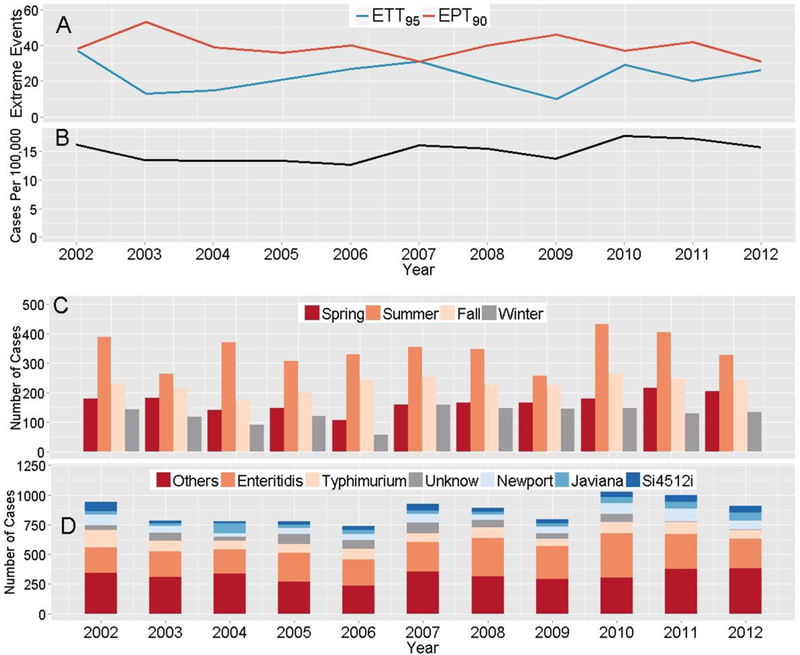
Description:Background: ; Salmonella is a leading cause of acute gastroenteritis worldwide. Patterns of salmonellosis have been linked to weather events. However, there is a dearth of data regarding the association between extreme events and risk of salmonellosis, and how this risk may disproportionately impact coastal communities. ; Methods: ; We obtained Salmonella case data from the Maryland Foodborne Diseases Active Surveillance Network (2002–2012), and weather data from the National Climatic Data Center (1960–2012). We developed exposure metrics related to extreme temperature and precipitation events using a 30 year baseline (1960–1989) and linked them with county-level salmonellosis data. Data were analyzed using negative binomial Generalized Estimating Equations. ; Results: ; We observed a 4.1% increase in salmonellosis risk associated with a 1 unit increase in extreme temperature events (Incidence Rate Ratio (IRR):1.041; 95% Confidence Interval (CI):1.013–1.069). This increase in risk was more pronounced in coastal versus non-coastal areas (5.1% vs 1.5%). Likewise, we observed a 5.6% increase in salmonellosis risk (IRR:1.056; CI:1.035–1.078) associated with a 1 unit increase in extreme precipitation events, with the impact disproportionately felt in coastal areas (7.1% vs 3.6%). ; Conclusions: ; To our knowledge, this is the first empirical evidence showing that extreme temperature/precipitation events—that are expected to be more frequent and intense in coming decades—are disproportionately impacting coastal communities with regard to salmonellosis. Adaptation strategies need to account for this differential burden, particularly in light of ever increasing coastal populations.
-
Subjects:
-
Source:Environ Int. 83:58-62
-
Pubmed ID:26093493
-
Pubmed Central ID:PMC6590700
-
Document Type:
-
Funding:
-
Place as Subject:
-
Volume:83
-
Download URL:
-
File Type:
 [PDF - 258.87 KB]
 -
Collection(s):
-
Main Document Checksum:urn:sha256:7ce91b62cc613ea08cd81c2785d562ee94f14b8acca23ff70ba20590bf26bb6f
Supporting Files


File Language:
English
 Was this page helpful?
 Found an issue?


CDC STACKS serves as an archival repository of CDC-published products including
scientific findings, journal articles, guidelines, recommendations, or other public health information authored or
co-authored by CDC or funded partners.
As a repository, CDC STACKS retains documents in their original published format to ensure public access to scientific information.
As a repository, CDC STACKS retains documents in their original published format to ensure public access to scientific information.
You May Also Like
COLLECTION
CDC Public Access