



Isolation of Lagos Bat Virus from Water Mongoose
Supporting Files
Public Domain

-
Dec 2006
File Language:
English
Details
-
Alternative Title:Emerg Infect Dis
-
Personal Author:
-
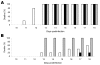
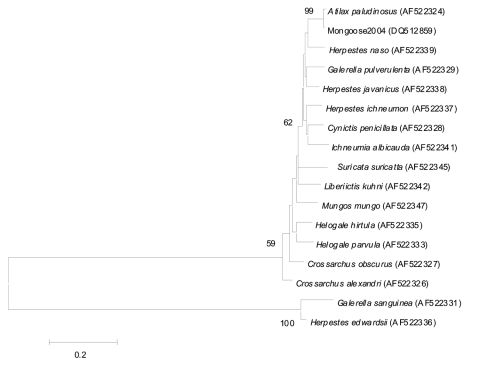
Description:A genotype 2 lyssavirus, Lagos bat virus (LBV), was isolated from a terrestrial wildlife species (water mongoose) in August 2004 in the Durban area of the KwaZulu-Natal Province of South Africa. The virus isolate was confirmed as LBV by antigenic and genetic characterization, and the mongoose was identified as Atilax paludinosus by mitochondrial cytochrome b sequence analysis. Phylogenetic analysis demonstrated sequence homology with previous LBV isolates from South African bats. Studies performed in mice indicated that the peripheral pathogenicity of LBV had been underestimated in previous studies. Surveillance strategies for LBV in Africa must be improved to better understand the epidemiology of this virus and to make informed decisions on future vaccine strategies because evidence is insufficent that current rabies vaccines provide protection against LBV.
-
Subjects:
- Research
- Animals
- Antigens, Viral
- Biological Assay
- Cytochromes b
- DNA, Mitochondrial
- Fluorescent Antibody Technique, Indirect
- Lyssavirus
- Mice
- Mice, Inbred ICR
- Nucleocapsid Proteins
- Phylogeny
- RNA, Viral
- Reverse Transcriptase Polymerase Chain Reaction
- Rhabdoviridae Infections
- Sequence Analysis, DNA
- Virulence
-
Source:Emerg Infect Dis. 12(12):1913-1918.
-
Document Type:
-
Place as Subject:
-
Location:
-
Volume:12
-
Issue:12
-
Download URL:
-
File Type:
 [PDF - 309.86 KB]
 -
Collection(s):
-
Main Document Checksum:urn:sha256:6cbe415fbaf41503b750ea3cc961d436a5bdcdd5f282f1cb965e95430dec8304
Supporting Files


File Language:
English
 Was this page helpful?
 Found an issue?



CDC STACKS serves as an archival repository of CDC-published products including
scientific findings, journal articles, guidelines, recommendations, or other public health information authored or
co-authored by CDC or funded partners.
As a repository, CDC STACKS retains documents in their original published format to ensure public access to scientific information.
As a repository, CDC STACKS retains documents in their original published format to ensure public access to scientific information.
You May Also Like
COLLECTION
Emerging Infectious Diseases