



West Nile Virus Infections Projected from Blood Donor Screening Data, United States, 2003
Supporting Files
Public Domain

-
Mar 2006
File Language:
English
Details
-
Alternative Title:Emerg Infect Dis
-
Personal Author:Busch, Michael P. ; Wright, David J. ; Custer, Brian ; Tobler, Leslie H. ; Stramer, Susan L. ; Kleinman, Steven H. ; Prince, Harry E. ; Bianco, Celso ; Foster, Gregory ; Petersen, Lyle R. ; Nemo, George ; Glynn, Simone A.
-
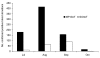
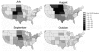
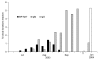
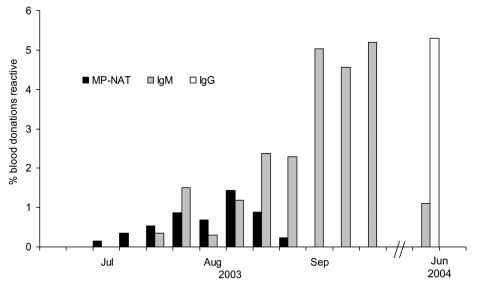
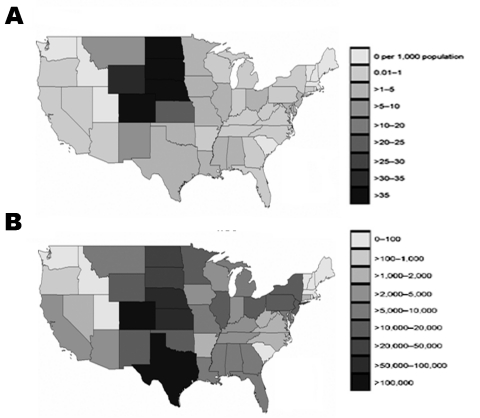
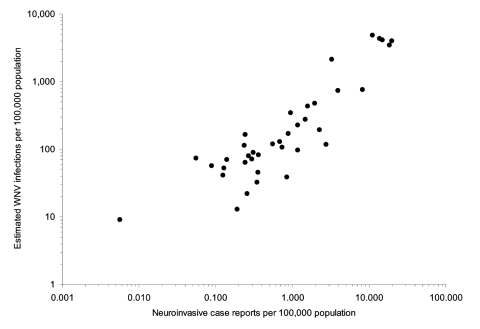
Description:National blood donor screening for West Nile virus (WNV) RNA using minipool nucleic acid amplification testing (MP-NAT) was implemented in the United States in July 2003. We compiled national NAT yield data and performed WNV immunoglobulin M (IgM) testing in 1 WNV-epidemic region (North Dakota). State-specific MP-NAT yield, antibody seroprevalence, and the average time RNA is detectable by MP-NAT were used to estimate incident infections in 2003. WNV donor screening yielded 944 confirmed viremic donors. MP-NAT yield peaked in August with >0.5% of donations positive for WNV RNA in 4 states. Peak IgM seroprevalence for North Dakota was 5.2% in late September. The average time viremia is detectable by MP-NAT was 6.9 days (95% confidence interval CI 3.0-10.7). An estimated 735,000 (95% CI 322,000-1,147,000) infections occurred in 2003, with 256 (95% CI 112-401) infections per neuroinvasive case. In addition to preventing transfusion-transmitted WNV infection, donor screening can serve as a tool to monitor seasonal incidence in the general population.
-
Subjects:
-
Source:Emerg Infect Dis. 12(3):395-402.
-
Document Type:
-
Place as Subject:
-
Location:
-
Volume:12
-
Issue:3
-
Download URL:
-
File Type:
 [PDF - 199.65 KB]
 -
Collection(s):
-
Main Document Checksum:urn:sha256:3995091a631ffcc985622014982f3bdd4333edcaaf43d6c5ff480bb4402c9ea4
Supporting Files


File Language:
English
 Was this page helpful?
 Found an issue?



CDC STACKS serves as an archival repository of CDC-published products including
scientific findings, journal articles, guidelines, recommendations, or other public health information authored or
co-authored by CDC or funded partners.
As a repository, CDC STACKS retains documents in their original published format to ensure public access to scientific information.
As a repository, CDC STACKS retains documents in their original published format to ensure public access to scientific information.
You May Also Like
COLLECTION
Emerging Infectious Diseases