



Web-based Surveillance and Global Salmonella Distribution, 2000–2002
Supporting Files
Public Domain

-
Mar 2006
File Language:
English
Details
-
Alternative Title:Emerg Infect Dis
-
Personal Author:
-
Corporate Authors:
-
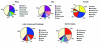
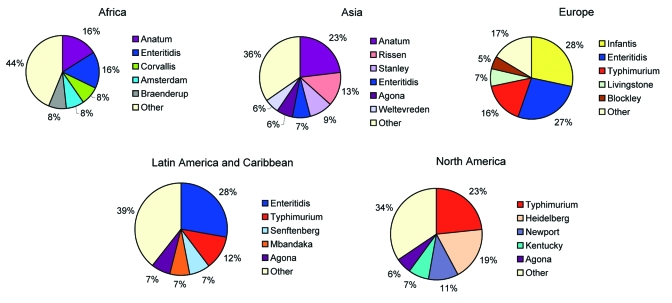
Description:Salmonellae are a common cause of foodborne disease worldwide. The World Health Organization (WHO) supports international foodborne disease surveillance through WHO Global Salm-Surv and other activities. WHO Global Salm-Surv members annually report the 15 most frequently isolated Salmonella serotypes to a Web-based country databank. We describe the global distribution of reported Salmonella serotypes from human and nonhuman sources from 2000 to 2002. Among human isolates, S. Enteritidis was the most common serotype, accounting for 65% of all isolates. Among nonhuman isolates, although no serotype predominated, Salmonella enterica serovar Typhimurium was reported most frequently. Several serotypes were reported from only 1 region of the world. The WHO Global Salm-Surv country databank is a valuable public health resource; it is a publicly accessible, Web-based tool that can be used by health professionals to explore hypotheses related to the sources and distribution of salmonellae worldwide.
-
Subjects:
-
Source:Emerg Infect Dis. 12(3):381-388.
-
Document Type:
-
Corporate as Subject:
-
Place as Subject:
-
Location:
-
Volume:12
-
Issue:3
-
Download URL:
-
File Type:
 [PDF - 295.91 KB]
 -
Collection(s):
-
Main Document Checksum:urn:sha256:93eb5ca91aea8fb2062906dcac276119a397f5b4adf651b366970a9761e001b7
Supporting Files


File Language:
English
 Was this page helpful?
 Found an issue?


CDC STACKS serves as an archival repository of CDC-published products including
scientific findings, journal articles, guidelines, recommendations, or other public health information authored or
co-authored by CDC or funded partners.
As a repository, CDC STACKS retains documents in their original published format to ensure public access to scientific information.
As a repository, CDC STACKS retains documents in their original published format to ensure public access to scientific information.
You May Also Like
COLLECTION
Emerging Infectious Diseases