



Primary Care Provider-Reported Involvement in Breast Cancer Treatment Decisions
Supporting Files

-
6 01 2019 ; 6-01-
-
Available in CDC Stacks on June 01, 2020, 12:00 AM

File Language:
English
Details
-
Alternative Title:Cancer
-
Personal Author:
-
Description:Background:
Treatment decisions for early-stage breast cancer patients often involve discussions with multiple oncology providers. However, the extent to which primary care providers (PCPs) are involved in initial treatment decisions remains unknown.
Methods:
A stratified random sample of PCPs identified by newly diagnosed early-stage breast cancer patients from the Georgia and Los Angeles SEER registries were surveyed (N=517, 61% response rate). PCPs were asked how frequently they discussed surgery, radiation and chemotherapy options with patients, how comfortable they were with these discussions, whether they had the necessary knowledge to participate in decision-making, and their confidence in their ability to help (5-item Likert-type scales). Multivariable logistic regression was used to identify PCP-reported attitudes associated with more PCP participation in each treatment decision.
Results:
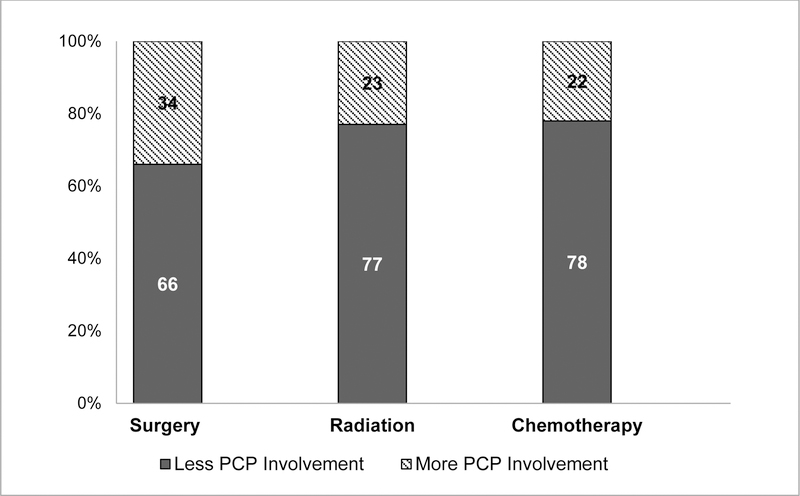
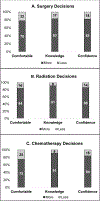
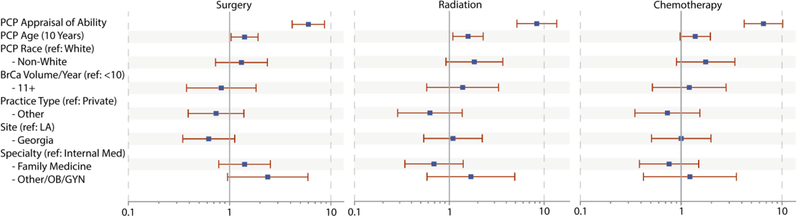
In this sample, 34% of PCPs reported that they discussed surgery, 23% discussed radiation, and 22% discussed chemotherapy options with their patients. Of those who reported more involvement in surgical decisions, 22% reported they were not comfortable having a discussion, and 17% did not feel they had the necessary knowledge to participate in treatment decision-making. PCPs who positively appraised their ability to participate were more likely to participate in all three decisions (Surgery OR: 6.01, 95%CI: 4.16–8.68; Radiation OR: 8.37, 95%CI: 5.16–13.58; Chemotherapy OR: 6.56, 95%CI: 4.23–10.17).
Conclusions:
A third of PCPs reported participating in breast cancer treatment decisions, yet gaps in knowledge about decision making and confidence in their ability to help exist. Efforts to increase PCP knowledge about breast cancer treatment options may be warranted. -
Keywords:
- primary care provider
- cancer care
- cancer treatment decisions
- treatment decision making
- breast cancer
- Adult
- Aged
- Breast Neoplasms
- Clinical Competence
- Clinical Decision-Making
- Female
- Georgia
- Humans
- Logistic Models
- Los Angeles
- Middle Aged
- Neoplasm Staging
- Physicians, Primary Care
- SEER Program
- Young Adult
-
Source:Cancer. 125(11):1815-1822
-
Pubmed ID:30707773
-
Pubmed Central ID:PMC6509002
-
Document Type:
-
Funding:HHSN261201000140C/CA/NCI NIH HHSUnited States/ ; HHSN261201000035C/CA/NCI NIH HHSUnited States/ ; P30 CA046592/CA/NCI NIH HHSUnited States/ ; HHSN261201000035I/CA/NCI NIH HHSUnited States/ ; HHSN261201300015C/CA/NCI NIH HHSUnited States/ ; HHSN261201000034C/CA/NCI NIH HHSUnited States/ ; U58 DP003862/DP/NCCDPHP CDC HHSUnited States/ ; K07 CA201052/CA/NCI NIH HHSUnited States/ ; P01 CA163233/CA/NCI NIH HHSUnited States/ ; U58 DP003875/DP/NCCDPHP CDC HHSUnited States/
-
Volume:125
-
Issue:11
-
Download URL:
-
File Type:
 [PDF - 843.15 KB]
 -
Collection(s):
-
Main Document Checksum:urn:sha256:1b89a6c50f685a5e120fa18d33ab794e15592d15439fbdea3a9d82051049070a
Supporting Files


File Language:
English
 Was this page helpful?
 Found an issue?




CDC STACKS serves as an archival repository of CDC-published products including
scientific findings, journal articles, guidelines, recommendations, or other public health information authored or
co-authored by CDC or funded partners.
As a repository, CDC STACKS retains documents in their original published format to ensure public access to scientific information.
As a repository, CDC STACKS retains documents in their original published format to ensure public access to scientific information.
You May Also Like
COLLECTION
CDC Public Access