


Understanding the Engagement of Key Decision Support Persons in Patient Decision Making Around Breast Cancer Treatment
Supporting Files

-
January 11 2019
-
File Language:
English
Details
-
Alternative Title:Cancer
-
Personal Author:
-
Description:Background:
Breast cancer patients involve multiple decision support persons (DSPs) in treatment decision making, yet little is known about DSP engagement in decision making and association with patient appraisal of the decision process.
Methods:
Newly diagnosed breast cancer patients reported to Georgia and LA SEER registries in 2014–15 were surveyed 7 months after diagnosis. The individual most involved in the respondent’s decision making (key DSP) was surveyed. DSP engagement was measured across 3 domains: 1) Informed about decisions; 2) Involved in decisions; 3) Aware of patients’ preferences. Patient decision appraisal included subjective decision quality and deliberation. We evaluated bivariate associations using chi-square tests between domains of DSP engagement and DSP independent variables. We used Anova and multivariable logistic regression to compare domains of DSP engagement with patient decision appraisal.
Results:
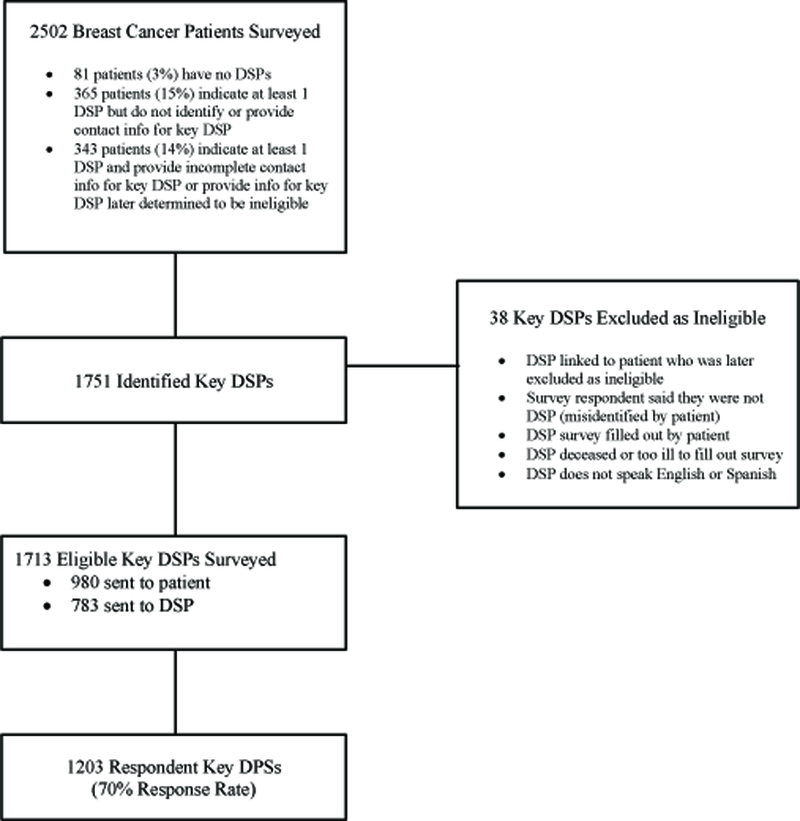
2502 patients (68% RR) and 1203 eligible DSPs (70% RR) responded. Most DSPs were husbands/partners or daughters, white, and college graduates. Husbands/partners were more likely to be more informed, involved, and aware (all p<0.001). English- and Spanish-speaking Latinos had higher extent of (p 0.017), but lower satisfaction with involvement (p<0.001). A highly informed DSP was associated with higher odds of patient-reported subjective decision quality (OR 1.46; 95% CI 1.03–2.08, p=0.03). A highly aware DSP was associated with higher odds of patient-reported deliberation (OR 1.83; 95% CI 1.36–2.47, p<.001).
Conclusions:
In this population-based study, informal DSPs were engaged with and positively contributed to patients’ treatment decision making. To improve decision quality, future interventions should incorporate DSPs.
-
Subjects:
-
Source:Cancer. 125(10):1709-1716
-
Pubmed ID:30633326
-
Pubmed Central ID:PMC6486440
-
Document Type:
-
Funding:HHSN261201000140C/CA/NCI NIH HHS/United States ; HHSN261201000035C/CA/NCI NIH HHS/United States ; HHSN261201300015C/RC/CCR NIH HHS/United States ; HHSN261201000035I/CA/NCI NIH HHS/United States ; HHSN261201000034C/CA/NCI NIH HHS/United States ; U58 DP003862/DP/NCCDPHP CDC HHS/United States ; K07 CA196752/CA/NCI NIH HHS/United States ; P01 CA163233/CA/NCI NIH HHS/United States ; U58 DP003875/DP/NCCDPHP CDC HHS/United States
-
Place as Subject:
-
Volume:125
-
Issue:10
-
Collection(s):
-
Main Document Checksum:urn:sha256:e300b38a15ef08d3fc9d217c6ff0760e41aa92ef7d68247b699ac23fae1801ee
-
Download URL:
-
File Type:
 [PDF
- 165.62 KB
]
[PDF
- 165.62 KB
]
Supporting Files


File Language:
English
ON THIS PAGE

CDC STACKS serves as an archival repository of CDC-published products including
scientific findings,
journal articles, guidelines, recommendations, or other public health information authored or
co-authored by CDC or funded partners.
As a repository, CDC STACKS retains documents in their original published format to ensure public access to scientific information.
As a repository, CDC STACKS retains documents in their original published format to ensure public access to scientific information.
You May Also Like
COLLECTION
CDC Public Access