


Implementation and Evaluation of Guillain-Barré Syndrome Surveillance in Puerto Rico during the 2016 Zika Virus Epidemic
Supporting Files
Public Domain

-
December 2018
-
File Language:
English
Details
-
Alternative Title:P R Health Sci J
-
Personal Author:Major, Chelsea G. ; Dirlikov, Emilio ; Medina, Nicole A. ; Lugo-Robles, Roberta ; Matos, Desiree ; Muñoz-Jordán, Jorge ; Colón-Sánchez, Candimar ; García-Negrón, Myriam ; Olivero-Segarra, Marangely ; Malavé-González, Graciela ; Thomas, Dana L. ; Luciano, Carlos A. ; Waterman, Stephen H. ; Sejvar, James ; Sharp, Tyler M. ; Rivera-García, Brenda
-
Description:Objective:
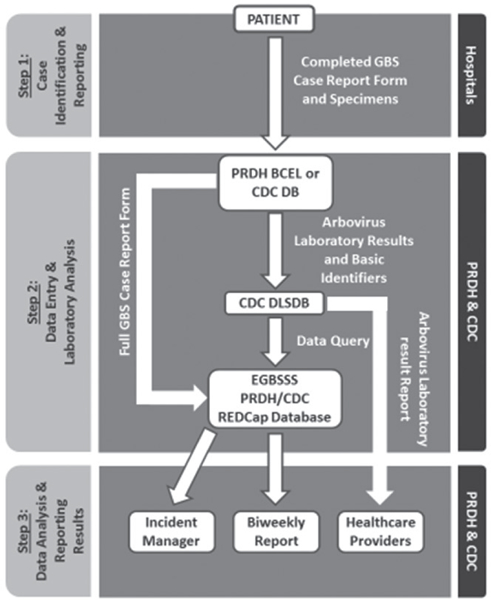
Guillain-Barré syndrome (GBS) is an uncommon autoimmune disorder that follows infection or vaccination, and increased incidence has been reported during Zika virus (ZIKV) transmission. During the 2016 ZIKV epidemic, the Puerto Rico Department of Health (PRDH) implemented the Enhanced GBS Surveillance System (EGBSSS). Here, we describe EGBSSS implementation and evaluate completeness, validity, and timeliness.
Methods:
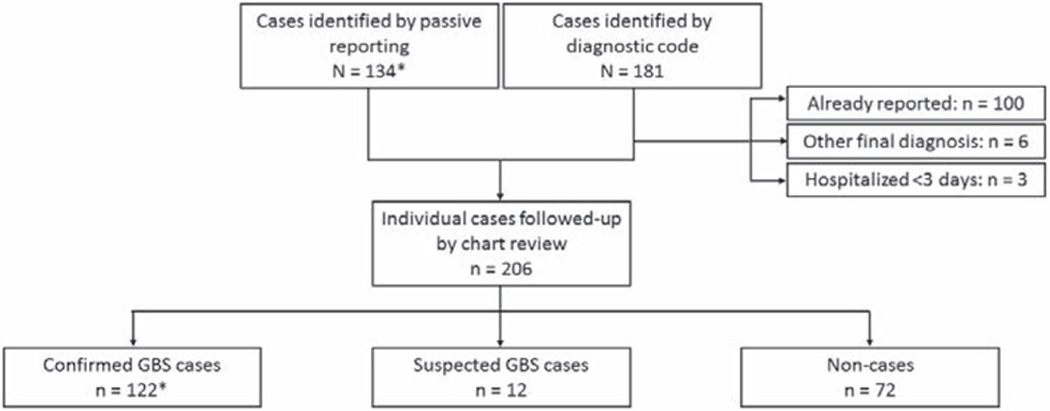
GBS cases were identified using passive surveillance and discharge diagnostic code for GBS. Completeness was evaluated by capture-recapture methods. Sensitivity and positive predictive value (PPV) for confirmed GBS cases were calculated for both case identification methods. Median time to completion of key time steps were compared by quarter (Q1–4) and hospital size.
Results:
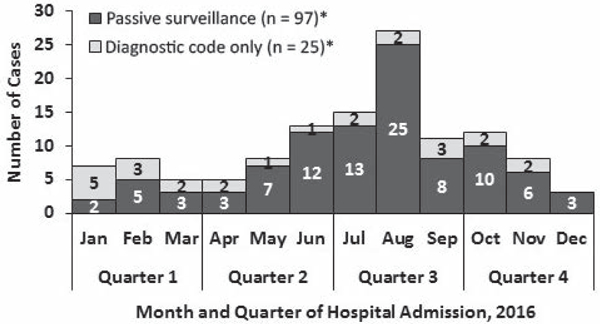
A total of 122 confirmed GBS cases with onset of neurologic illness in 2016 were identified. Capture-recapture methodology estimated that four confirmed GBS cases were missed by both identification methods. Identification of cases by diagnostic code had a higher sensitivity than passive surveillance (89% vs. 80%), but a lower PPV (60% vs. 72%). There was a significant decrease from Q1 to Q3 in median time from hospital admission to case reporting (11 days vs. 2 days, p = 0.032) and from Q2 to Q3 in median time from specimen receipt to arbovirus laboratory test reporting (35 days vs. 26 days, p = 0.004).
Conclusion:
EGBSSS provided complete, valid, and increasingly timely surveillance data, which guided public health action and supported healthcare providers during the ZIKV epidemic. This evaluation provides programmatic lessons for GBS surveillance and emergency response surveillance. [P R Health Sci J 2018;37(Special Issue):S85-S92]
-
Subjects:
-
Source:P R Health Sci J. 37(Spec Issue):S85-S92
-
Document Type:
-
Place as Subject:
-
Volume:37
-
Collection(s):
-
Main Document Checksum:urn:sha-512:d1b57e52c4cebafe78dac20d45c2ea94238dd0020c496b6ee9c328e76f7ed4ed1cc90f388bc2b498f51a3dc37127f8ef6c0e76d063c1ca8328632b68c577f532
-
Download URL:
-
File Type:
 [PDF
- 257.45 KB
]
[PDF
- 257.45 KB
]
Supporting Files


File Language:
English
ON THIS PAGE





CDC STACKS serves as an archival repository of CDC-published products including
scientific findings,
journal articles, guidelines, recommendations, or other public health information authored or
co-authored by CDC or funded partners.
As a repository, CDC STACKS retains documents in their original published format to ensure public access to scientific information.
As a repository, CDC STACKS retains documents in their original published format to ensure public access to scientific information.
You May Also Like
COLLECTION
CDC Public Access