



Gender, depression, and blue-collar work: A retrospective cohort study of U.S. aluminum manufacturers
Supporting Files

-
May 2019
-
Available in CDC Stacks on 2020-05-01T00:00:00Z
File Language:
English
Details
-
Journal Article:Epidemiology
-
Personal Author:
-
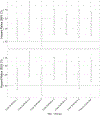
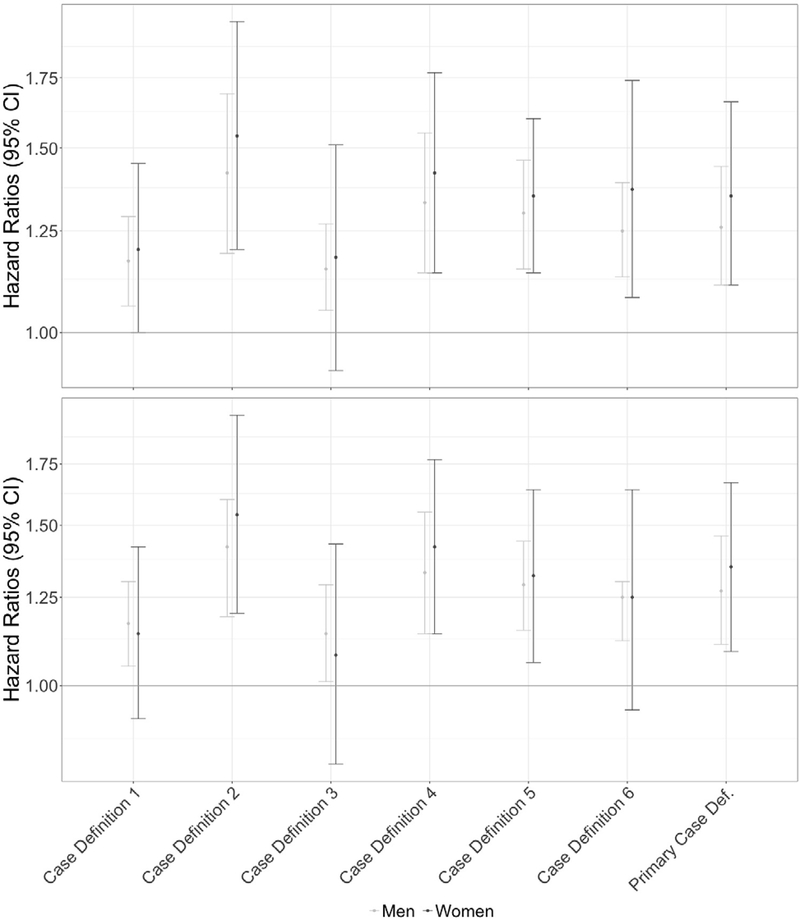
Description:Background: ; Industrial blue-collar workers face multiple work-related stressors, but evidence regarding the burden of mental illness among today’s blue-collar men and women remains limited. ; Methods: ; In this retrospective cohort study, we examined health and employment records for 37,183 blue- and white-collar workers employed by a single U.S. aluminum manufacturer from 2003 – 2013. Using Cox proportional hazards regression, we modeled time to first episode of treated depression by gender and occupational class. Among cases, we modeled rates of depression-related service utilization with generalized gamma regression. ; Results: ; Compared with their white-collar counterparts, blue-collar men were more likely to be treated for depression (HR = 1.3, 95% CI 1.1 – 1.4) as were blue-collar women (HR = 1.4, 1.2 – 1.6). Blue-collar women were most likely to be treated for depression as compared with white-collar men (HR = 3.2, 95% CI 2.1 – 5.0). However, blue-collar workers used depression-related services less frequently than their white-collar counterparts among both men (RR = 0.91, 95% CI 0.84 – 0.98) and women (RR = 0.82, 95% CI 0.77 – 0.88). ; Conclusion: ; Blue-collar women were most likely to be treated for depression compared with white-collar workers, and blue-collar women were most likely to be treated for depression compared with white-collar men. However, blue-collar men and women used depression-related healthcare services less frequently than white-collar workers. These findings underscore that blue-collar women may be uniquely susceptible to depression, and suggest that blue-collar workers may encounter barriers to care-seeking related mental illness other than their insurance status.
-
Subjects:
-
Source:Epidemiology. 30(3):435-444
-
DOI:
-
Pubmed ID:30964814
-
Pubmed Central ID:PMC6461367
-
Document Type:
-
Funding:
-
Genre:
-
Volume:30
-
Issue:3
-
Download URL:
-
File Type:
 [PDF - 274.11 KB]
 -
Collection(s):
-
Main Document Checksum:urn:sha-512:edbe8287fdf9a9f43e2b15fcc11446e82816647f05089071429ae2af01e960347d8acad149dd4d081f36b9eacdb5292b698b1ef3dedbb542de0cd7a65396d14c
Supporting Files


File Language:
English
 Was this page helpful?
 Found an issue?

CDC STACKS serves as an archival repository of CDC-published products including
scientific findings, journal articles, guidelines, recommendations, or other public health information authored or
co-authored by CDC or funded partners.
As a repository, CDC STACKS retains documents in their original published format to ensure public access to scientific information.
As a repository, CDC STACKS retains documents in their original published format to ensure public access to scientific information.
You May Also Like
COLLECTION
CDC Public Access