


Concordance analysis between different methodologies used for identification of oral isolates of Candida species
Supporting Files
Public Domain

-
September 30 2018
-
File Language:
English
Details
-
Journal Article:Colomb Med (Cali)
-
Personal Author:
-
Description:Background:
The yeasts species determination is fundamental not only for an accurate diagnosis but also for establishing a suitable patient treatment. We performed a concordance study of five methodologies for the species identification of oral isolates of Candida in Colombia.
Methods:
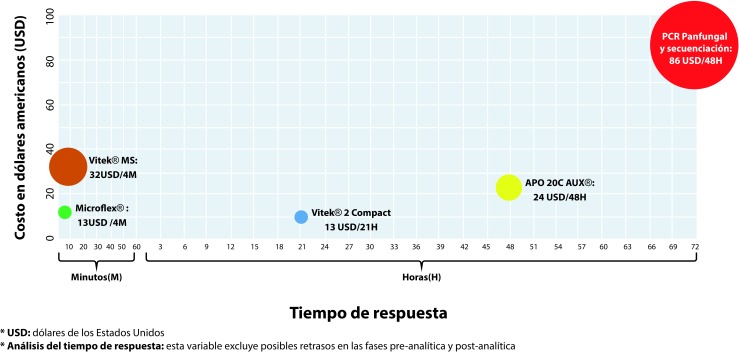
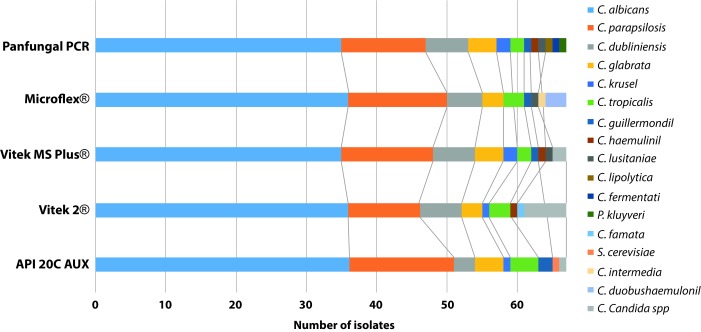
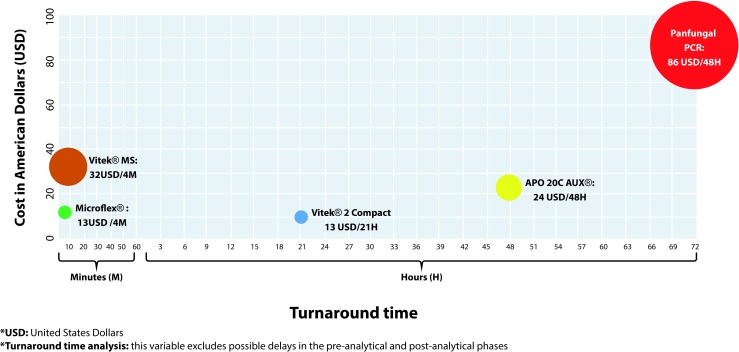
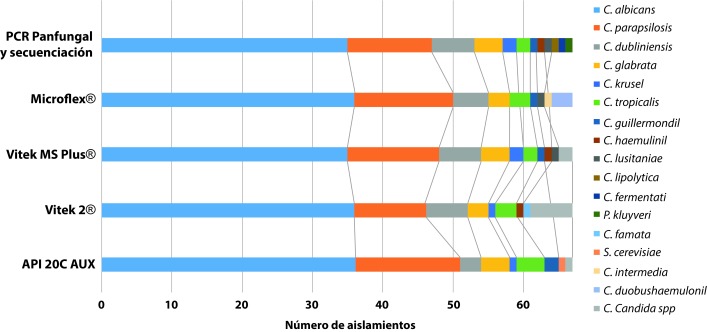
Sixty-seven Candida isolates were tested by; API® 20C-AUX, Vitek®2 Compact, Vitek®MS, Microflex® and a molecular test (panfungal PCR and sequencing). The commercial cost and processing time of the samples was done by graphical analysis.
Results:
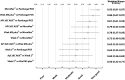
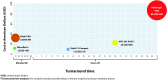
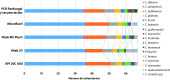
Panfungal PCR differentiated 12 species of Candida, Vitek®MS and Microflex® methods identified 9 species, and API® 20C-AUX and Vitek®2 Compact methods identified 8 species each. Weighted Kappa (wK) showed a high agreement between Panfungal PCR, Vitek®MS, Microflex® and API® 20C-AUX (wK 0.62-0.93). The wK that involved the Vitek®2 Compact method presented moderate or good concordances compared with the other methods (wK 0.56-0.73). Methodologies based on MALDI TOF MS required 4 minutes to generate results and the Microflex® method had the lowest selling price.
Conclusion:
The methods evaluated showed high concordance in their results, being higher for the molecular methods and the methodologies based on MALDI TOF. The latter are faster and cheaper, presenting as promising alternatives for the routine identification of yeast species of the genus Candida.
-
Subjects:
-
Source:Colomb Med (Cali). 2018; 49(3):193-200
-
DOI:
-
Pubmed ID:30410193
-
Pubmed Central ID:PMC6220485
-
Document Type:
-
Genre:
-
Volume:49
-
Issue:3
-
Collection(s):
-
Main Document Checksum:urn:sha-512:93c1d80fdfda340ecbc5d45ad8405e647426c931f704b42b8c41ec21430fc325b1c48d354306eb39389031c3f0490c7b98ebcd7fdd5574864d07156dd732614e
-
Download URL:
-
File Type:
 [PDF
- 399.77 KB
]
[PDF
- 399.77 KB
]
Supporting Files


File Language:
English
ON THIS PAGE




CDC STACKS serves as an archival repository of CDC-published products including
scientific findings,
journal articles, guidelines, recommendations, or other public health information authored or
co-authored by CDC or funded partners.
As a repository, CDC STACKS retains documents in their original published format to ensure public access to scientific information.
As a repository, CDC STACKS retains documents in their original published format to ensure public access to scientific information.
You May Also Like
COLLECTION
CDC Public Access