



Babesia divergens–like Infection, Washington State
Supporting Files
Public Domain

-
Apr 2004
File Language:
English
Details
-
Alternative Title:Emerg Infect Dis
-
Personal Author:
-
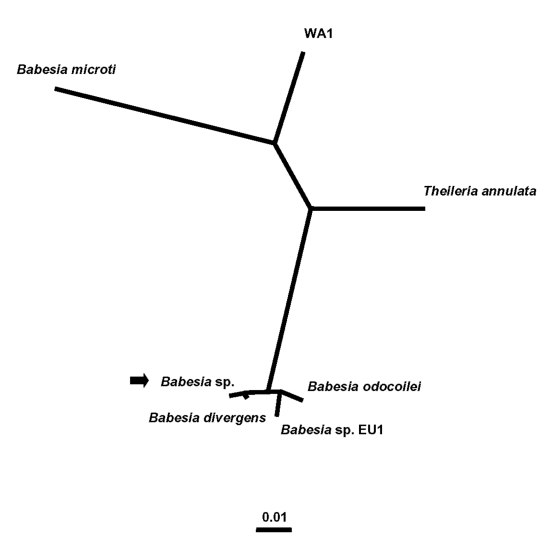
Description:Most reported U.S. zoonotic cases of babesiosis have occurred in the Northeast and been caused by Babesia microti. In Washington State, three cases of babesiosis have been reported previously, which were caused by WA1 (for "Washington 1")-type parasites. We investigated a case of babesiosis in Washington in an 82-year-old man whose spleen had been removed and whose parasitemia level was 41.4%. The complete 18S ribosomal RNA gene of the parasite was amplified from specimens of his whole blood by polymerase chain reaction. Phylogenetic analysis showed the parasite is most closely related, but not identical, to B. divergens (similarity score, 99.5%), a bovine parasite in Europe. By indirect fluorescent-antibody testing, his serum reacted to B. divergens but not to B. microti or WA1 antigens. This case demonstrates that babesiosis can be caused by novel parasites detectable by manual examination of blood smears but not by serologic or molecular testing for B. microti or WA1-type parasites.
-
Subjects:
-
Source:Emerg Infect Dis. 10(4):622-629.
-
Document Type:
-
Place as Subject:
-
Location:
-
Volume:10
-
Issue:4
-
Download URL:
-
File Type:
 [PDF - 265.90 KB]
 -
Collection(s):
-
Main Document Checksum:urn:sha256:6505c698f35690613afbb2cd9423182eaa5f5dea0b6e7ffdb5d9a3d5635f30e6
Supporting Files


File Language:
English
 Was this page helpful?
 Found an issue?

CDC STACKS serves as an archival repository of CDC-published products including
scientific findings, journal articles, guidelines, recommendations, or other public health information authored or
co-authored by CDC or funded partners.
As a repository, CDC STACKS retains documents in their original published format to ensure public access to scientific information.
As a repository, CDC STACKS retains documents in their original published format to ensure public access to scientific information.
You May Also Like
COLLECTION
Emerging Infectious Diseases