



Myelodysplastic Syndrome and Acute Myeloid Leukemia Following Use of Granulocyte Colony-Stimulating Factors in Older Non-Hodgkin Lymphoma Patients
Supporting Files

-
December 12 2018
-
File Language:
English
Details
-
Alternative Title:Cancer
-
Personal Author:
-
Description:Background
Granulocyte colony-stimulating factors(G-CSF), used for prevention of complications from chemotherapy-related neutropenia, are linked to risk of developing second primary myelodysplastic syndrome and acute myeloid leukemia(MDS/AML). Our purpose was to examine the relationship between use of a specific G-CSF agent and risk of MDS/AML among older patients with non-Hodgkin lymphoma(NHL).
Methods
We conducted a retrospective cohort study of adults aged >65 years with first primary NHL between 2001–2011, using the Surveillance Epidemiology and End Results-Medicare linked database. We estimated adjusted hazard ratios(HR) and 95% confidence intervals(CI) for MDS/AML risk associated with G-CSF(filgrastim and pegfilgrastim) use in Cox proportional hazards models stratified by treatment accounting for confounding by indication.
Results
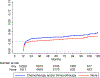
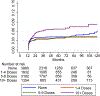
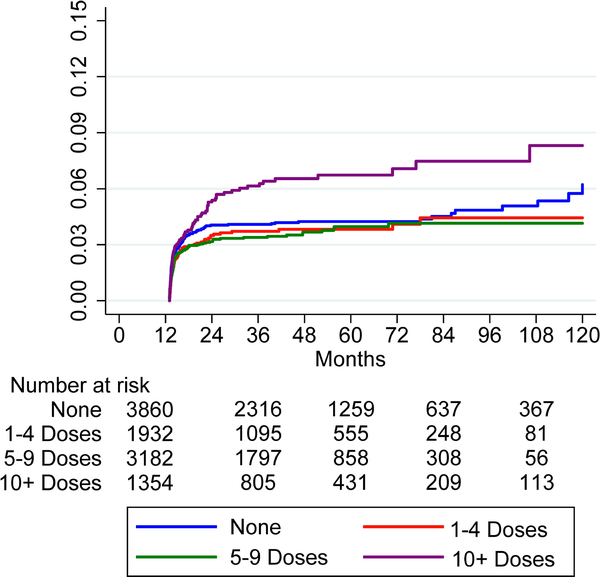
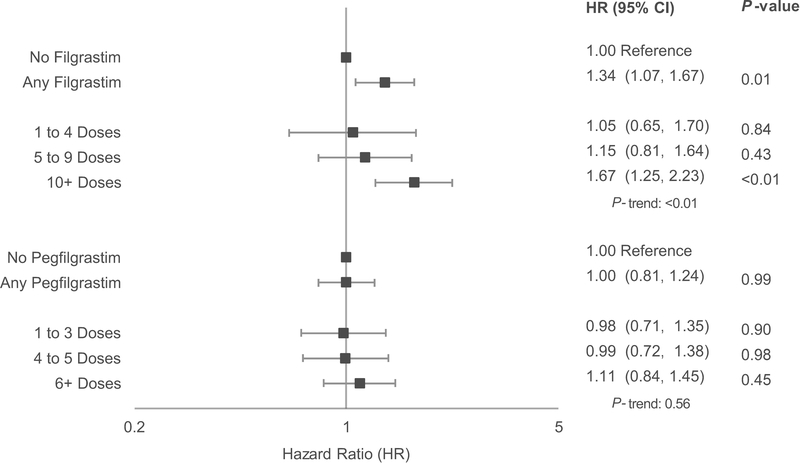
Among 18,245 NHL patients with median follow up of 3.5 years, 56% received chemotherapy and/or immunotherapy, and G-CSF was most commonly used in those receiving rituximab plus multiple chemotherapy regimens(77%). Subsequent MDS/AML diagnoses were identified in 666(3.7%) patients. We observed modest increased risk of MDS/AML with use of G-CSF(HR=1.28, 95% CI 1.01–1.62) and a trend with increasing doses(P-trend <0.01). When analyzing specific agents, increased MDS/AML risk was consistently observed with filgrastim(10+ doses: HR=1.67, 95% CI 1.25–2.23), but not pegfilgrastim(10+ doses: HR=1.11, 95% CI 0.84–1.45).
Conclusions
We found higher MDS/AML risk among those receiving G-CSF that was specific to the use of filgrastim(≥10 doses), but not pegfilgrastim. Neutropenia prophylaxis is an essential component of highly effective NHL treatment regimens. Differential risk related to the type of G-CSF agents used warrants further study given their increasing use and newly available FDA-approved biosimilar products.
-
Subjects:
-
Source:Cancer. 125(7):1143-1154
-
Pubmed ID:30548485
-
Pubmed Central ID:PMC6420387
-
Document Type:
-
Funding:HHSN261201000035C/CA/NCI NIH HHS/United States ; R21 MD011439/MD/NIMHD NIH HHS/United States ; HHSN261201000035I/CA/NCI NIH HHS/United States ; UL1 TR002003/TR/NCATS NIH HHS/United States ; HHSN261201000034C/CA/NCI NIH HHS/United States ; HHSN261201000140C/CA/NCI NIH HHS/United States ; KL2 TR002002/TR/NCATS NIH HHS/United States ; U58 DP003862/DP/NCCDPHP CDC HHS/United States ; KL2 TR000048/TR/NCATS NIH HHS/United States
-
Name as Subject:
-
Place as Subject:
-
Volume:125
-
Issue:7
-
Collection(s):
-
Main Document Checksum:urn:sha256:66af518cf0ce5cdf860a5e71e4f5dd5331378380f3b7f6f248b96f8fecd8e9ad
-
Download URL:
-
File Type:
 [PDF
- 602.84 KB
]
[PDF
- 602.84 KB
]
Supporting Files


File Language:
English
 Was this page helpful?
 Found an issue?


CDC STACKS serves as an archival repository of CDC-published products including
scientific findings,
journal articles, guidelines, recommendations, or other public health information authored or
co-authored by CDC or funded partners.
As a repository, CDC STACKS retains documents in their original published format to ensure public access to scientific information.
As a repository, CDC STACKS retains documents in their original published format to ensure public access to scientific information.
You May Also Like
COLLECTION
CDC Public Access