



Genetic modifiers of radon induced lung cancer risk - A genome-wide interaction study in former uranium miners
Supporting Files

-
11 2018 ; 11-2018
-
Available in CDC Stacks on November 01, 2019, 12:00 AM
File Language:
English
Details
-
Alternative Title:Int Arch Occup Environ Health
-
Personal Author:Rosenberger, Albert
 ;
Hung, Rayjean J
;
Christiani, David C
;
Caporaso, Neil E
;
Liu, Geoffrey
;
Bojesen, Stig E
;
Marchand, Loic Le
;
Haiman, Ch. A.
;
Albanes, Demetrios
;
Aldrich, Melinda C
;
Tardon, Adonina
;
Fernández-Tardón, G.
;
Rennert, Gad
;
Field, John K
;
Kiemeney, B.
;
Lazarus, Philip
;
Haugen, Aage
;
Zienolddiny, Shanbeh
;
Lam, Stephen
;
Schabath, Matthew B
;
Andrew, Angeline S
;
Brunnsstöm, Hans
;
Goodman, Gary E
;
Doherty, Jennifer A
;
Chen, Chu
;
Teare, M Dawn
;
Wichmann, H-Erich
;
Manz, Judith
;
Risch, Angela
;
Muley, Thomas R
;
Johansson, Mikael
;
Brennan, Paul
;
Landi, Maria Teresa
;
Amos, Christopher I
;
Pesch, Beate
;
Johnen, Georg
;
Brüning, Thomas
;
Bickeböller, Heike
;
Gomolka, Maria
;
Hung, Rayjean J
;
Christiani, David C
;
Caporaso, Neil E
;
Liu, Geoffrey
;
Bojesen, Stig E
;
Marchand, Loic Le
;
Haiman, Ch. A.
;
Albanes, Demetrios
;
Aldrich, Melinda C
;
Tardon, Adonina
;
Fernández-Tardón, G.
;
Rennert, Gad
;
Field, John K
;
Kiemeney, B.
;
Lazarus, Philip
;
Haugen, Aage
;
Zienolddiny, Shanbeh
;
Lam, Stephen
;
Schabath, Matthew B
;
Andrew, Angeline S
;
Brunnsstöm, Hans
;
Goodman, Gary E
;
Doherty, Jennifer A
;
Chen, Chu
;
Teare, M Dawn
;
Wichmann, H-Erich
;
Manz, Judith
;
Risch, Angela
;
Muley, Thomas R
;
Johansson, Mikael
;
Brennan, Paul
;
Landi, Maria Teresa
;
Amos, Christopher I
;
Pesch, Beate
;
Johnen, Georg
;
Brüning, Thomas
;
Bickeböller, Heike
;
Gomolka, Maria
-
Description:Purpose
Radon is a risk factor for lung cancer and uranium miners are more exposed than the general population. A genome-wide interaction analysis was carried out to identify genomic loci, genes or gene sets that modify the susceptibility to lung cancer given occupational exposure to the radioactive gas radon.
Methods
Samples from 28 studies provided by the International Lung Cancer Consortium were pooled with samples of former uranium miners collected by the German Federal Office of Radiation Protection. In total 15,077 cases and 13,522 controls, all of European ancestries, comprising 463 uranium miners were compared. The DNA of all participants was genotyped with the OncoArray. We fitted single-marker and in multi-marker models and performed an exploratory gene-set analysis to detect cumulative enrichment of significance in sets of genes.
Results
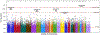
We discovered a genome-wide significant interaction of the marker rs12440014 within the gene CHRNB4 (OR=0.26, 95%.CI: 0.11–0.60, p=0.0386 corrected for multiple testing). At least suggestive significant interaction of linkage disequilibrium blocks was observed at the chromosomal regions 18q21.23 (p=1.2×10⁻⁶), 5q23.2 (p=2.5×10⁻⁶), 1q21.3 (p=3.2×10⁻⁶), 10p13 (p=1.3×10⁻⁵) and 12p12.1 (p=7.1×10⁻⁵). Genes belonging to the Gene Ontology term „DNA dealkylation involved in DNA repair” (GO:0006307; p=0.0139) or the gene-family HGNC:476 „microRNAs” (p=0.0159) were enriched with LD-block-wise significance.
Conclusion
The well-established association of the genomic region 15q25 to lung cancer might be influenced by exposure to radon among uranium miners. Further, lung cancer susceptibility is related to the functional capability of DNA damage signalling via ubiquitination processes and repair of radiation-induced double-strand breaks by the single-strand annealing mechanism. -
Subjects:
- Carcinogens, Environmental
- Case-Control Studies
- DNA Damage
- Female
- Genetic Markers
- Genetic Predisposition to Disease
- Genome-Wide Association Study
- Genotype
- Humans
- Linkage Disequilibrium
- Lung Neoplasms
- Male
- Middle Aged
- Mining
- Neoplasms, Radiation-Induced
- Nerve Tissue Proteins
- Occupational Diseases
- Occupational Exposure
- Radon
- Receptors, Nicotinic
- Risk Factors
- Ubiquitination
- Uranium
-
Keywords:
-
Source:Int Arch Occup Environ Health. 91(8):937-950
-
Pubmed ID:29971594
-
Pubmed Central ID:PMC6375683
-
Document Type:
-
Funding:P20 CA090578/CA/NCI NIH HHSUnited States/ ; R01 DE013158/DE/NIDCR NIH HHSUnited States/ ; K07 CA172294/CA/NCI NIH HHSUnited States/ ; P50 CA119997/CA/NCI NIH HHSUnited States/ ; P30 CA076292/CA/NCI NIH HHSUnited States/ ; P50 CA090578/CA/NCI NIH HHSUnited States/ ; 001/WHO_/World Health OrganizationInternational/ ; UM1 CA167462/CA/NCI NIH HHSUnited States/ ; R01 CA111703/CA/NCI NIH HHSUnited States/ ; U19 CA148127/CA/NCI NIH HHSUnited States/ ; UL1 TR000445/TR/NCATS NIH HHSUnited States/ ; R01 CA092824/CA/NCI NIH HHSUnited States/ ; R35 CA197449/CA/NCI NIH HHSUnited States/ ; P01 CA068384/CA/NCI NIH HHSUnited States/ ; T42 OH008416/OH/NIOSH CDC HHSUnited States/ ; U01 CA167462/CA/NCI NIH HHSUnited States/ ; U19 CA203654/CA/NCI NIH HHSUnited States/ ; P20 RR018787/RR/NCRR NIH HHSUnited States/ ; S10 RR025141/RR/NCRR NIH HHSUnited States/ ; R01 CA074386/CA/NCI NIH HHSUnited States/ ; U01 HG004798/HG/NHGRI NIH HHSUnited States/ ; R01 CA151989/CA/NCI NIH HHSUnited States/
-
Volume:91
-
Issue:8
-
Download URL:
-
File Type:
 [PDF - 494.91 KB]
 -
Collection(s):
-
Main Document Checksum:urn:sha-512:a0f3c77faf14eb886cc3535e8832ca969e5598ba653e6c7a8f7af34b0c67d4b54a31801b8d1a6046205ace795301487212444d5cda444bd44cb7e0a4f34c8812
Supporting Files


File Language:
English
 Was this page helpful?
 Found an issue?


CDC STACKS serves as an archival repository of CDC-published products including
scientific findings, journal articles, guidelines, recommendations, or other public health information authored or
co-authored by CDC or funded partners.
As a repository, CDC STACKS retains documents in their original published format to ensure public access to scientific information.
As a repository, CDC STACKS retains documents in their original published format to ensure public access to scientific information.
You May Also Like
COLLECTION
CDC Public Access