



Reassortments among Avian Influenza A(H5N1) Viruses Circulating in Indonesia, 2015–2016
Supporting Files
Public Domain

-
Mar 2019
File Language:
English
Details
-
Alternative Title:Emerg Infect Dis
-
Personal Author:Karo-karo, Desniwaty ; Bodewes, Rogier ; Wibawa, Hendra ; Artika, Made ; Pribadi, Eko Sugeng ; Diyantoro, D. ; Pratomo, Widya ; Sugama, Agus ; Hendrayani, Nani ; Indasari, Iin ; Wibowo, Michael Haryadi ; Muljono, David Handojo ; Stegeman, Jan Arend ; Koch, Guus
-
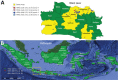
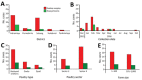
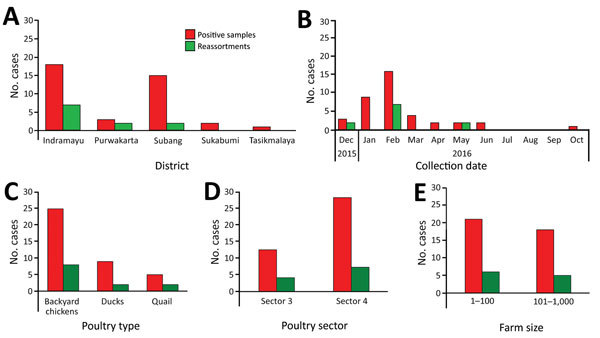
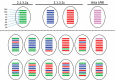
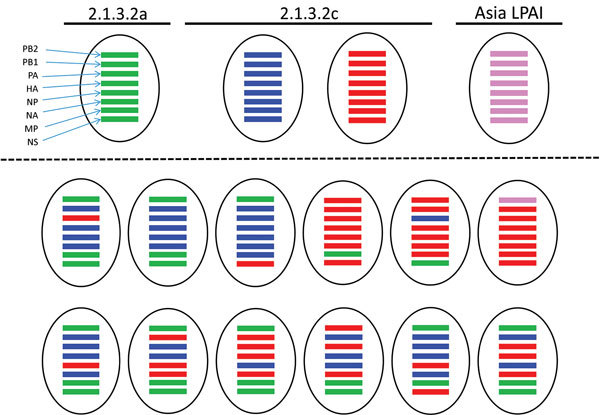
Description:Highly pathogenic avian influenza (HPAI) A(H5N1) viruses have been circulating since 2003 in Indonesia, with major impacts on poultry health, severe economic losses, and 168 fatal laboratory-confirmed human cases. We performed phylogenetic analysis on 39 full-genome H5N1 virus samples collected during outbreaks among poultry in 2015-2016 in West Java and compared them with recently published sequences from Indonesia. Phylogenetic analysis revealed that the hemagglutinin gene of all samples belonged to 2 genetic groups in clade 2.3.2.1c. We also observed these groups for the neuraminidase, nucleoprotein, polymerase, and polymerase basic 1 genes. Matrix, nonstructural protein, and polymerase basic 2 genes of some HPAI were most closely related to clade 2.1.3 instead of clade 2.3.2.1c, and a polymerase basic 2 gene was most closely related to Eurasian low pathogenicity avian influenza. Our results detected a total of 13 reassortment types among HPAI in Indonesia, mostly in backyard chickens in Indramayu.
-
Subjects:
-
Source:Emerg Infect Dis. 25(3):465-472
-
Pubmed ID:30789142
-
Pubmed Central ID:PMC6390736
-
Document Type:
-
Place as Subject:
-
Location:
-
Volume:25
-
Issue:3
-
Download URL:
-
File Type:
 [PDF - 3.69 MB]
 -
Collection(s):
-
Main Document Checksum:urn:sha256:356b630a18098a6f3f597b3e884db173b7881271e1857c3dbf1b4bacaa9faa10
Supporting Files


File Language:
English
 Was this page helpful?
 Found an issue?


CDC STACKS serves as an archival repository of CDC-published products including
scientific findings, journal articles, guidelines, recommendations, or other public health information authored or
co-authored by CDC or funded partners.
As a repository, CDC STACKS retains documents in their original published format to ensure public access to scientific information.
As a repository, CDC STACKS retains documents in their original published format to ensure public access to scientific information.
You May Also Like
COLLECTION
Emerging Infectious Diseases