


Ethylbenzene and Styrene Exposure in the United States based on Urinary Mandelic Acid and Phenylglyoxylic Acid: NHANES 2005 – 2006 and 2011 – 2012
Supporting Files

-
Jan 10 2019
-
File Language:
English
Details
-
Alternative Title:Environ Res
-
Personal Author:
-
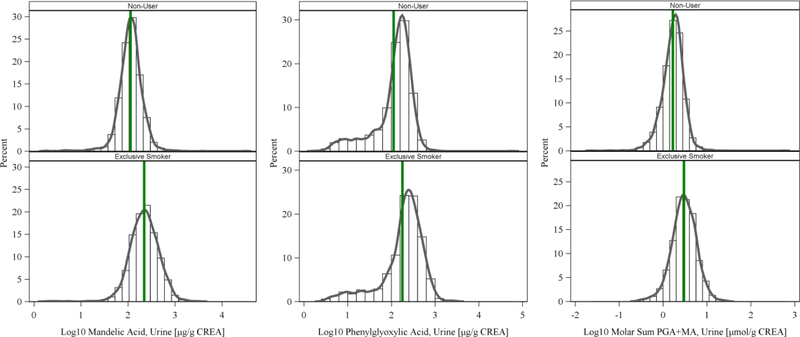
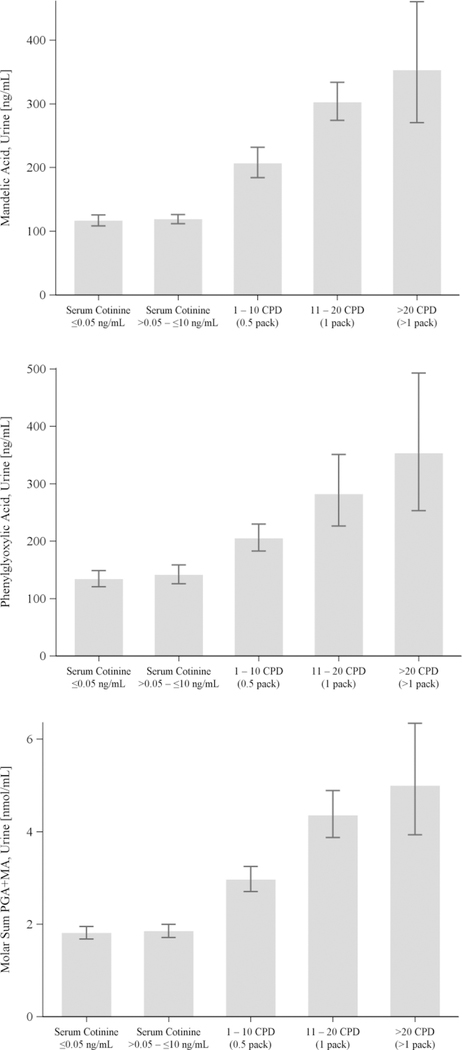
Description:Ethylbenzene and styrene are air toxicants with widespread nonoccupational exposure sources, including tobacco smoke and diet. Ethylbenzene and styrene (EB/S) exposure was quantified from their common metabolites measured in spot urine samples obtained from participants (≥6 years old) in the 2005-2006 and 2011-2012 cycles of the National Health and Nutrition Examination Survey (NHANES; N = 4690). EB/S metabolites mandelic acid (MA) and phenylglyoxylic acid (PGA) were measured using ultra-high performance liquid chromatography coupled with electrospray ionization tandem mass spectrometry (UPLC-ESI-MS/MS). MA and PGA were detected in 98.9% and 90.6% of tested urine specimens, respectively. Exclusive smokers had 2-fold and 1.6-fold higher median urinary MA and PGA, respectively, compared with non-users. Sampleweighted regression analysis among exclusive smokers showed that smoking 0.5 pack cigarettes per day significantly increased MA (+97.9 μg/L) and PGA (+69.3 μg/L), controlling for potential confounders. In comparison, exposure from the median daily dietary intake of grain products increased MA by 1.95 μg/L and was not associated with statistically significant changes in urinary PGA levels. Conversely, consuming vegetables and fruit was associated with decreased MA and PGA. These results confirm tobacco smoke as a major source of ethylbenzene and styrene exposure for the general U.S. population.
-
Subjects:
-
Source:Environ Res. 171:101-110
-
Pubmed ID:30660916
-
Pubmed Central ID:PMC6382531
-
Document Type:
-
Funding:
-
Volume:171
-
Collection(s):
-
Main Document Checksum:urn:sha256:90ca5d0e48d551ae8a0d974cc7234d600293db8ce38d86757fccb85b15721413
-
Download URL:
-
File Type:
 [PDF
- 682.03 KB
]
[PDF
- 682.03 KB
]
Supporting Files


File Language:
English
ON THIS PAGE

CDC STACKS serves as an archival repository of CDC-published products including
scientific findings,
journal articles, guidelines, recommendations, or other public health information authored or
co-authored by CDC or funded partners.
As a repository, CDC STACKS retains documents in their original published format to ensure public access to scientific information.
As a repository, CDC STACKS retains documents in their original published format to ensure public access to scientific information.
You May Also Like
COLLECTION
CDC Public Access