


BMI1 enhancer polymorphism underlies chromosome 10p12.31 association with childhood acute lymphoblastic leukemia
Supporting Files

-
12 01 2018
-
File Language:
English
Details
-
Alternative Title:Int J Cancer
-
Personal Author:de Smith, Adam J. ; Walsh, Kyle M. ; Francis, Stephen S. ; Zhang, Chenan ; Hansen, Helen M. ; Smirnov, Ivan ; Morimoto, Libby ; Whitehead, Todd P. ; Kang, Alice ; Shao, Xiaorong ; Barcellos, Lisa F. ; McKean-Cowdin, Roberta ; Zhang, Luoping ; Fu, Cecilia ; Wang, Rong ; Yu, Herbert ; Hoh, Josephine ; Dewan, Andrew T. ; Metayer, Catherine ; Ma, Xiaomei ; Wiemels, Joseph L.
-
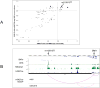
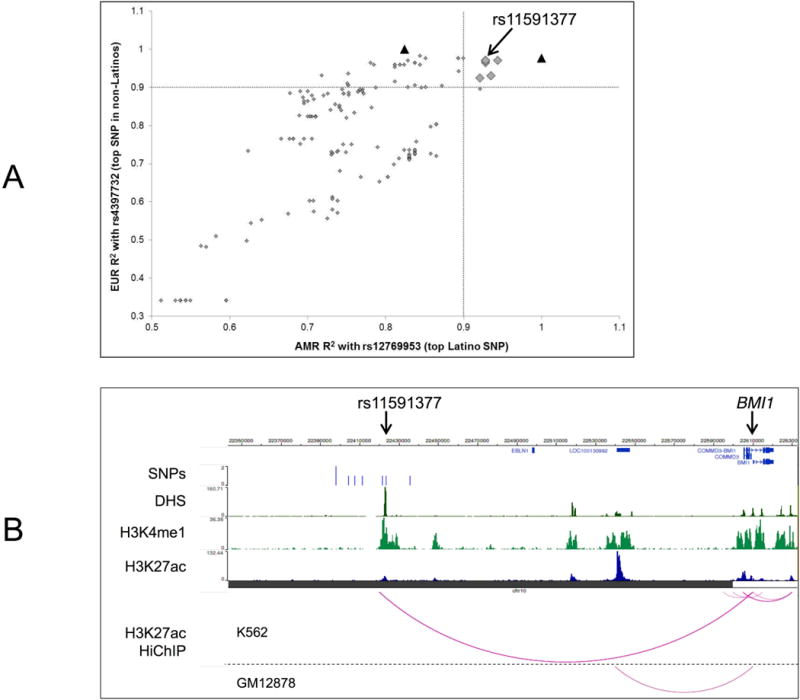
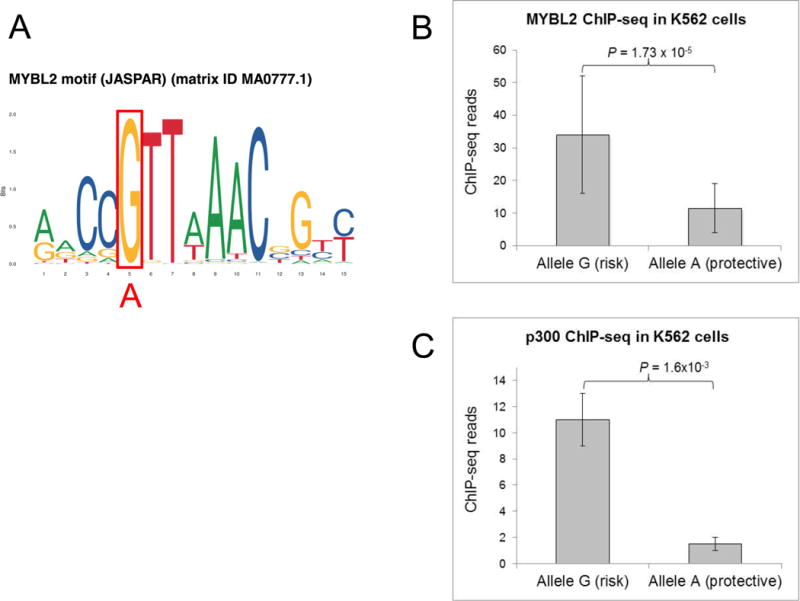
Description:Genome-wide association studies of childhood acute lymphoblastic leukemia (ALL) have identified regions of association at PIP4K2A and upstream of BMI1 at chromosome 10p12.31-12.2. The contribution of both loci to ALL risk and underlying functional variants remain to be elucidated. We carried out single nucleotide polymorphism (SNP) imputation across chromosome 10p12.31-12.2 in Latino and non-Latino white ALL cases and controls from two independent California childhood leukemia studies, and additional Genetic Epidemiology Research on Aging study controls. Ethnicity-stratified association analyses were performed using logistic regression, with meta-analysis including 3,133 cases (1,949 Latino, 1,184 non-Latino white) and 12,135 controls (8,584 Latino, 3,551 non-Latino white). SNP associations were identified at both BMI1 and PIP4K2A. After adjusting for the lead PIP4K2A SNP, genome-wide significant associations remained at BMI1, and vice-versa (p| < 10| ), supporting independent effects. Lead SNPs differed by ethnicity at both peaks. We sought functional variants in tight linkage disequilibrium with both the lead Latino SNP among Admixed Americans and lead non-Latino white SNP among Europeans. This pinpointed rs11591377 (p| = 2.1 x 10| ) upstream of BMI1, residing within a hematopoietic stem cell enhancer of BMI1, and which showed significant preferential binding of the risk allele to MYBL2 (p = 1.73 x 10| ) and p300 (p = 1.55 x 10| ) transcription factors using binomial tests on ChIP-Seq data from a SNP heterozygote. At PIP4K2A, we identified rs4748812 (p| = 1.3 x 10| ), which alters a RUNX1 binding motif and demonstrated chromosomal looping to the PIP4K2A promoter. Fine-mapping chromosome 10p12 in a multi-ethnic ALL GWAS confirmed independent associations and identified putative functional variants upstream of BMI1 and at PIP4K2A.
-
Subjects:
-
Keywords:
-
Source:Int J Cancer. 143(11):2647-2658
-
Pubmed ID:29923177
-
Pubmed Central ID:PMC6235695
-
Document Type:
-
Funding:R24 ES028524/ES/NIEHS NIH HHSUnited States/ ; P01 ES018172/NH/NIH HHSUnited States/ ; R01 CA155461/NH/NIH HHSUnited States/ ; R01 ES009137/NH/NIH HHSUnited States/ ; R01 CA175737/NH/NIH HHSUnited States/ ; R01 CA155461/CA/NCI NIH HHSUnited States/ ; P01 ES018172/ES/NIEHS NIH HHSUnited States/ ; R01 CA175737/CA/NCI NIH HHSUnited States/ ; R01 AG033067/AG/NIA NIH HHSUnited States/ ; U58 DP003862/DP/NCCDPHP CDC HHSUnited States/ ; R01 ES009137/ES/NIEHS NIH HHSUnited States/
-
Volume:143
-
Issue:11
-
Collection(s):
-
Main Document Checksum:urn:sha256:8db936f0cc9ab01093c8a52a60b53a3d553360829b9657292ba7e3ef2e4e5d8a
-
Download URL:
-
File Type:
 [PDF
- 619.20 KB
]
[PDF
- 619.20 KB
]
Supporting Files


File Language:
English
ON THIS PAGE



CDC STACKS serves as an archival repository of CDC-published products including
scientific findings,
journal articles, guidelines, recommendations, or other public health information authored or
co-authored by CDC or funded partners.
As a repository, CDC STACKS retains documents in their original published format to ensure public access to scientific information.
As a repository, CDC STACKS retains documents in their original published format to ensure public access to scientific information.
You May Also Like
COLLECTION
CDC Public Access