


Spectrum of cancer risk among HIV-infected people in the United States during the modern antiretroviral therapy era: a population-based registry linkage study
Supporting Files

-
Aug 10 2017
-
File Language:
English
Details
-
Alternative Title:Lancet HIV
-
Personal Author:
-
Description:Background
Monitoring cancer risk among HIV-infected people in the modern antiretroviral therapy (ART) era is critical given their elevated risk for many cancers and prolonged survival with immunosuppression, ART exposure, and aging. Our study described cancer risk in HIV-infected people in the United States relative to the general population.
Methods
Utilizing data from linked population-based HIV and cancer registries (nine areas; 1996–2012), we calculated standardized incidence ratios (SIRs). We tested SIR differences by AIDS status and over time using Poisson regression.
Findings
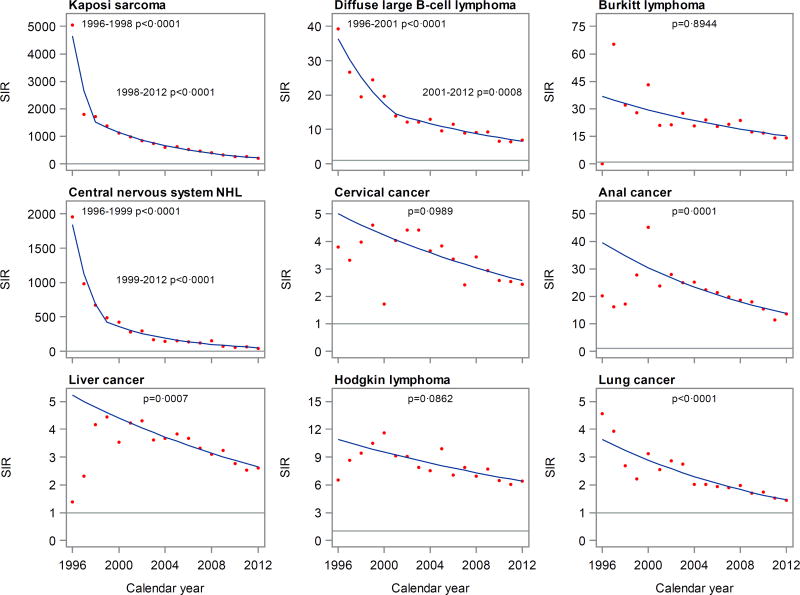
Among 448,258 HIV-infected people, risk was elevated (p<0·0001) for cancer overall (SIR 1·69; 95%CI: 1·67–1·72), AIDS-defining cancers (Kaposi sarcoma [498; 478–519], non-Hodgkin lymphoma [11·5; 11·1–11·9], and cervix [3·24; 2·94–3·56]), most other virus-related cancers (e.g., anus [19·1; 18·1–20·0], liver [3·21; 3·02–3·41], and Hodgkin lymphoma [7·70; 7·20–8·23]), and some virus-unrelated cancers (e.g., lung [1·97; 1·89–2·05]), but not for other common cancers. Risk for several cancers was higher after AIDS onset and declined across calendar periods. After multivariable adjustment, SIRs decreased significantly across 1996–2012 for six cancers (Kaposi sarcoma, two non-Hodgkin lymphoma subtypes, anus, liver, and lung) but remained elevated in the latest period. SIRs did not increase over time for any cancer.
Interpretation
Risks for several virus-related cancers and lung cancer declined among HIV-infected people, likely reflecting ART expansion since 1996. Despite declines, risk for many cancers remain elevated in the modern treatment era.
Funding
National Cancer Institute.
-
Subjects:
-
Source:Lancet HIV. 4(11):e495-e504.
-
Pubmed ID:28803888
-
Pubmed Central ID:PMC5669995
-
Document Type:
-
Funding:U58 DP003931/DP/NCCDPHP CDC HHS/United States ; U62 PS004011/PS/NCHHSTP CDC HHS/United States ; R01 CA165937/CA/NCI NIH HHS/United States ; HHSN261201300019C/CA/NCI NIH HHS/United States ; U58 DP003919/DP/NCCDPHP CDC HHS/United States ; Z01 CP010150-09/NULL/Intramural NIH HHS/United States ; U58 DP003875/DP/NCCDPHP CDC HHS/United States ; U58 DP003868/DP/NCCDPHP CDC HHS/United States ; HHSN261201300021C/CA/NCI NIH HHS/United States ; U58 DP003921/DP/NCCDPHP CDC HHS/United States ; U62 PS001005/PS/NCHHSTP CDC HHS/United States ; U62 PS004001/PS/NCHHSTP CDC HHS/United States ; U58 DP000824/DP/NCCDPHP CDC HHS/United States
-
Place as Subject:
-
Volume:4
-
Issue:11
-
Collection(s):
-
Main Document Checksum:urn:sha256:bff75989332c597f058f7346ed0b03fc54904402e68a0b580974f60b2de19780
-
Download URL:
-
File Type:
 [PDF
- 441.27 KB
]
[PDF
- 441.27 KB
]
Supporting Files


File Language:
English
ON THIS PAGE

CDC STACKS serves as an archival repository of CDC-published products including
scientific findings,
journal articles, guidelines, recommendations, or other public health information authored or
co-authored by CDC or funded partners.
As a repository, CDC STACKS retains documents in their original published format to ensure public access to scientific information.
As a repository, CDC STACKS retains documents in their original published format to ensure public access to scientific information.
You May Also Like
COLLECTION
CDC Public Access