



Human Norovirus Replication in Human Intestinal Enteroids as Model to Evaluate Virus Inactivation
Supporting Files

-
August 2018
-
Series: Emerging Infectious Diseases
File Language:
English
Details
-
Journal Article:Emerging Infectious Diseases
-
Personal Author:
-
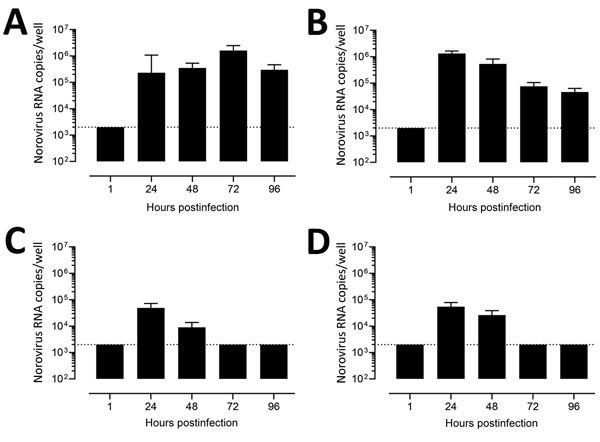
Description:Human noroviruses are a leading cause of epidemic and endemic acute gastroenteritis worldwide and a leading cause of foodborne illness in the United States. Recently, human intestinal enteroids (HIEs) derived from human small intestinal tissue have been shown to support human norovirus replication. We implemented the HIE system in our laboratory and tested the effect of chlorine and alcohols on human norovirus infectivity. Successful replication was observed for 6 norovirus GII genotypes and was dependent on viral load and genotype of the inoculum. GII.4 viruses had higher replication levels than other genotypes. Regardless of concentration or exposure time, alcohols slightly reduced, but did not completely inactivate, human norovirus. In contrast, complete inactivation of the 3 GII.4 viruses occurred at concentrations as low as 50 ppm of chlorine. Taken together, our data confirm the successful replication of human noroviruses in HIEs and their utility as tools to study norovirus inactivation strategies.
-
Subjects:
-
Series:
-
Pubmed ID:30014841
-
Pubmed Central ID:PMC6056096
-
Document Type:
-
Funding:
-
Genre:
-
Rights:Public Domain
-
Volume:24
-
Issue:8
-
Citation:Emerg Infect Dis. 24(8):1453-1464
-
Download URL:
-
File Type:
 [PDF - 3.14 MB]
 -
Collection(s):
-
Main Document Checksum:urn:sha-512:0c8a58c5238651e92340c71e90b95dff263c8c303bf2e09c4ff84089875004b98e0b680bb79d472ce93df3e207cfb6c365d46dc5106d1297460236682215ca0c
Supporting Files


File Language:
English
 Was this page helpful?
 Found an issue?













CDC STACKS serves as an archival repository of CDC-published products including
scientific findings, journal articles, guidelines, recommendations, or other public health information authored or
co-authored by CDC or funded partners.
As a repository, CDC STACKS retains documents in their original published format to ensure public access to scientific information.
As a repository, CDC STACKS retains documents in their original published format to ensure public access to scientific information.
You May Also Like
COLLECTION
Emerging Infectious Diseases