



Susceptibility of Human Prion Protein to Conversion by Chronic Wasting Disease Prions
Supporting Files
Public Domain

-
August 2018
File Language:
English
Details
-
Alternative Title:Emerg Infect Dis
-
Personal Author:
-
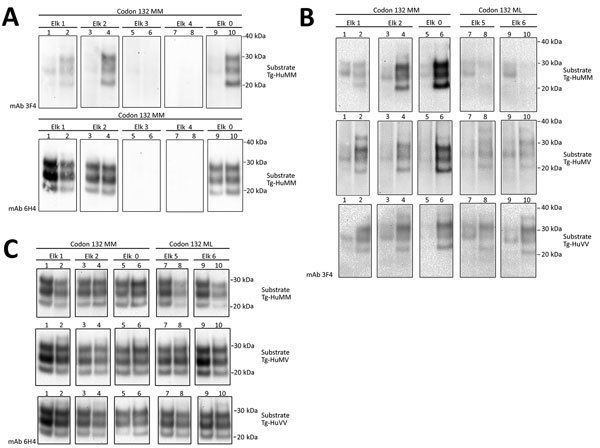
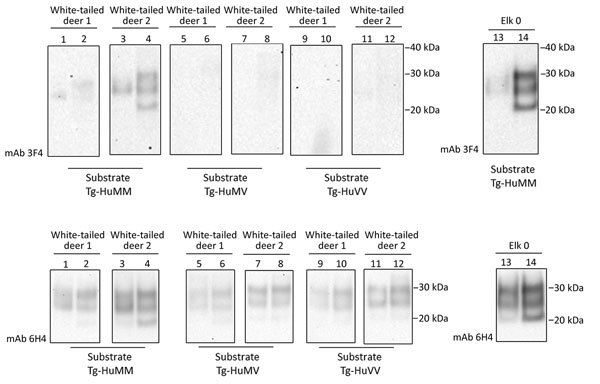
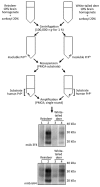
Description:Chronic wasting disease (CWD) is a contagious and fatal neurodegenerative disease and a serious animal health issue for deer and elk in North America. The identification of the first cases of CWD among free-ranging reindeer and moose in Europe brings back into focus the unresolved issue of whether CWD can be zoonotic like bovine spongiform encephalopathy. We used a cell-free seeded protein misfolding assay to determine whether CWD prions from elk, white-tailed deer, and reindeer in North America can convert the human prion protein to the disease-associated form. We found that prions can convert, but the efficiency of conversion is affected by polymorphic variation in the cervid and human prion protein genes. In view of the similarity of reindeer, elk, and white-tailed deer in North America to reindeer, red deer, and roe deer, respectively, in Europe, a more comprehensive and thorough assessment of the zoonotic potential of CWD might be warranted.
-
Subjects:
-
Source:Emerg Infect Dis. 24(8):1482-1489
-
Pubmed ID:30014840
-
Pubmed Central ID:PMC6056132
-
Document Type:
-
Place as Subject:
-
Volume:24
-
Issue:8
-
Download URL:
-
File Type:
 [PDF - 1.51 MB]
 -
Collection(s):
-
Main Document Checksum:urn:sha256:7306024e4583052ccd9b7a6bff0a9735e3a148cb6d8a602ee100b35f164fba94
Supporting Files


File Language:
English
 Was this page helpful?
 Found an issue?





CDC STACKS serves as an archival repository of CDC-published products including
scientific findings, journal articles, guidelines, recommendations, or other public health information authored or
co-authored by CDC or funded partners.
As a repository, CDC STACKS retains documents in their original published format to ensure public access to scientific information.
As a repository, CDC STACKS retains documents in their original published format to ensure public access to scientific information.
You May Also Like
COLLECTION
Emerging Infectious Diseases