


Global Distribution of Human Protoparvoviruses
Supporting Files
Public Domain

-
Jul 2018
-
File Language:
English
Details
-
Alternative Title:Emerg Infect Dis
-
Personal Author:Väisänen, Elina ; Mohanraj, Ushanandini ; Kinnunen, Paula M. ; Jokelainen, Pikka ; Al-Hello, Haider ; Barakat, Ali M. ; Sadeghi, Mohammadreza ; Jalilian, Farid A. ; Majlesi, Amir ; Masika, Moses ; Mwaengo, Dufton ; Anzala, Omu ; Delwart, Eric ; Vapalahti, Olli ; Hedman, Klaus ; Söderlund-Venermo, Maria
-
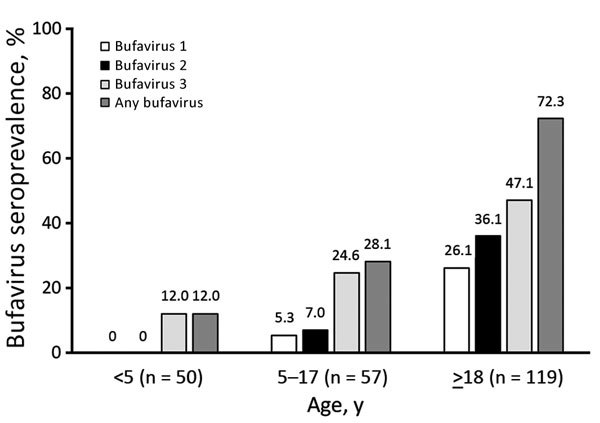
Description:Development of next-generation sequencing and metagenomics has revolutionized detection of novel viruses. Among these viruses are 3 human protoparvoviruses: bufavirus, tusavirus, and cutavirus. These viruses have been detected in feces of children with diarrhea. In addition, cutavirus has been detected in skin biopsy specimens of cutaneous T-cell lymphoma patients in France and in 1 melanoma patient in Denmark. We studied seroprevalences of IgG against bufavirus, tusavirus, and cutavirus in various populations (n = 840), and found a striking geographic difference in prevalence of bufavirus IgG. Although prevalence was low in adult populations in Finland (1.9%) and the United States (3.6%), bufavirus IgG was highly prevalent in populations in Iraq (84.8%), Iran (56.1%), and Kenya (72.3%). Conversely, cutavirus IgG showed evenly low prevalences (0%-5.6%) in all cohorts, and tusavirus IgG was not detected. These results provide new insights on the global distribution and endemic areas of protoparvoviruses.
-
Subjects:
-
Source:Emerg Infect Dis. 24(7):1292-1299.
-
Pubmed ID:29912685
-
Pubmed Central ID:PMC6038761
-
Document Type:
-
Volume:24
-
Issue:7
-
Collection(s):
-
Main Document Checksum:urn:sha256:915e39c7574e53669bb607513b01bb2c7fe3a8af41926c3c80b957c459a3a318
-
Download URL:
-
File Type:
 [PDF
- 1.10 MB
]
[PDF
- 1.10 MB
]
Supporting Files


File Language:
English
ON THIS PAGE



CDC STACKS serves as an archival repository of CDC-published products including
scientific findings,
journal articles, guidelines, recommendations, or other public health information authored or
co-authored by CDC or funded partners.
As a repository, CDC STACKS retains documents in their original published format to ensure public access to scientific information.
As a repository, CDC STACKS retains documents in their original published format to ensure public access to scientific information.
You May Also Like
COLLECTION
Emerging Infectious Diseases