


Genomic Epidemiology of Global Carbapenemase-Producing Enterobacter spp., 2008–2014
Supporting Files
Public Domain

-
Jun 2018
-
File Language:
English
Details
-
Alternative Title:Emerg Infect Dis
-
Personal Author:
-
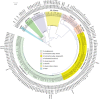
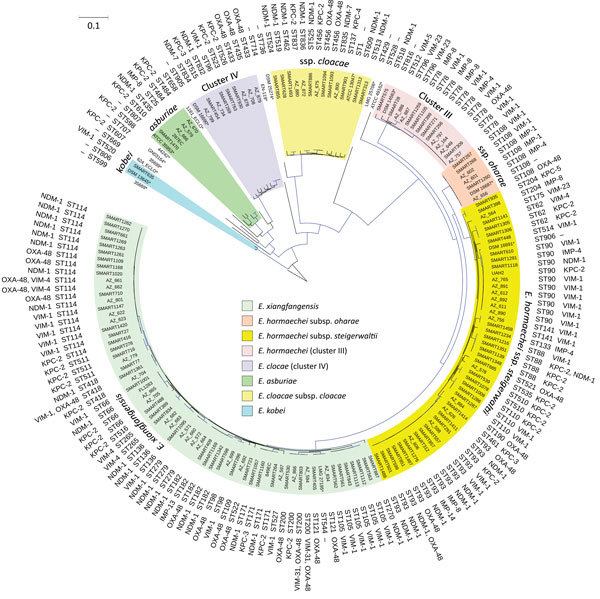
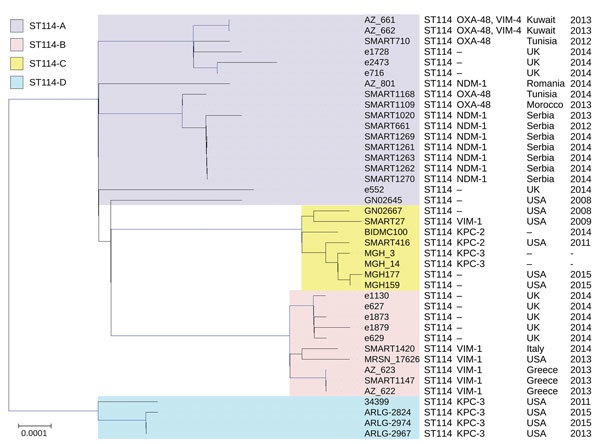
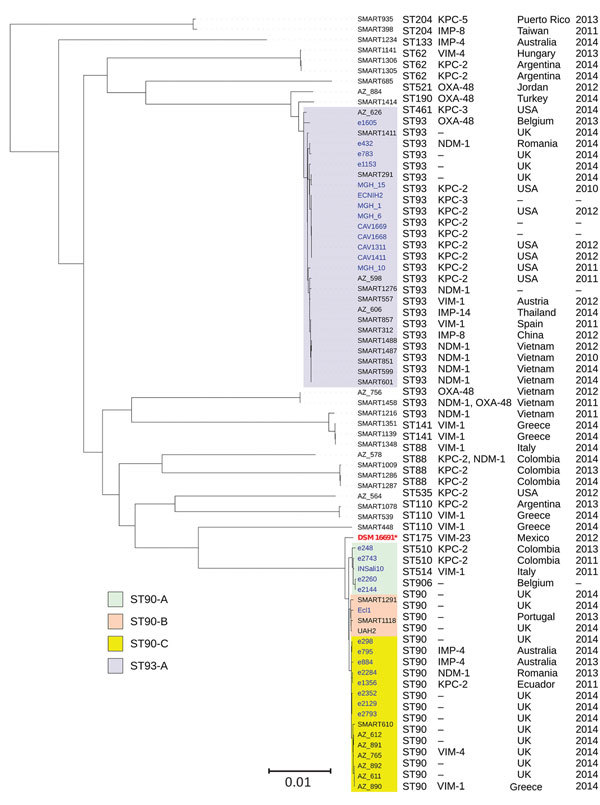
Description:We performed whole-genome sequencing on 170 clinical carbapenemase-producing Enterobacter spp. isolates collected globally during 2008-2014. The most common carbapenemase was VIM, followed by New Delhi metallo-β-lactamase (NDM), Klebsiella pneumoniae carbapenemase, oxacillin 48, and IMP. The isolates were of predominantly 2 species (E. xiangfangensis and E. hormaechei subsp. steigerwaltii) and 4 global clones (sequence type [ST] 114, ST93, ST90, and ST78) with different clades within ST114 and ST90. Particular genetic structures surrounding carbapenemase genes were circulating locally in various institutions within the same or between different STs in Greece, Guatemala, Europe, Spain, Serbia, and Vietnam. We found a common NDM genetic structure (NDM-GE-U.S.), previously described on pNDM-U.S. from Klebsiella pneumoniae ATCC BAA-214, in 14 different clones obtained from 6 countries spanning 4 continents. Our study highlights the importance of surveillance programs using whole-genome sequencing in providing insight into the molecular epidemiology of carbapenemase-producing Enterobacter spp.
-
Subjects:
-
Source:Emerg Infect Dis. 24(6):1010-1019.
-
Pubmed ID:29774858
-
Pubmed Central ID:PMC6004858
-
Document Type:
-
Volume:24
-
Issue:6
-
Collection(s):
-
Main Document Checksum:urn:sha256:43ed64943c2d71fd611b32a54340f4c786f939ac1d1b65b51b6dcd81ec988887
-
Download URL:
-
File Type:
 [PDF
- 5.26 MB
]
[PDF
- 5.26 MB
]
Supporting Files


File Language:
English
ON THIS PAGE


CDC STACKS serves as an archival repository of CDC-published products including
scientific findings,
journal articles, guidelines, recommendations, or other public health information authored or
co-authored by CDC or funded partners.
As a repository, CDC STACKS retains documents in their original published format to ensure public access to scientific information.
As a repository, CDC STACKS retains documents in their original published format to ensure public access to scientific information.
You May Also Like
COLLECTION
Emerging Infectious Diseases