



An assessment of false positive rates for malaria rapid diagnostic tests caused by non-Plasmodium infectious agents and immunological factors
Supporting Files
Public Domain

-
2018/05/14
-
File Language:
English
Details
-
Alternative Title:PLoS One
-
Personal Author:
-
Description:Background
Malaria rapid diagnostic tests (RDTs) can produce false positive (FP) results in patients with human African trypanosomiasis and rheumatoid factor (RF), but specificity against other infectious agents and immunological factors is largely unknown. Low diagnostic specificity caused by cross-reactivity may lead to over-estimates of the number of malaria cases and over-use of antimalarial drugs, at the cost of not diagnosing and treating the true underlying condition.
Methods
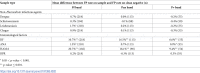
Data from the WHO Malaria RDT Product Testing Programme was analysed to assess FP rates of 221 RDTs against four infectious agents (Chagas, dengue, Leishmaniasis and Schistosomiasis) and four immunological factors (anti-nuclear antibody, human anti-mouse antibody (HAMA), RF and rapid plasma regain). Only RDTs with a FP rate against clean negative samples less than 10% were included. Paired t-tests were used to compare product-specific FP rates on clean negative samples and samples containing non-Plasmodium infectious agents and immunological factors.
Results
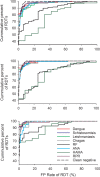
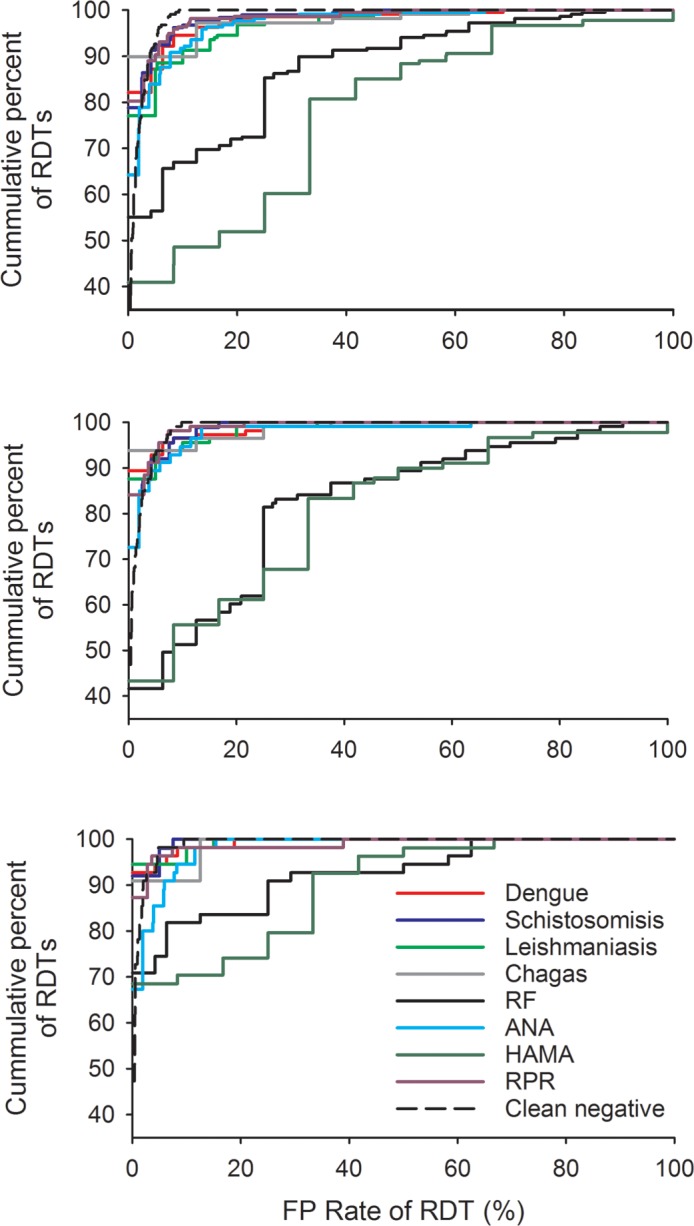
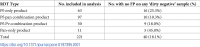
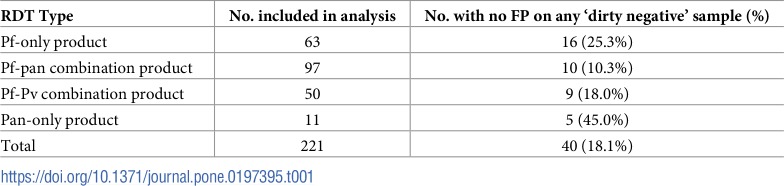
Forty (18%) RDTs showed no FP results against any tested infectious agent or immunological factor. In the remaining RDTs significant and clinically relevant increases in FP rates were observed for samples containing HAMA and RF (P<0.001). There were significant correlations between product-matched FP rates for RF and HAMA on all RDT test bands (P<0.001), and FP rates for each infectious agent and immunological factor were also correlated between test bands of combination RDTs (P≤0.002).
Conclusions
False positive results against non-Plasmodium infectious agents and immunological factors does not appear to be a universal property of malaria RDTs. However, since many malaria RDTs have elevated FP rates against HAMA and RF positive samples practitioners may need to consider the possibility of false positive results for malaria in patients with conditions that stimulate HAMA or RF.
-
Subjects:
-
Source:PLoS One. 13(5).
-
Pubmed ID:29758050
-
Pubmed Central ID:PMC5951549
-
Document Type:
-
Genre:
-
Volume:13
-
Issue:5
-
Collection(s):
-
Main Document Checksum:urn:sha-512:a231cd6a9f7a564e8fe47e6e19f84d81c33f447d4e480d4c8f846ef393dad5be2df9ffe2e0fdf1e1153f49fc5e947cbc44a647c8f1548acd182416f83417d185
-
Download URL:
-
File Type:
 [PDF
- 1.11 MB
]
[PDF
- 1.11 MB
]
Supporting Files


File Language:
English
 Was this page helpful?
 Found an issue?

CDC STACKS serves as an archival repository of CDC-published products including
scientific findings,
journal articles, guidelines, recommendations, or other public health information authored or
co-authored by CDC or funded partners.
As a repository, CDC STACKS retains documents in their original published format to ensure public access to scientific information.
As a repository, CDC STACKS retains documents in their original published format to ensure public access to scientific information.
You May Also Like
COLLECTION
CDC Public Access