



Sensitivity and specificity for malaria classification of febrile persons by rapid diagnostic test, microscopy, parasite DNA, histidine-rich protein 2, and IgG: Dakar, Senegal 2015
Supporting Files

-
8 2022 ; 8-2022
-
Available in CDC Stacks on 2024-03-18T00:00:00Z
File Language:
English
Details
-
Alternative Title:Int J Infect Dis
-
Personal Author:
-
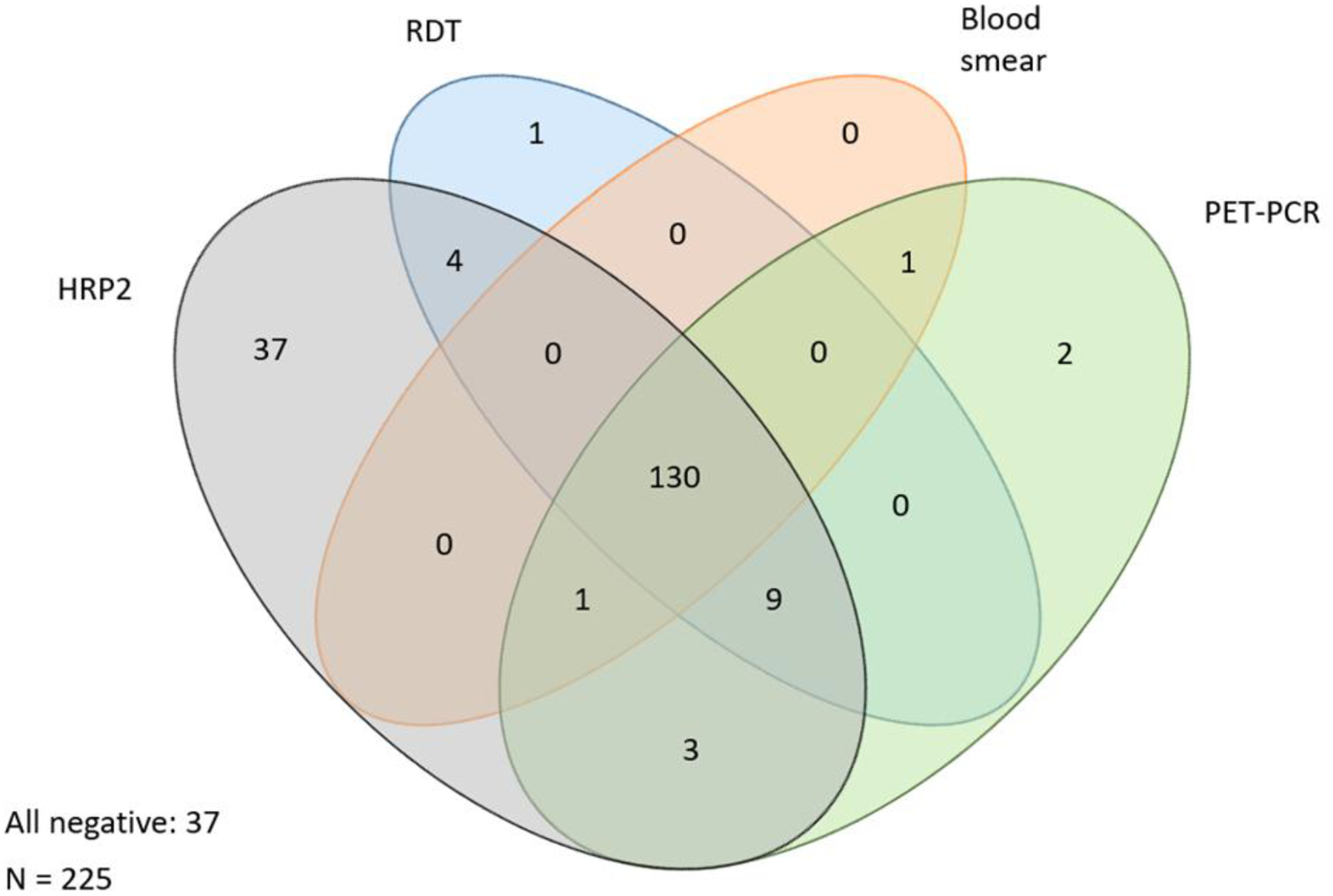
Description:Objectives: ; Different methods detecting Plasmodium parasite infection or exposure are available, but systematic comparison of all these methodologies to predict malaria infection is lacking. Understanding the characteristics of respective tests is helpful to choose the most appropriate tests for epidemiological or research purposes. ; Methods: ; Microscopy, RDT, and PCR was performed for 496 patients presenting with febrile illness in Dakar, Senegal in 2015. Blood samples had laboratory multiplex assays performed for IgG serology and detection of HRP2 antigen. Sensitivity (Se) and specificity (Sp) for different tests were calculated using PCR as the gold standard for detecting active infection. Modeling through latent class analysis (LCA) compared each test to a modeled gold standard for Se/Sp estimates. ; Results: ; Against PCR, Se/Sp were 95.2%/93.7% for RDT, 90.4%/100.0% for microscopy, and 97.9%/48.1% for lab HRP2 detection. Compared to the modeled gold standard, Se of microscopy was 93.5%, and Se of RDT, PCR, and lab HRP2 detection were all greater than 99%. Se/Sp of IgG serology were substantially for detecting active infection. ; Conclusions: ; Compared to single tests, a combinatorial LCA approach of multiple biomarkers for detecting malaria infection from patient samples provides greater sensitivity and specificity for epidemiological estimates and research objectives.
-
Subjects:
-
Keywords:
-
Source:Int J Infect Dis. 121:92-97
-
Pubmed ID:35504551
-
Pubmed Central ID:PMC10948003
-
Document Type:
-
Funding:
-
Volume:121
-
Download URL:
-
File Type:
 [PDF - 206.95 KB]
 -
Collection(s):
-
Main Document Checksum:urn:sha256:19944bd391f6f9dfe789b1788114b83957e2305fd6540d6f89c9aa29ba1a105a
Supporting Files


File Language:
English
 Was this page helpful?
 Found an issue?


CDC STACKS serves as an archival repository of CDC-published products including
scientific findings, journal articles, guidelines, recommendations, or other public health information authored or
co-authored by CDC or funded partners.
As a repository, CDC STACKS retains documents in their original published format to ensure public access to scientific information.
As a repository, CDC STACKS retains documents in their original published format to ensure public access to scientific information.
You May Also Like
COLLECTION
CDC Public Access