



Contribution of Maternal Antiretroviral Therapy and Breastfeeding to 24-Month Survival in Human Immunodeficiency Virus-Exposed Uninfected Children: An Individual Pooled Analysis of African and Asian Studies
Supporting Files

-
May 17 2018
-
Available in CDC Stacks on December 21, 2017, 12:00 AM
File Language:
English
Details
-
Alternative Title:Clin Infect Dis
-
Personal Author:Arikawa, Shino ; Rollins, Nigel ; Jourdain, Gonzague ; Humphrey, Jean ; Kourtis, Athena P ; Hoffman, Irving ; Essex, Max ; Farley, Tim ; Coovadia, Hoosen M ; Gray, Glenda ; Kuhn, Louise ; Shapiro, Roger ; Leroy, Valériane ; Bollinger, Robert C ; Onyango-Makumbi, Carolyne ; Lockman, Shahin ; Marquez, Carina ; Doherty, Tanya ; Dabis, François ; Mandelbrot, Laurent ; Le Coeur, Sophie ; Rolland, Matthieu ; Joly, Pierre ; Newell, Marie-Louise ; Becquet, Renaud
-
Description:Background
Human immunodeficiency virus (HIV)–infected pregnant women increasingly receive antiretroviral therapy (ART) to prevent mother-to-child transmission (PMTCT). Studies suggest HIV-exposed uninfected (HEU) children face higher mortality than HIV-unexposed children, but most evidence relates to the pre-ART era, breastfeeding of limited duration, and considerable maternal mortality. Maternal ART and prolonged breastfeeding while on ART may improve survival, although this has not been reliably quantified.
Methods
Individual data on 19 219 HEU children from 21 PMTCT trials/cohorts undertaken from 1995 to 2015 in Africa and Asia were pooled to estimate the association between 24-month mortality and maternal/infant factors, using random-effects Cox proportional hazards models. Adjusted attributable fractions of risks computed using the predict function in the R package “frailtypack” were used to estimate the relative contribution of risk factors to overall mortality.
Results
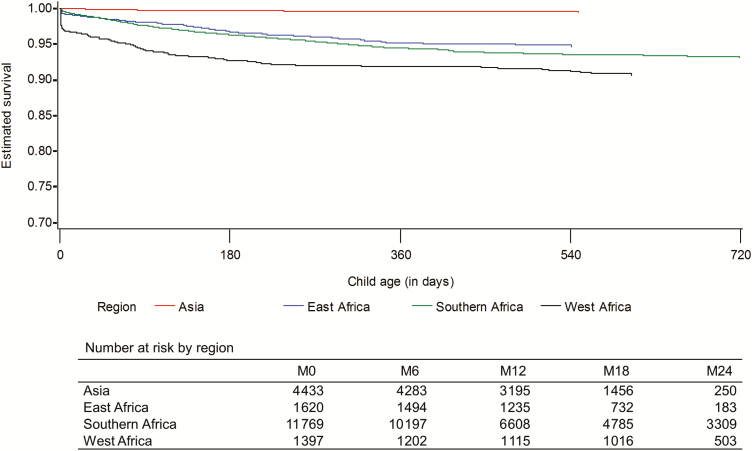
Cumulative incidence of death was 5.5% (95% confidence interval, 5.1–5.9) by age 24 months. Low birth weight (LBW <2500 g, adjusted hazard ratio (aHR, 2.9), no breastfeeding (aHR, 2.5), and maternal death (aHR, 11.1) were significantly associated with increased mortality. Maternal ART (aHR, 0.5) was significantly associated with lower mortality. At the population level, LBW accounted for 16.2% of 24-month mortality, never breastfeeding for 10.8%, mother not receiving ART for 45.6%, and maternal death for 4.3%; combined, these factors explained 63.6% of deaths by age 24 months.
Conclusions
Survival of HEU children could be substantially improved if public health practices provided all HIV-infected mothers with ART and supported optimal infant feeding and care for LBW neonates. -
Subjects:
-
Source:Clin Infect Dis. 2017; 66(11):1668-1677.
-
Pubmed ID:29272387
-
Pubmed Central ID:PMC5961296
-
Document Type:
-
Funding:
-
Place as Subject:
-
Volume:66
-
Issue:11
-
Download URL:
-
File Type:
 [PDF - 1.07 MB]
 -
Collection(s):
-
Main Document Checksum:urn:sha256:7d6b54923bb2171935568d85ce45ea5550144748fcef7f1f5aa571223491d11d
Supporting Files


File Language:
English
 Was this page helpful?
 Found an issue?


CDC STACKS serves as an archival repository of CDC-published products including
scientific findings, journal articles, guidelines, recommendations, or other public health information authored or
co-authored by CDC or funded partners.
As a repository, CDC STACKS retains documents in their original published format to ensure public access to scientific information.
As a repository, CDC STACKS retains documents in their original published format to ensure public access to scientific information.
You May Also Like
COLLECTION
CDC Public Access