



Emergence of a novel GII.17 norovirus – End of the GII.4 era?
Supporting Files

-
7 02 2015
-
Available in CDC Stacks on 2018-04-27T00:00:00Z
File Language:
English
Details
-
Journal Article:Euro Surveill
-
Personal Author:de Graaf, M ; van Beek, J ; Vennema, H ; Podkolzin, A T ; Hewitt, J ; Bucardo, F ; Templeton, K ; Mans, J ; Nordgren, J ; Reuter, G ; Lynch, M ; Rasmussen, L D ; Iritani, N ; Chan, M C ; Martella, V ; Ambert-Balay, K ; Vinjé, J ; White, P A ; Koopmans, M P
-
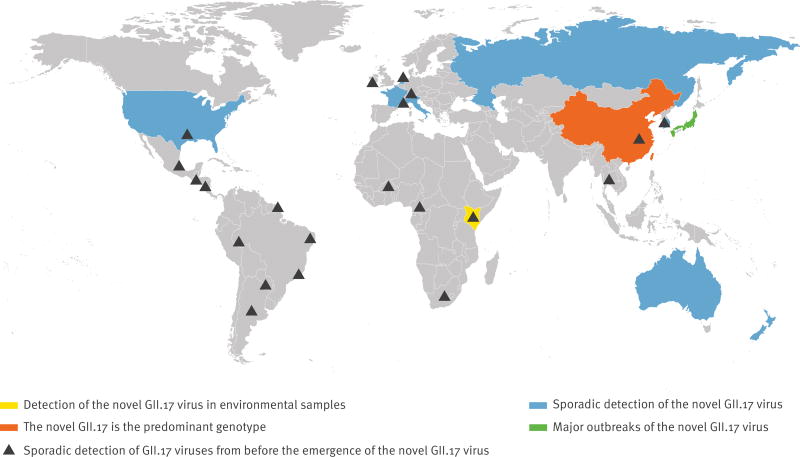
Description:In the winter of 2014/15 a novel GII.P17-GII.17 norovirus strain (GII.17 Kawasaki 2014) emerged, as a major cause of gastroenteritis outbreaks in China and Japan. Since their emergence these novel GII.P17-GII.17 viruses have replaced the previously dominant GII.4 genotype Sydney 2012 variant in some areas in Asia but were only detected in a limited number of cases on other continents. This perspective provides an overview of the available information on GII.17 viruses in order to gain insight in the viral and host characteristics of this norovirus genotype. We further discuss the emergence of this novel GII.P17-GII.17 norovirus in context of current knowledge on the epidemiology of noroviruses. It remains to be seen if the currently dominant norovirus strain GII.4 Sydney 2012 will be replaced in other parts of the world. Nevertheless, the public health community and surveillance systems need to be prepared in case of a potential increase of norovirus activity in the next seasons caused by this novel GII.P17-GII.17 norovirus.
-
Subjects:
-
Pubmed ID:26159308
-
Pubmed Central ID:PMC5921880
-
Document Type:
-
Funding:
-
Genre:
-
Volume:20
-
Issue:26
-
Citation:Euro Surveill. 20(26)
-
Download URL:
-
File Type:
 [PDF - 1.05 MB]
 -
Collection(s):
-
Main Document Checksum:urn:sha-512:74b0992d040144262c472aad34e401634eeafbdd33943ee84931edcfefeaefe0ee31f2c892f949ea3e607e341cda8cce8c175a318602521cef228049d0e51bdf
Supporting Files


File Language:
English
 Was this page helpful?
 Found an issue?



CDC STACKS serves as an archival repository of CDC-published products including
scientific findings, journal articles, guidelines, recommendations, or other public health information authored or
co-authored by CDC or funded partners.
As a repository, CDC STACKS retains documents in their original published format to ensure public access to scientific information.
As a repository, CDC STACKS retains documents in their original published format to ensure public access to scientific information.
You May Also Like
COLLECTION
CDC Public Access