



Travel Characteristics and Pretravel Health Care Among Pregnant or Breastfeeding U.S. Women Preparing for International Travel
Supporting Files

-
Dec 2017
-
File Language:
English
Details
-
Alternative Title:Obstet Gynecol
-
Personal Author:
-
Corporate Authors:
-
Description:OBJECTIVE
To study characteristics and preventive interventions of adult pregnant and breastfeeding travelers seeking pretravel health care in the United States.
METHODS
This cross-sectional study analyzed data (2009–2014) of pregnant and breastfeeding travelers seen at U.S. travel clinics participating in Global TravEpiNet. Nonpregnant, nonbreastfeeding adult female travelers of childbearing age were used for comparison. We evaluated the prescription of malaria chemoprophylaxis and antibiotics for this population as well as the administration of three travel-related vaccines: hepatitis A, typhoid, and yellow fever. We also evaluated use of tetanus toxoid, reduced diphtheria toxoid, and acellular pertussis and influenza vaccines, because these are widely recommended in pregnancy.
RESULTS
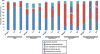
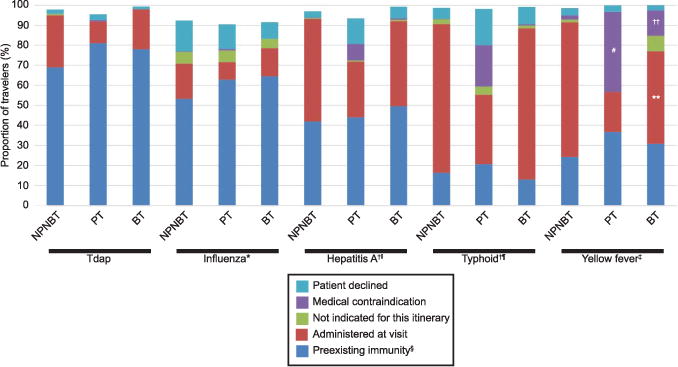
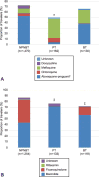
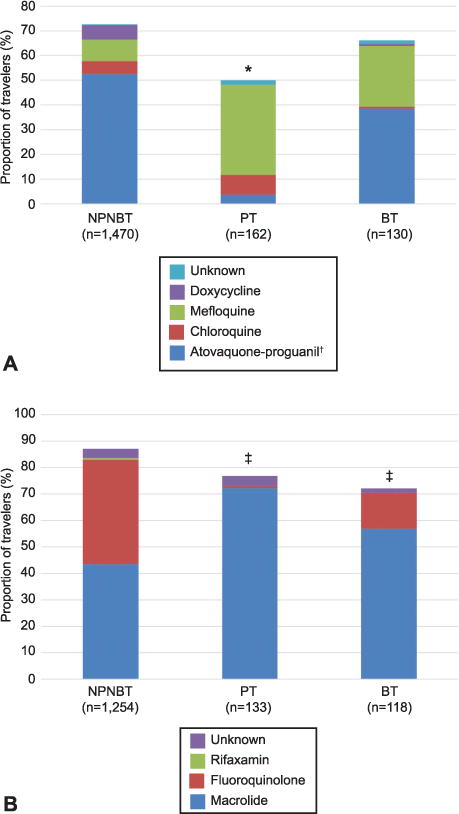
Of 21,138 female travelers of childbearing age in Global TravEpiNet, 170 (0.8%) were pregnant and 139 (0.7%) were breastfeeding. Many traveled to destinations endemic for mosquito-borne illnesses, including malaria (pregnant: 95%; breastfeeding: 94%), dengue (pregnant: 87%; breastfeeding: 81%), or yellow fever (pregnant: 35%; breastfeeding: 50%). Compared with nonpregnant, nonbreastfeeding adult female travelers, eligible pregnant travelers were less likely to be vaccinated against hepatitis A (28% compared with 51%, P<.001) and typhoid (35% compared with 74%, P<.001). More than 20% of eligible pregnant travelers did not receive influenza vaccination. Yellow fever vaccine was occasionally provided to pregnant and breastfeeding travelers traveling to countries entirely endemic for yellow fever (6 [20%] of 30 pregnant travelers and 18 [46%] of 39 breastfeeding travelers). Half of pregnant travelers and two thirds of breastfeeding travelers preparing to travel to malaria-holoendemic countries received a prescription for malaria prophylaxis.
CONCLUSION
Most pregnant and breastfeeding travelers seen for pretravel health consultations traveled to destinations with high risk for vector-borne or other travel-related diseases. Destination-specific preventive interventions were frequently underused.
-
Subjects:
-
Source:Obstet Gynecol. 130(6):1357-1365.
-
Pubmed ID:29112671
-
Pubmed Central ID:PMC5909816
-
Document Type:
-
Funding:
-
Place as Subject:
-
Volume:130
-
Issue:6
-
Collection(s):
-
Main Document Checksum:urn:sha256:3990609e4bab62aae689d3742949266ebf03f7f3e63c6911c93f7486d4634699
-
Download URL:
-
File Type:
 [PDF
- 423.85 KB
]
[PDF
- 423.85 KB
]
Supporting Files


File Language:
English
 Was this page helpful?
 Found an issue?
CDC STACKS serves as an archival repository of CDC-published products including
scientific findings,
journal articles, guidelines, recommendations, or other public health information authored or
co-authored by CDC or funded partners.
As a repository, CDC STACKS retains documents in their original published format to ensure public access to scientific information.
As a repository, CDC STACKS retains documents in their original published format to ensure public access to scientific information.
You May Also Like
COLLECTION
CDC Public Access