


Description of a mass poisoning in a rural district in Mozambique: The first documented bongkrekic acid poisoning in Africa
Supporting Files

-
4 17 2018
-
File Language:
English
Details
-
Alternative Title:Clin Infect Dis
-
Personal Author:Gudo, Eduardo Samo ; Cook, Kyla ; Kasper, Amelia M. ; Vergara, Alfredo ; Salomão, Cristolde ; Oliveira, Fernanda ; Ismael, Hamida ; Saeze, Cristovão ; Mosse, Carla ; Fernandes, Quinhas ; Viegas, Sofia Omar ; Baltazar, Cynthia S. ; Doyle, Timothy J. ; Yard, Ellen ; Steck, Alaina ; Serret, Mayda ; Falconer, Travis M. ; Kern, Sara E. ; Brzezinski, Jennifer L. ; Turner, James A. ; Boyd, Brian L. ; Jani, Ilesh V.
-
Description:Background
On January 9, 2015, in a rural town in Mozambique, over 230 people became sick and 75 died from an illness linked to drinking pombe, a traditional alcoholic beverage.
Methods
An investigation was conducted to identify cases and determine the cause of the outbreak. A case was defined as any resident of Chitima who developed any new or unexplained neurologic, gastrointestinal, or cardiovascular symptom from January 9 at 6:00 a.m. through January 12. We conducted medical record reviews; healthcare worker and community surveys; anthropological and toxicological investigations of local medicinal plants and commercial pesticides; and laboratory testing of the suspect and control pombe.
Results
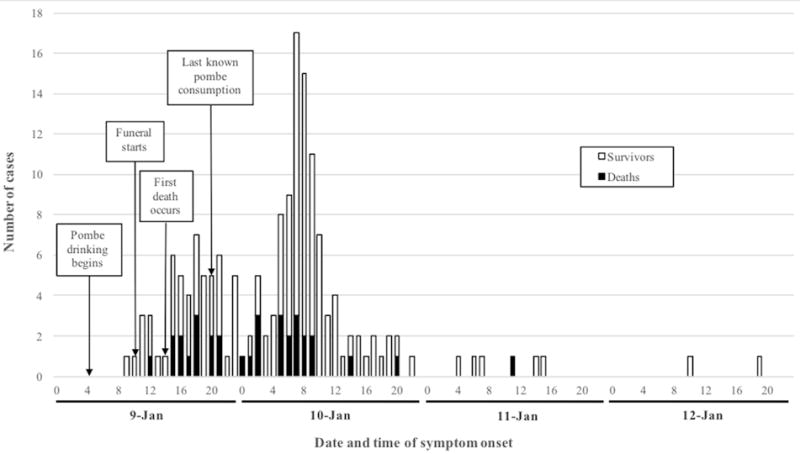
We identified 234 cases; 75 (32%) died and 159 recovered. Overall, 61% of cases were female (n=142), and ages ranged from 1–87 years (median: 30 years). Signs and symptoms included abdominal pain, diarrhea, vomiting, and generalized malaise. Death was preceded by psychomotor agitation and abnormal posturing. The median interval from pombe consumption to symptom onset was 16 hours. Toxic levels of bongkrekic acid (BA) were detected in the suspect pombe but not in the control pombe. Burkholderia gladioli pathovar cocovenenans, the bacteria that produces BA, was detected in the flour used to make the pombe.
Conclusions
We report for the first time an outbreak of a highly lethal illness linked to BA, a deadly food-borne toxin in Africa. Given that no previous outbreaks have been recognized outside of Asia, our investigation suggests that BA might be an unrecognized cause of toxic outbreaks globally.
-
Subjects:
-
Source:Clin Infect Dis. 66(9):1400-1406
-
Pubmed ID:29155976
-
Pubmed Central ID:PMC5908738
-
Document Type:
-
Funding:
-
Volume:66
-
Issue:9
-
Collection(s):
-
Main Document Checksum:urn:sha256:81826d47d0fc0ae35045f3169d8b558f55d6ea08bc337b604726fea5a6ea5cbf
-
Download URL:
-
File Type:
 [PDF
- 196.31 KB
]
[PDF
- 196.31 KB
]
Supporting Files


File Language:
English
ON THIS PAGE

CDC STACKS serves as an archival repository of CDC-published products including
scientific findings,
journal articles, guidelines, recommendations, or other public health information authored or
co-authored by CDC or funded partners.
As a repository, CDC STACKS retains documents in their original published format to ensure public access to scientific information.
As a repository, CDC STACKS retains documents in their original published format to ensure public access to scientific information.
You May Also Like
COLLECTION
CDC Public Access