



Shiga Toxin–Producing E. coli Infections Associated with Flour
Supporting Files

-
11 23 2017
-
Available in CDC Stacks on November 23, 2018, 12:00 AM
File Language:
English
Details
-
Alternative Title:N Engl J Med
-
Personal Author:Crowe, Samuel J. ; Bottichio, Lyndsay ; Shade, Lauren N. ; Whitney, Brooke M. ; Corral, Nereida ; Melius, Beth ; Arends, Katherine D. ; Donovan, Danielle ; Stone, Jolianne ; Allen, Krisandra ; Rosner, Jessica ; Beal, Jennifer ; Whitlock, Laura ; Blackstock, Anna ; Wetherington, June ; Newberry, Lisa A. ; Schroeder, Morgan N. ; Wagner, Darlene ; Trees, Eija ; Viazis, Stelios ; Wise, Matthew E. ; Neil, Karen P.
-
Description:BACKGROUND
In 2016, a multijurisdictional team investigated an outbreak of Shiga toxin–producing Escherichia coli (STEC) serogroup O121 and O26 infections linked to contaminated flour from a large domestic producer.
METHODS
A case was defined as infection with an outbreak strain in which illness onset was between December 21, 2015, and September 5, 2016. To identify exposures associated with the outbreak, outbreak cases were compared with non-STEC enteric illness cases, matched according to age group, sex, and state of residence. Products suspected to be related to the outbreak were collected for STEC testing, and a common point of contamination was sought. Whole-genome sequencing was performed on isolates from clinical and food samples.
RESULTS
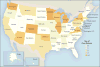
A total of 56 cases were identified in 24 states. Univariable exact conditional logistic-regression models of 22 matched sets showed that infection was significantly associated with the use of one brand of flour (odds ratio, 21.04; 95% confidence interval CI, 4.69 to 94.37) and with tasting unbaked homemade dough or batter (odds ratio, 36.02; 95% CI, 4.63 to 280.17). Laboratory testing isolated the outbreak strains from flour samples, and whole-genome sequencing revealed that the isolates from clinical and food samples were closely related to one another genetically. Trace-back investigation identified a common flour-production facility.
CONCLUSIONS
This investigation implicated raw flour as the source of an outbreak of STEC infections. Although it is a low-moisture food, raw flour can be a vehicle for foodborne pathogens. -
Keywords:
- Adolescent
- Adult
- Aged
- Aged, 80 and over
- Child
- Child, Preschool
- Disease Outbreaks
- Escherichia coli Infections
- Female
- Flour
- Food Microbiology
- Foodborne Diseases
- Humans
- Infant
- Logistic Models
- Male
- Middle Aged
- Serogroup
- Shiga-Toxigenic Escherichia coli
- Surveys and Questionnaires
- United States
- Young Adult
-
Source:N Engl J Med. 377(21):2036-2043
-
Pubmed ID:29166238
-
Pubmed Central ID:PMC5792826
-
Document Type:
-
Funding:
-
Volume:377
-
Issue:21
-
Download URL:
-
File Type:
 [PDF - 1.00 MB]
 -
Collection(s):
-
Main Document Checksum:urn:sha256:4918c1411a63f5d6dc255d6bfb8e5ee29dd723204fd33f20e05de479eda9047e
Supporting Files


File Language:
English
 Was this page helpful?
 Found an issue?



CDC STACKS serves as an archival repository of CDC-published products including
scientific findings, journal articles, guidelines, recommendations, or other public health information authored or
co-authored by CDC or funded partners.
As a repository, CDC STACKS retains documents in their original published format to ensure public access to scientific information.
As a repository, CDC STACKS retains documents in their original published format to ensure public access to scientific information.
You May Also Like
COLLECTION
CDC Public Access