



Evolution of Sequence Type 4821 Clonal Complex Meningococcal Strains in China from Prequinolone to Quinolone Era, 1972–2013
Supporting Files
Public Domain

-
Apr 2018
File Language:
English
Details
-
Alternative Title:Emerg Infect Dis
-
Personal Author:
-
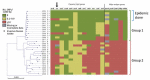
Description:The expansion of hypervirulent sequence type 4821 clonal complex (CC4821) lineage Neisseria meningitidis bacteria has led to a shift in meningococcal disease epidemiology in China, from serogroup A (MenA) to MenC. Knowledge of the evolution and genetic origin of the emergent MenC strains is limited. In this study, we subjected 76 CC4821 isolates collected across China during 1972-1977 and 2005-2013 to phylogenetic analysis, traditional genotyping, or both. We show that successive recombination events within genes encoding surface antigens and acquisition of quinolone resistance mutations possibly played a role in the emergence of CC4821 as an epidemic clone in China. MenC and MenB CC4821 strains have spread across China and have been detected in several countries in different continents. Capsular switches involving serogroups B and C occurred among epidemic strains, raising concerns regarding possible increases in MenB disease, given that vaccines in use in China do not protect against MenB.
-
Subjects:
- Research
- Antigens, Bacterial
- Genetic Variation
- Genome, Bacterial
- Genotype
- History, 20Th Century
- History, 21St Century
- Humans
- Meningitis, Meningococcal/Epidemiology
- Meningitis, Meningococcal/History
- Meningitis, Meningococcal/Microbiology
- Neisseria Meningitidis
- Phylogeny
- Population Surveillance
- Recombination, Genetic
- Whole Genome Sequencing
-
Source:Emerg Infect Dis. 24(4):683-690.
-
Pubmed ID:29553310
-
Pubmed Central ID:PMC5875256
-
Document Type:
-
Place as Subject:
-
Location:
-
Volume:24
-
Issue:4
-
Download URL:
-
File Type:
 [PDF - 1.37 MB]
-
Collection(s):
-
Main Document Checksum:urn:sha256:28ba3070796c1c94827aa69121e05fcd48a1a08c34e9b5b4f487fc5acc209854
Supporting Files


File Language:
English
 Was this page helpful?
 Found an issue?



CDC STACKS serves as an archival repository of CDC-published products including
scientific findings, journal articles, guidelines, recommendations, or other public health information authored or
co-authored by CDC or funded partners.
As a repository, CDC STACKS retains documents in their original published format to ensure public access to scientific information.
As a repository, CDC STACKS retains documents in their original published format to ensure public access to scientific information.
You May Also Like
COLLECTION
Emerging Infectious Diseases