


Cancer incidence disparities in Upper Manhattan New York City neighborhoods: the role of race/ethnicity, socioeconomic status, and known risk factors
Supporting Files

-
Jul 2016
-
File Language:
English
Details
-
Alternative Title:Eur J Cancer Prev
-
Personal Author:
-
Description:OBJECTIVE
We examined effects of race/ethnicity and neighborhood, a proxy of socioeconomic status, on cancer incidence in New York City neighborhoods: East Harlem (EH), Central Harlem (CH), and Upper East Side (UES).
METHODS
In this ecological study, Community Health Survey (CHS) data (2002–2006) and New York State Cancer Registry incidence data (2007–2011) were stratified by gender, age, race/ethnicity, and neighborhood. Logistic regression models were fitted to each cancer incidence rate with race/ethnicity, neighborhood, and CHS-derived risk factors as predictor variables.
RESULTS
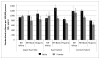
Neighborhood was significantly associated with all cancers and 14 out of 25 major cancers. EH and CH residence conferred higher risk of all cancers compared to UES (OR=1.34; CI: 1.07, 1.68 and OR=1.39; CI: 1.12, 1.72, respectively). Prevalence of diabetes and tobacco smoking were the largest contributors to high cancer rates.
CONCLUSIONS
Despite juxtaposition and similar proximity to medical centers, cancer incidence disparities persist among EH, CH, and UES neighborhoods. Targeted, neighborhood-specific outreach may aid in reducing cancer incidence rates.
-
Subjects:
-
Source:Eur J Cancer Prev. 25(4):349-356.
-
Pubmed ID:26186470
-
Pubmed Central ID:PMC4715792
-
Document Type:
-
Funding:
-
Place as Subject:
-
Volume:25
-
Issue:4
-
Collection(s):
-
Main Document Checksum:urn:sha256:14889d70a173bb329df62a1460376469716d529a6b38cd1f0d7c4e3e5152f674
-
Download URL:
-
File Type:
 [PDF
- 250.53 KB
]
[PDF
- 250.53 KB
]
Supporting Files


File Language:
English
ON THIS PAGE


CDC STACKS serves as an archival repository of CDC-published products including
scientific findings,
journal articles, guidelines, recommendations, or other public health information authored or
co-authored by CDC or funded partners.
As a repository, CDC STACKS retains documents in their original published format to ensure public access to scientific information.
As a repository, CDC STACKS retains documents in their original published format to ensure public access to scientific information.
You May Also Like
COLLECTION
CDC Public Access